
We read your photo as:
Fill in the blanks in the following sentences: 1. Il est difficile pour un Ingénieur de travailler sans _. 2. Mon oncle est riche il n'achète pas des livres à ses enfants. 3. Le sport _ les peuples.
ScanSolve AI Answer
Step-by-step solution
13 stepsAnalyze Question 1.
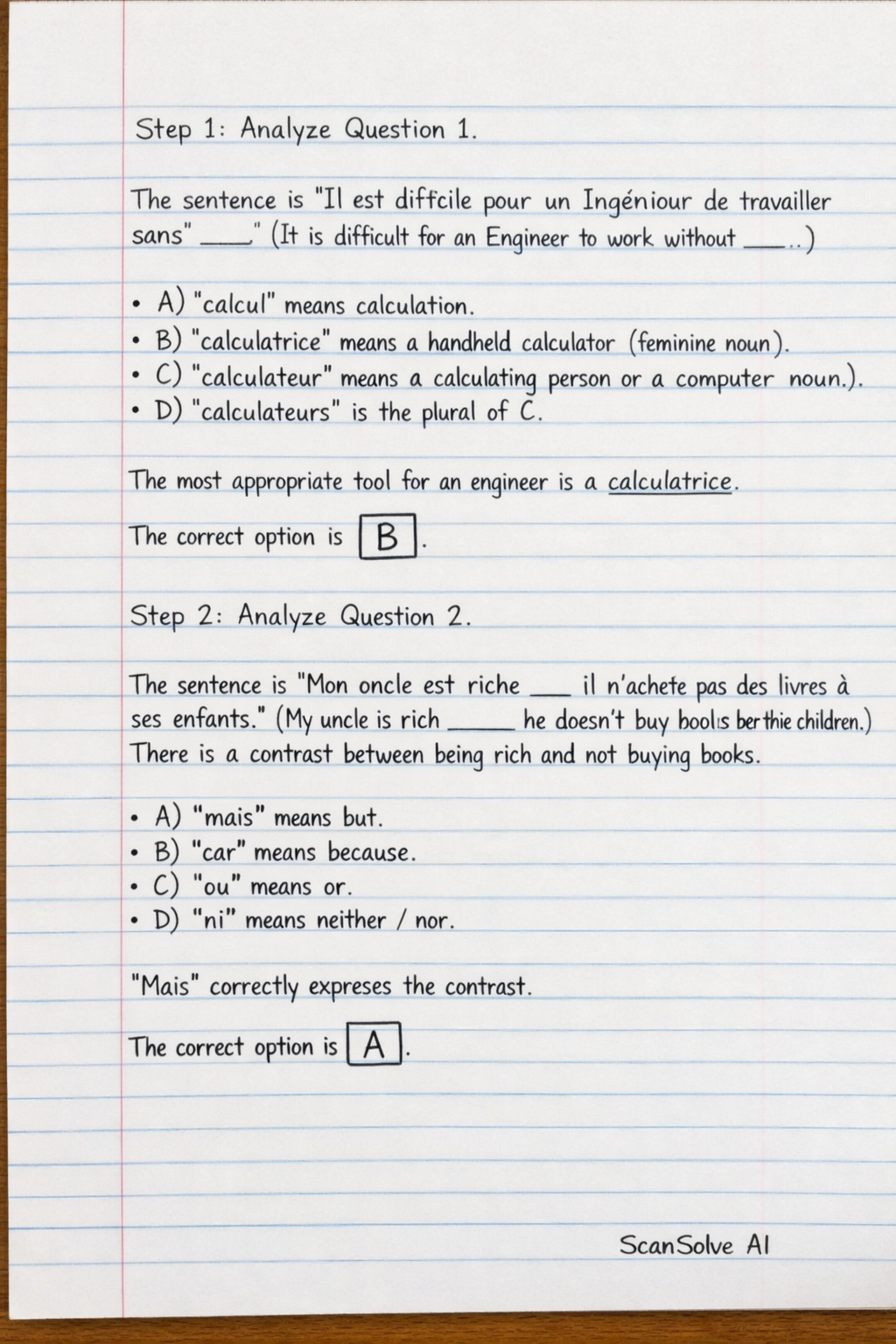
The sentence is "Il est difficile pour un Ingénieur de travailler sans ____." (It is difficult for an Engineer to work without ____.) An engineer typically uses a calculator for calculations.
- A) "calcul" means calculation.
- B) "calculatrice" means a handheld calculator (feminine noun).
- C) "calculateur" means a calculating person or a computer (masculine noun).
- D) "calculateurs" is the plural of C. The most appropriate tool for an engineer is a calculatrice. The correct option is .
Analyze Question 2.
The sentence is "Mon oncle est riche ____ il n'achète pas des livres à ses enfants." (My uncle is rich ____ he doesn't buy books for his children.) There is a contrast between being rich and not buying books.
- A) "mais" means but.
- B) "car" means because.
- C) "ou" means or.
- D) "ni" means neither/nor. "Mais" correctly expresses the contrast. The correct option is .
Analyze Question 3.
The sentence is "Le sport ____ les peuples." (Sport ____ people.) "Le sport" is a singular subject.
- A) "unis" is a masculine plural adjective or past participle.
- B) "unie" is a feminine singular adjective or past participle.
- C) "uni" is a masculine singular adjective or past participle.
- D) "unit" is the third-person singular present tense of the verb "unir" (to unite). The verb "unit" makes sense in this context: "Sport unites people." The correct option is .
Analyze Question 4.
The sentence is "Avec ____ moto, on peut facilement faire des courses." (With ____ motorcycle, one can easily run errands.) "Moto" is a feminine noun (short for "motocyclette").
- A) "Un" is a masculine singular indefinite article.
- B) "De" is a preposition meaning of/from.
- C) "Une" is a feminine singular indefinite article.
- D) "De la" is a partitive article or preposition + definite article. "Une" is the correct indefinite article for "moto". The correct option is .
Analyze Question 5.
The sentence is "Ma voisine a acheté de ____ habits pour ses filles." (My neighbor bought some ____ clothes for her daughters.) "Habits" (clothes) is a masculine plural noun. The adjective must agree with it.
- A) "belle" is feminine singular.
- B) "belles" is feminine plural.
- C) "beau" is masculine singular.
- D) "beaux" is masculine plural. "Beaux" agrees with "habits". The correct option is .
Analyze Question 6.
The sentence is "Tu as achevé ton exercice ____ temps." (You finished your exercise ____ time.)
- A) "À" (at/to). "À temps" means on time.
- B) "En" (in/within). "En temps" means in time or within the allotted time.
- C) "Dans" (in/into). "Dans le temps" means in the past. "En temps" is the most suitable preposition to express completing something within a given period. The correct option is .
Analyze Question 7.
The sentence is "Pour ____ le Covid-19, il faut observer les mesures barrières." (To ____ Covid-19, one must observe barrier measures.) The preposition "pour" is followed by an infinitive verb.
- A) "évitez" is the imperative or present tense (vous form).
- B) "évité" is the past participle.
- C) "éviter" is the infinitive form of the verb "to avoid".
- D) "évite" is the imperative or present tense (tu form or il/elle/on form). "Éviter" is the correct infinitive. The correct option is .
Analyze Question 8.
The sentence is "Il me faut ____ pain pour la salade." (I need ____ bread for the salad.) "Pain" (bread) is a masculine singular noun. To express "some bread", the partitive article is used.
- A) "dû" is a past participle meaning due/owed.
- B) "du" is the masculine singular partitive article (de + le).
- C) "le" is the masculine singular definite article.
- D) "de" is a preposition meaning of/from. "Du" is the correct partitive article. The correct option is .
Analyze Question 9.
The sentence is "Pour remonter le moral des malades, le médecin leur parle ____." (To cheer up the sick, the doctor speaks to them ____.) To cheer someone up, one should speak kindly.
- A) "Méchamment" means meanly.
- B) "gravement" means seriously/gravely.
- C) "gentiment" means kindly.
- D) "intensément" means intensely. "Gentiment" is the appropriate adverb. The correct option is .
Analyze Question 10.
The sentence is "Le mécanicien ____ on parlait hier vient d'arriver." (The mechanic ____ we were talking about yesterday just arrived.) The verb is "parler de" (to talk about). When the relative pronoun refers to the object of "de", "dont" is used.
- A) "dont" means of whom/about whom.
- B) "donc" means therefore.
- C) "que" is a direct object relative pronoun.
- D) "qui" is a subject relative pronoun. "Dont" correctly links "le mécanicien" to "on parlait de lui". The correct option is .
Analyze Question 11.
The sentence is "Les hommes ____ les bagages dans le bus avant le départ." (The men ____ the luggage in the bus before departure.) "Les hommes" is a third-person plural subject. The action of loading luggage before departure suggests an ongoing or habitual past action, or a simple past action.
- A) "Chargez" is imperative (vous form).
- B) "Charges" is a noun or present tense (tu form).
- C) "Charger" is an infinitive.
- D) "Chargeaient" is the imperfect tense, third-person plural, meaning "were loading". This fits the context of an action happening before departure. The correct option is .
Analyze Question 12.
The dialogue is "-As-tu vu ma fille ? - Oui, je ____ ai vue." (Did you see my daughter? - Yes, I saw ____.) "Ma fille" is a feminine singular direct object. The past participle "vue" agrees with it, confirming it's a direct object. The direct object pronoun for "ma fille" is "la". Since the auxiliary verb "ai" starts with a vowel, "la" contracts to "l'".
- A) "Lui" is an indirect object pronoun.
- B) "l'" is the contracted direct object pronoun for "la" or "le" before a vowel.
- C) "la" is the feminine singular direct object pronoun.
- D) "le" is the masculine singular direct object pronoun. "L'" is the correct pronoun. The correct option is .
Analyze Question 13.
The sentence is "Pendant les examens, il a passé des ____ nuits." (During the exams, he spent ____ nights.) The question is incomplete as the options are not visible. However, based on common idioms and previous questions, it is highly likely referring to "sleepless nights," which in French is "nuits blanches." Without options, a definitive answer cannot be given.
The final answers are:
- (Question incomplete, options not visible)
Still stuck on this one?
Ask a follow-up, and the answer starts from this question.
More Languages Questions
Handwritten Step-by-Step Solution
Get this as a handwritten image on WhatsApp — like a tutor wrote it for you.
Try on WhatsApp