
We read your photo as:
Fill in the blanks in the following sentences with the correct French demonstrative adjectives, adverbs, pronouns, and possessive pronouns.
ScanSolve AI Answer
Answer
Step-by-step solution
19 stepsAnalyze Question 1.
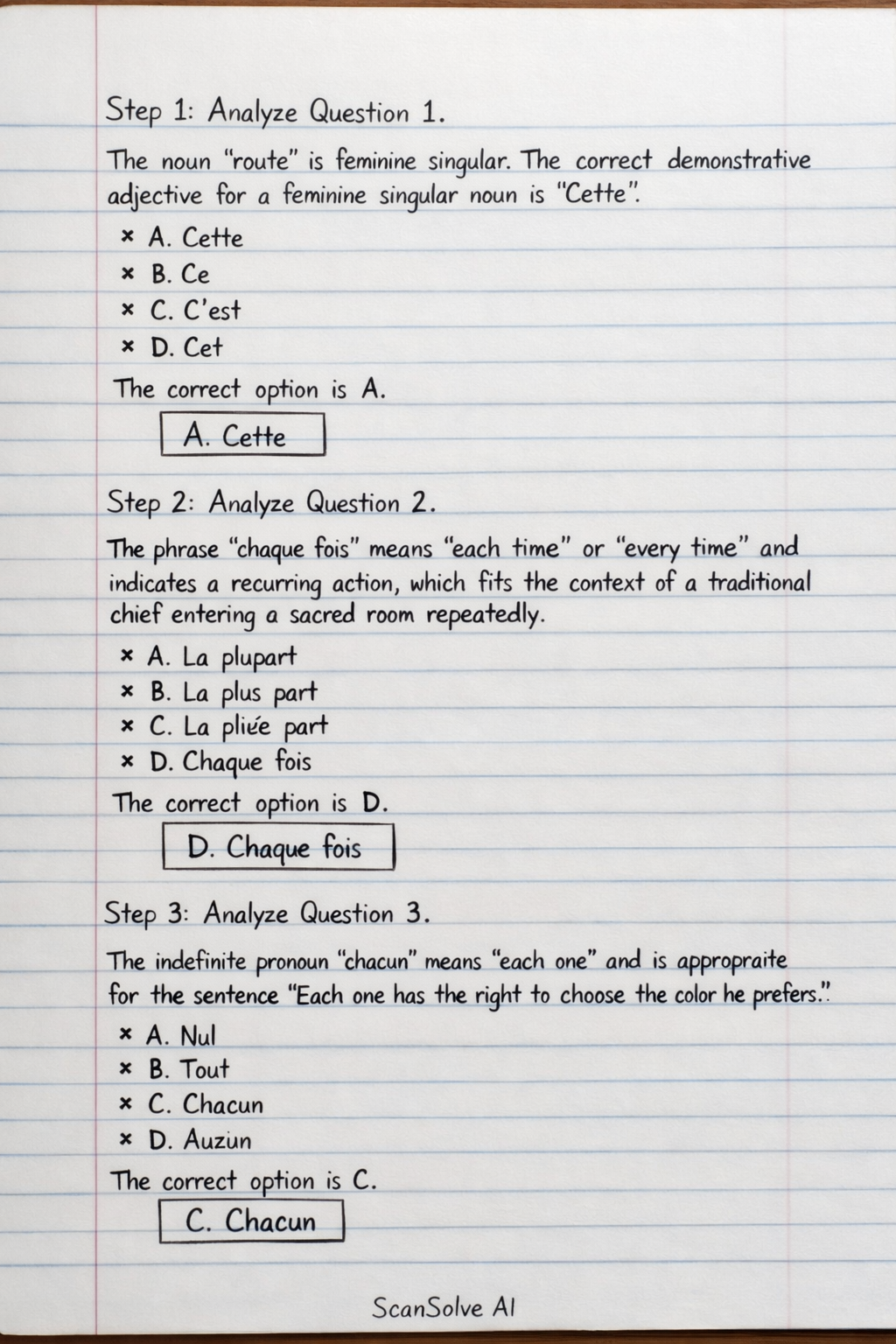
The noun "route" is feminine singular. The correct demonstrative adjective for a feminine singular noun is "Cette".
- A. Cette
- B. Ce
- C. C'est
- D. Cet The correct option is A.
Analyze Question 2.
The phrase "chaque fois" means "each time" or "every time" and indicates a recurring action, which fits the context of a traditional chief entering a sacred room repeatedly.
- A. La plupart
- B. La plus part
- C. La pluie part
- D. Chaque fois The correct option is D.
Analyze Question 3.
The indefinite pronoun "chacun" means "each one" and is appropriate for the sentence "Each one has the right to choose the color he prefers."
- A. Nul
- B. Tout
- C. Chacun
- D. Aucun The correct option is C.
Analyze Question 4.
The noun "introduction" is feminine singular. The possessive pronoun must agree in gender and number with "introduction". "La tienne" means "yours" (feminine singular).
- A. le tien
- B. le mien
- C. la mienne
- D. la tienne The correct option is D.
Analyze Question 5.
The noun "hôpital" is masculine singular and starts with a silent 'h' (which acts like a vowel for adjective agreement). The adjective "beau" (beautiful) changes to "bel" before a vowel or silent 'h'.
- A. beaux
- B. belle
- C. beau
- D. bel The correct option is D.
Analyze Question 6.
The noun "voie" means "way" or "path", which fits the context of a tourist looking for a way to get to the city.
- A. voie
- B. voix
- C. voit
- D. vois The correct option is A.
Analyze Question 7.
"L'année dernière" (last year) and "chaque matin" (every morning) indicate a habitual action in the past, requiring the imperfect tense. The subject "ma mère et moi" corresponds to "nous". The imperfect form of "prier" for "nous" is "priions".
- A. prierons
- B. prions
- C. priions
- D. prieront The correct option is C.
Analyze Question 8.
The sentence requires an infinitive verb to act as the subject. "Aimer" (to love) is the infinitive form.
- A. Aimes
- B. Aimez
- C. Aimer
- D. Aimé The correct option is C.
Analyze Question 9.
The phrase "Nous voulons que" (We want that) requires the subjunctive mood. The subject is "tu". The subjunctive form of "devenir" (to become) for "tu" is "deviennes".
- A. devient
- B. deviens
- C. devienne
- D. deviennes The correct option is D.
Analyze Question 10.
"La deuxième femme de mon père" (my father's second wife) is a stepmother, which in French is "belle-mère".
- A. belle-sœur
- B. belle-mère
- C. belle-fille
- D. cousine The correct option is B.
Analyze Question 11.
This is a common French proverb: "Mieux vaut tard que jamais" (Better late than never).
- A. maintenant
- B. toujours
- C. jamais
- D. demain The correct option is C.
Analyze Question 12.
"Fruits frais" is a plural noun. The correct partitive article for plural nouns is "des".
- A. des
- B. du
- C. de
- D. les The correct option is A.
Analyze Question 13.
In the passé composé with "avoir", when the direct object ("que" referring to "La table", which is feminine singular) precedes the verb, the past participle must agree with the direct object. Therefore, "importé" becomes "importée".
- A. a importée
- B. a importé
- C. as importé
- D. as importée The correct option is A.
Analyze Question 14.
Someone who creates content on Facebook is typically referred to as a "blogueur" (blogger).
- A. Le bibliothécaire
- B. Le libraire
- C. Le blogueur
- D. Le lecteur The correct option is C.
Analyze Question 15.
This is a Type 2 conditional sentence ("Si + imparfait, conditionnel présent"). The first clause is "Si les enseignants avaient" (imperfect). The second clause requires the conditional present for "ils". The conditional present of "acheter" for "ils" is "achèteraient".
- A. achèteraient
- B. achèteraient
- C. achètent
- D. achèterait The correct option is A.
Analyze Question 16.
The phrase "Vous souhaitez que" (You wish that) requires the subjunctive mood. The subject "notre pays" is equivalent to "il". The subjunctive form of "être" for "il" is "soit".
- A. soyons
- B. soyez
- C. soient
- D. soit The correct option is D.
Analyze Question 17.
Drinking potable water is essential to avoid waterborne diseases. Among the options, "la typhoïde" (typhoid) is a waterborne disease.
- A. le cancer
- B. la typhoïde
- C. le rhume
- D. les maux de dents The correct option is B.
Analyze Question 18.
The French idiom "Avoir le cœur sur la main" means to be very generous or open-hearted. The English equivalent is "To have a heart of gold".
- A. To have the heart on the hand
- B. To have a heart of gold
- C. To be very weak
- D. To be very strong The correct option is B.
Analyze Question 19.
The sentence "Ces enfants sont talentueux, ____ ils ne travaillent pas" shows a contrast between being talented and not working. The conjunction "mais" (but) expresses this contrast.
- A. car
- B. donc
- C. ou
- D. mais The correct option is D.
Try one yourself
A new problem that tests the same skill.
Still stuck on this one?
Ask a follow-up, and the answer starts from this question.
More Languages Questions
Handwritten Step-by-Step Solution
Get this as a handwritten image on WhatsApp — like a tutor wrote it for you.
Try on WhatsApp