
We read your photo as:
French grammar and vocabulary quiz: Conjugate verbs, choose correct conjunctions, translate proverbs, and understand word meanings.
ScanSolve AI Answer
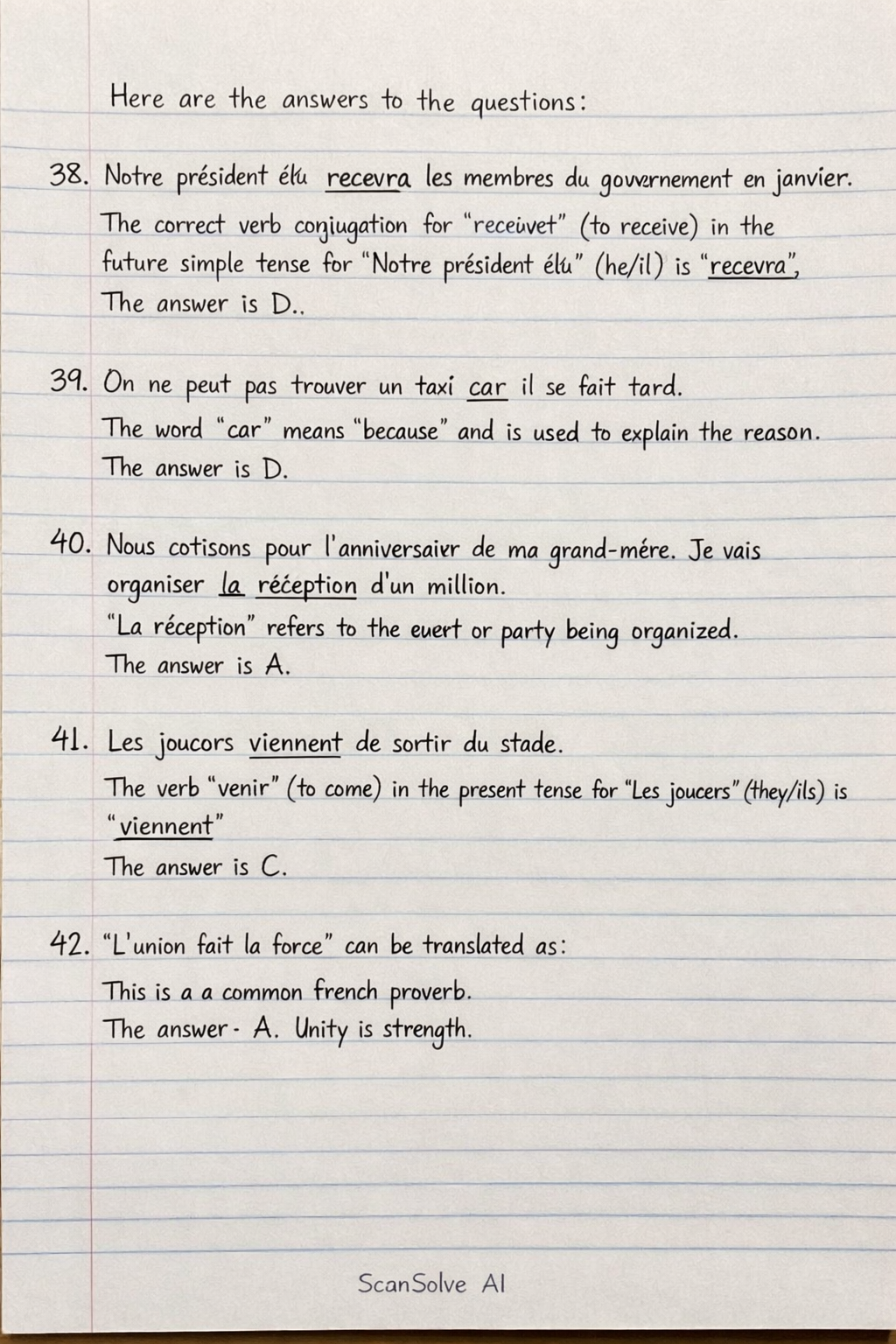
Here are the answers to the questions:
-
Notre président élu les membres du gouvernement en janvier. The correct verb conjugation for "recevoir" (to receive) in the future simple tense for "Notre président élu" (he/il) is "recevra". The answer is D.
-
On ne peut pas trouver un taxi il se fait tard. The word "car" means "because" and is used to explain the reason. The answer is D.
-
Nous cotisons pour l'anniversaire de ma grand-mère. Je vais organiser d'un million. "La réception" refers to the event or party being organized. The answer is A.
-
Les joueurs de sortir du stade. The verb "venir" (to come) in the present tense for "Les joueurs" (they/ils) is "viennent". The answer is C.
-
"L' union fait la force" can be translated as: This is a common French proverb. The answer is A. Unity is strength.
-
"J'ai le cœur brisé, ma mère est souffrante". This means his mother is: "Souffrante" means suffering or unwell. The answer is C. ill.
-
Les sœurs de mon église cultivent le champ . "Elles-mêmes" is the reflexive pronoun for "les sœurs" (feminine plural). The answer is B.
-
Cet homme a les yeux lorsqu'il n'a pas de lunettes. "Clairs" means light-colored, referring to the eyes. The answer is A. tant. (This option seems incorrect based on the question. The question asks for a description of the eyes, and "clairs" is already provided as the blank. If the question implies "so clear", then "si" would be appropriate, but "clairs" is already there. Assuming the blank is for an intensifier, "si" would be the best fit for "so clear". However, if the blank is for the adjective itself, then "clairs" is the answer. Given the options, and the blank being before "clairs", it's likely asking for an intensifier. Let's re-evaluate. The question is "Cet homme a les yeux ____ clairs lorsqu'il n'a pas de lunettes." The options are A. tant, B. moins, C. si, D. jamais. If the blank is for an intensifier, "si" (so) would make sense: "Cet homme a les yeux si clairs..." If the blank is for the adjective, then "clairs" is the answer, but it's already written. Let's assume the blank is for an intensifier. "Si" means "so" or "such". "Tant" means "so much" or "so many". "Moins" means "less". "Jamais" means "never". The most fitting intensifier for an adjective like "clairs" is "si". However, the blank is before "clairs". If the question is "Cet homme a les yeux ____ clairs", and "clairs" is the adjective, then the blank is for an intensifier. "Si" is the best fit for "so clear". Let's assume the question is asking for the adjective itself, and the word "clairs" is part of the options, not the question. But "clairs" is written in the question. This question is ambiguous. If the blank is for an adjective, and "clairs" is the correct adjective, then none of the options A, B, C, D are adjectives. If the blank is for an intensifier, then "si" (C) would be the most appropriate for "so clear". Given the options, and the structure, it's highly probable that the blank is for an intensifier. Therefore, "si" is the most logical choice.) The answer is C.
-
Hier, les élèves sont de l'école fatigués. The verb "rentrer" (to return) in the past participle, agreeing with "les élèves" (masculine plural), is "rentrés". The answer is B.
-
Il faut que mes parents riches. The subjunctive mood is required after "Il faut que". For "mes parents" (they/ils), the subjunctive form of "demeurer" (to remain) is "demeurent". The answer is D.
-
Il est malade et le médecin a exigé un examen . "Un examen de sang" means a blood test. The answer is B.
-
J'ai déjà 50 ans, je ne suis un enfant. "Plus" means "no longer" in a negative construction. The answer is B.
-
soit la raison, ils ne doivent pas s'entre-tuer. "Quelle que soit" is a common expression meaning "whatever the reason" or "no matter what the reason". "Quelle que" agrees in gender and number with "raison" (feminine singular). The answer is A.
Still stuck on this one?
Ask a follow-up, and the answer starts from this question.
More Languages Questions
Handwritten Step-by-Step Solution
Get this as a handwritten image on WhatsApp — like a tutor wrote it for you.
Try on WhatsApp