
We read your photo as:
Hlama mafokontsi a supago
Languages
ScanSolve AI Answer
Answer
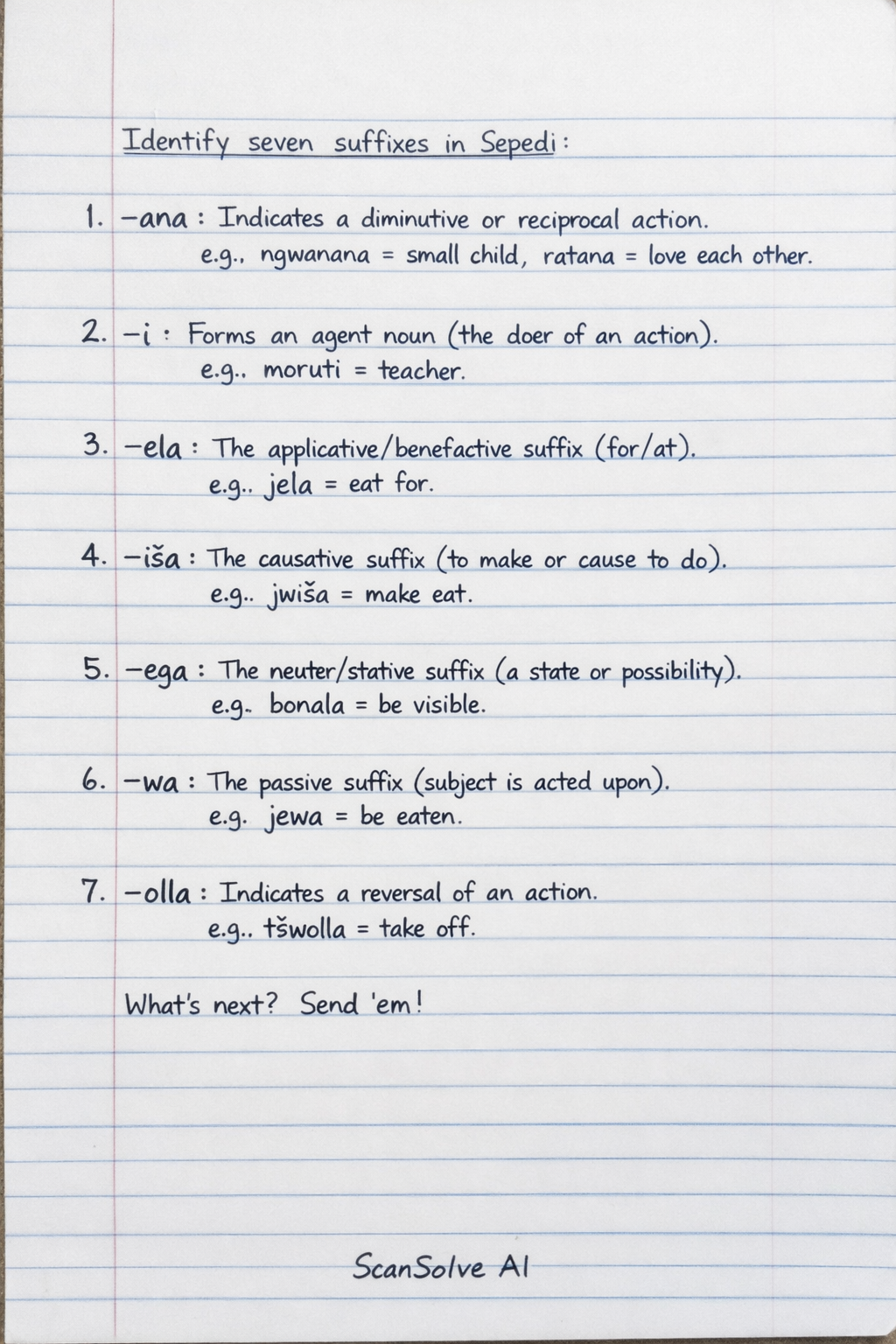
This is the same question as before: "Hlama mafokontši a šupago", which means "Identify seven suffixes".
Here are the seven common suffixes in Sepedi again:
- -ana: Indicates a diminutive (e.g., ngwanana - small child) or reciprocal action (e.g., ratana - love each other).
- -i: Forms an agent noun, indicating the doer of an action (e.g., moruti - teacher).
- -ela: The applicative or benefactive suffix, meaning "for" or "at" (e.g., jela - eat for/at).
- -iša: The causative suffix, meaning "to make/cause to do" (e.g., jwiša - make eat).
- -ega: The neuter or stative suffix, indicating a state or possibility (e.g., bonala - be visible/appear).
- -wa: The passive suffix, indicating that the subject is acted upon (e.g., jewa - be eaten).
- -olla: Indicates a reversal of an action (e.g., tšwolla - take off).
Was this helpful?
Still stuck on this one?
Ask a follow-up, and the answer starts from this question.
Got a different question?Ask your own question
More Languages Questions
QDIPOTSO TSA PATLISISO 1 Tlhalosa lereo semelo ka mafoko a gago 2 Ka mela e meraro tlhamosa gore…Q3.1 Hlamusela hi ndzhundzuluko wa mipfumawulo lowu humelelaka eka ntsongahato wa maviti. 3.2 Tirhisa…QHlanganisa lemisho ngalezizihlanganiso. (Futhi, ukuze, ngoba, noma, kodwa)QAnswer 2.2 in setswana.. kwala tlhamo 400-450 ya mafoko
Handwritten Step-by-Step Solution
Get this as a handwritten image on WhatsApp — like a tutor wrote it for you.
Try on WhatsApp