
This languages problem is solved step by step below, with detailed explanations to help you understand the method and arrive at the correct answer.
ScanSolve AI Answer
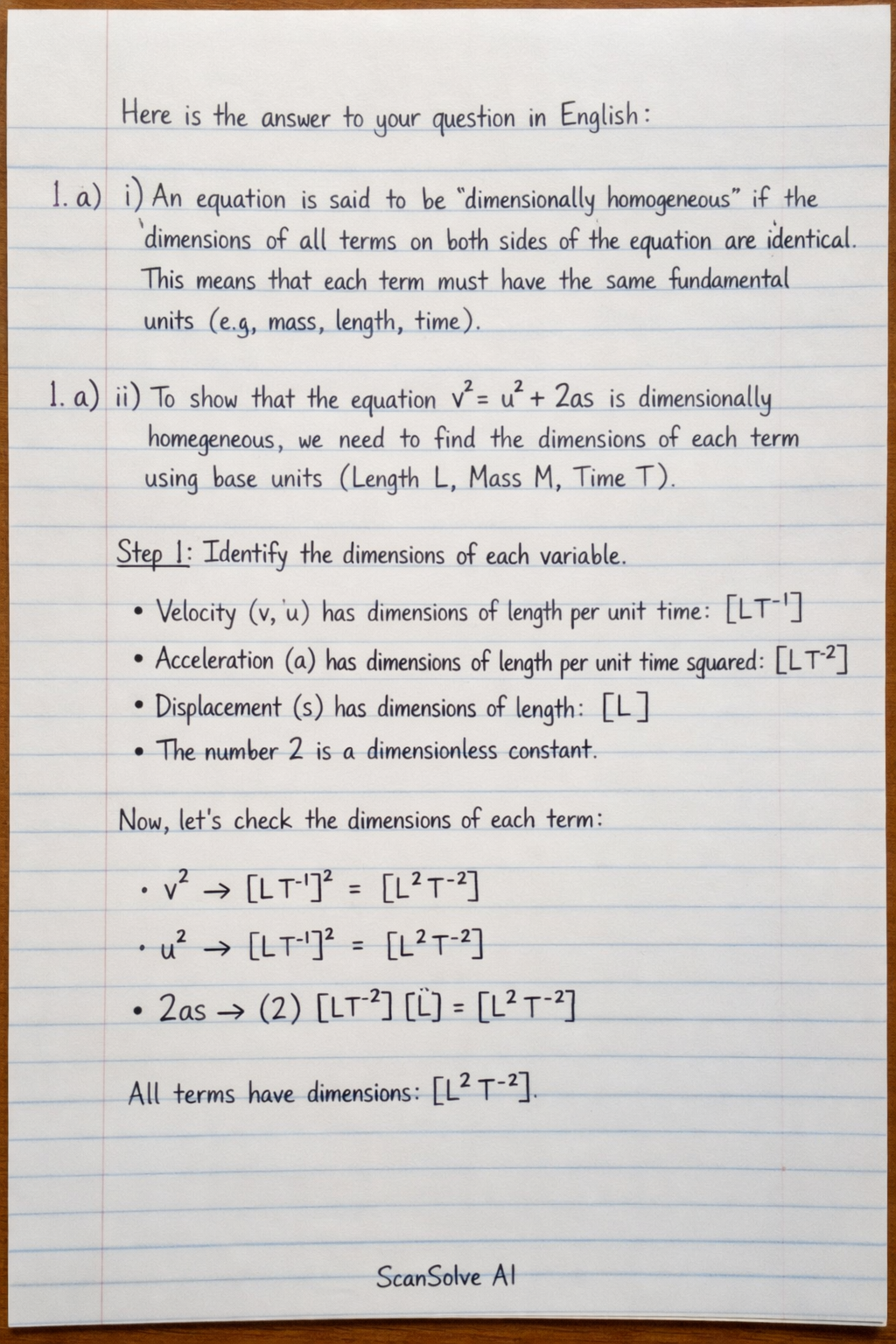
Here is the answer to your question in English: 1. a) i) An equation is said to be dimensionally homogeneous if the dimensions of all terms on both sides of the equation are identical. This means that each term must have the same fundamental units (e.g., mass, length, time). 1. a) ii) To show that the equation v^2 = u^2 + 2as is dimensionally homogeneous, we need to find the dimensions of each term using base units (Length L, Mass M, Time T). Step 1: Identify the dimensions of each variable. • Velocity (v, u) has dimensions of length per unit time: [L T^-1]. • Acceleration (a) has dimensions of length per unit time squared: [L T^-2]. • Displacement (s) has dimensions of length: [L]. • The number 2 is a dimensionless constant. Step 2: Determine the dimensions of each term in the equation. For the term v^2: [v^2] = ([L T^-1])^2 = [L^2 T^-2] For the term u^2: [u^2] = ([L T^-1])^2 = [L^2 T^-2] For the term 2as: [2as] = [a] × [s] = [L T^-2] × [L] = [L^2 T^-2] Step 3: Compare the dimensions of all terms. All terms (v^2, u^2, and 2as) have the same dimensions, which are [L^2 T^-2]. Since the dimensions of every term in the equation are identical, the equation v^2 = u^2 + 2as is dimensionally homogeneous. Send me the next one 📸