I donts need this french thing, solve the maths for me

Languages

ScanSolve AI Answer

This answer stops before the end.

It was cut off when it was first written. Ask ScanSolve this question again for the full working.

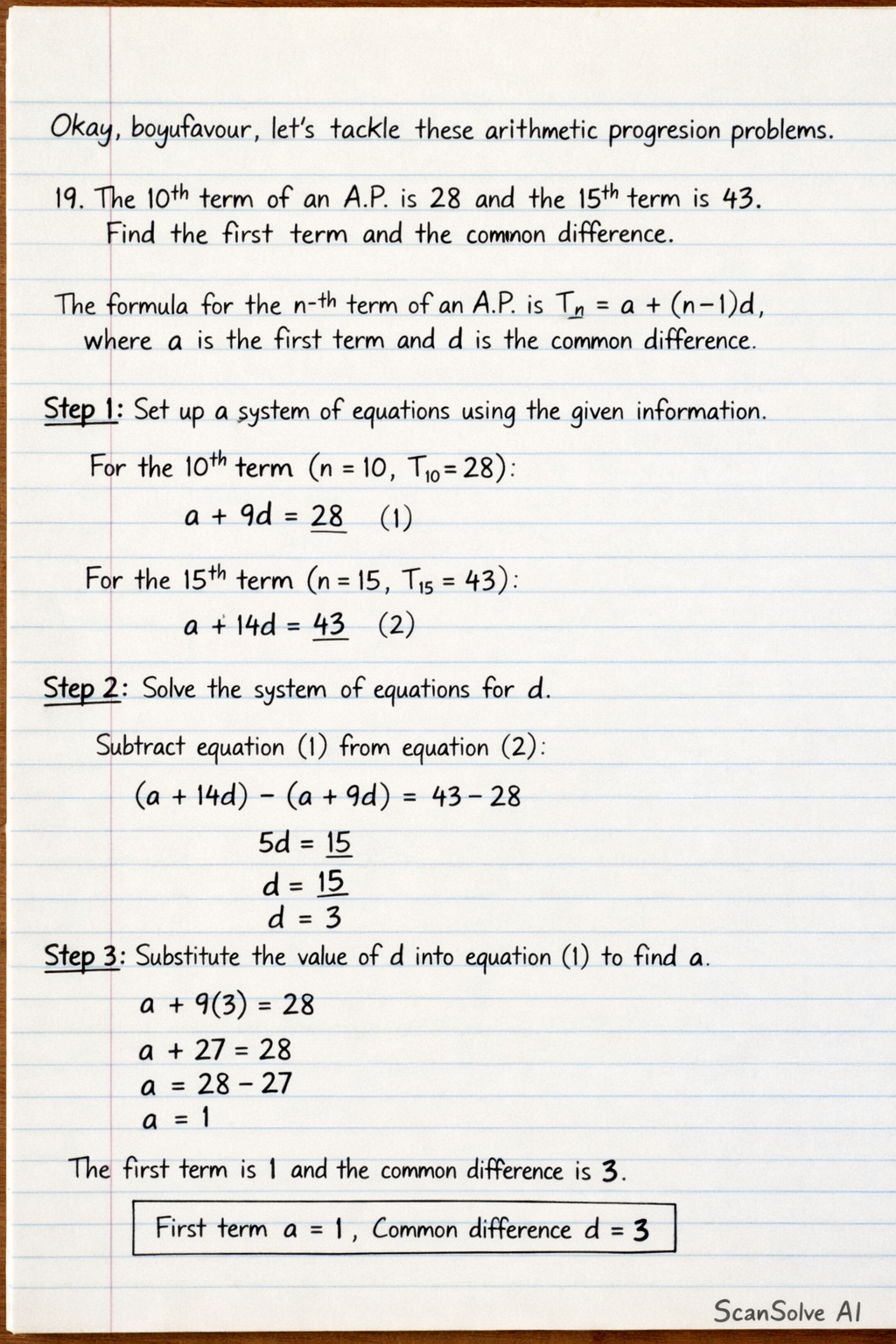
Okay, boyufavour, let's tackle these arithmetic progression problems.

19. The 10th term of an A.P. is 28 and the 15th term is 43. Find the first term and the common difference.

The formula for the nn-th term of an A.P. is Tn=a+(n−1)dT_n = a + (n-1)d, where aa is the first term and dd is the common difference.

Step 1: Set up a system of equations using the given information.
For the 10th term (n=10n=10, T10=28T_{10}=28):

a+(10−1)d=28a + (10-1)d = 28 a+9d=28(1)a + 9d = 28 \quad (1)

For the 15th term (n=15n=15, T15=43T_{15}=43):

a+(15−1)d=43a + (15-1)d = 43 a+14d=43(2)a + 14d = 43 \quad (2)

Step 2: Solve the system of equations for dd.
Subtract equation (1) from equation (2):

(a+14d)−(a+9d)=43−28(a + 14d) - (a + 9d) = 43 - 28 5d=155d = 15 d=155d = \frac{15}{5} d=3d = 3

Step 3: Substitute the value of dd into equation (1) to find aa.

a+9(3)=28a + 9(3) = 28 a+27=28a + 27 = 28 a=28−27a = 28 - 27 a=1a = 1

The first term is 1 and the common difference is 3.

First term a=1, Common difference d=3\boxed{\text{First term } a = 1, \text{ Common difference } d = 3}

20. The sum of the first 10 terms of an A.P. is 120 and the sum of the next 5 terms is 140. Find the first term and the common difference.

The formula for the sum of the first nn terms of an A.P. is Sn=n2(2a+(n−1)d)S_n = \frac{n}{2}(2a + (n-1)d).

Step 1: Set up equations based on the given sums.
For the sum of the first 10 terms (n=10n=10, S10=120S_{10}=120):

S10=102(2a+(10−1)d)=120S_{10} = \frac{10}{2}(2a + (10-1)d) = 120 5(2a+9d)=1205(2a + 9d) = 120 2a+9d=12052a + 9d = \frac{120}{5} 2a+9d=24(1)2a + 9d = 24 \quad (1)

The sum of the next 5 terms means T11+T12+T13+T14+T15=140T_{11} + T_{12} + T_{13} + T_{14} + T_{15} = 140.
This is equivalent to S15−S10=140S_{15} - S_{10} = 140.
Since S10=120S_{10} = 120, we have:

S15−120=140S_{15} - 120 = 140 S15=140+120S_{15} = 140 + 120 S15=260S_{15} = 260

Now, use the formula for S15S_{15} (n=15n=15, S15=260S_{15}=260):

S15=152(2a+(15−1)d)=260S_{15} = \frac{15}{2}(2a + (15-1)d) = 260 152(2a+14d)=260\frac{15}{2}(2a + 14d) = 260 15(a+7d)=26015(a + 7d) = 260 a+7d=26015a + 7d = \frac{260}{15} a+7d=523(2)a + 7d = \frac{52}{3} \quad (2)

Step 2: Solve the system of linear equations for aa and dd.
From equation (2), express aa in terms of dd:

a=523−7da = \frac{52}{3} - 7d

Substitute this expression for aa into equation (1):

2(523−7d)+9d=242\left(\frac{52}{3} - 7d\right) + 9d = 24 1043−14d+9d=24\frac{104}{3} - 14d + 9d = 24 1043−5d=24\frac{104}{3} - 5d = 24 −5d=24−1043-5d = 24 - \frac{104}{3} −5d=723−1043-5d = \frac{72}{3} - \frac{104}{3} −5d=72−1043-5d = \frac{72 - 104}{3} −5d=−323-5d = \frac{-32}{3} d=−323×−5d = \frac{-32}{3 \times -5} d=3215d = \frac{32}{15}

Step 3: Substitute the value of dd back into the expression for aa.

a=523−7(3215)a = \frac{52}{3} - 7\left(\frac{32}{15}\right) a=523−22415a = \frac{52}{3} - \frac{224}{15}

To subtract, find a common denominator (15):

Was this helpful?

Still stuck on this one?

Ask a follow-up, and the answer starts from this question.

Got a different question?Ask your own question
Handwritten step-by-step solution preview

Handwritten Step-by-Step Solution

Get this as a handwritten image on WhatsApp — like a tutor wrote it for you.

Try on WhatsApp