
In number 4 why did you multiply it by it's conjugate twice ,also since it had no denominator originally why then did you also multiply it by it's conjugate in the denominator
ScanSolve AI Answer
Answer
You're asking about Step 4: .
Step-by-step solution
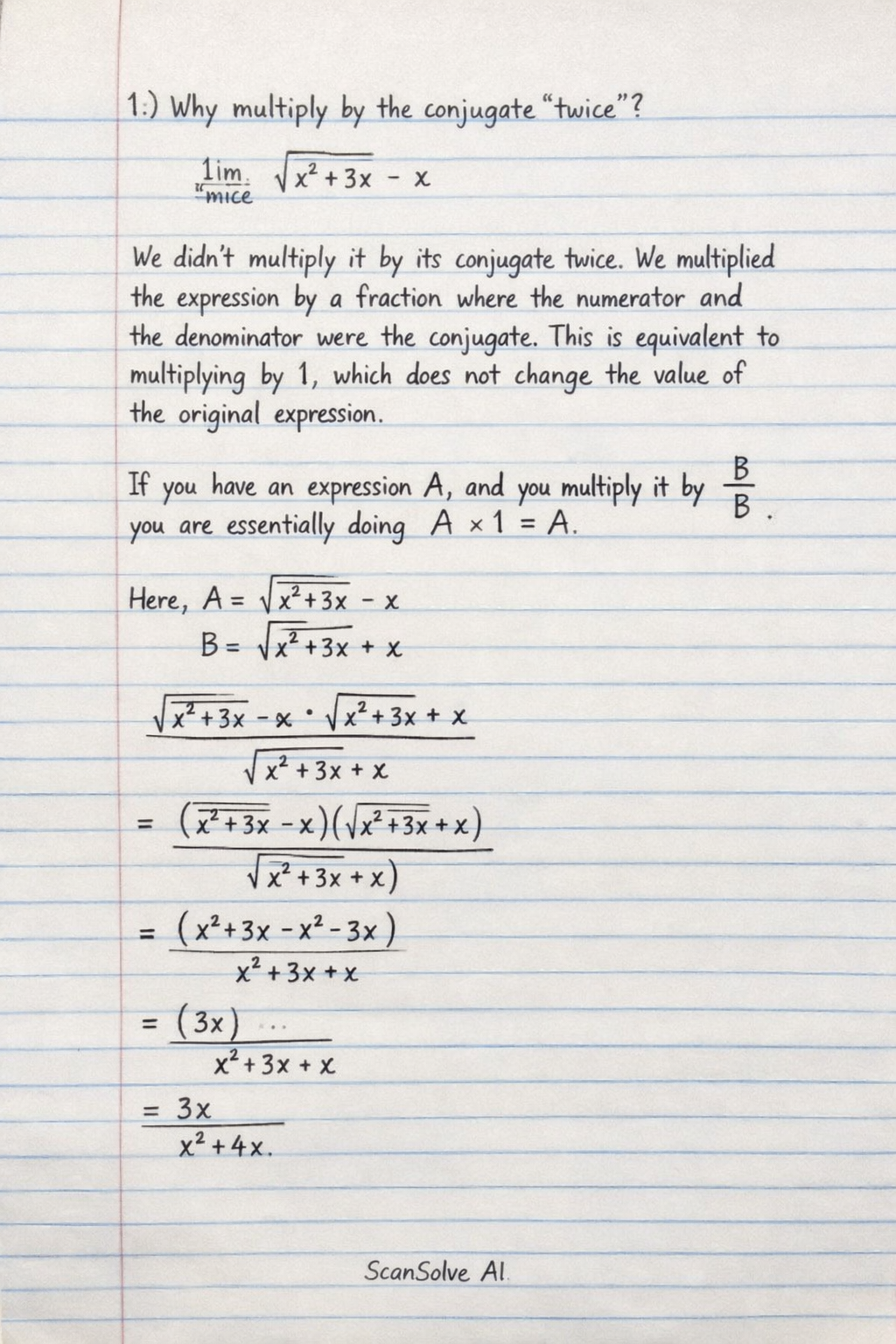
2 stepsWhy multiply by the conjugate "twice"?
We didn't multiply it by its conjugate twice. We multiplied the expression by a fraction where the numerator and the denominator were the conjugate. This is equivalent to multiplying by 1, which does not change the value of the original expression.
If you have an expression , and you multiply it by , you are essentially doing . Here, and .Why multiply by its conjugate in the denominator if it had no denominator originally?
The original expression is of the indeterminate form as . This form cannot be evaluated directly.
Multiplying by the conjugate is a common algebraic technique used to transform expressions involving square roots, especially when dealing with limits of the form or .
When we multiply by its conjugate , we get . This eliminates the square root from the numerator (or wherever the original difference was).
In our case:By doing this, we transform the expression into a fraction:
This new form is , which is another indeterminate form, but one that can be solved by dividing the numerator and denominator by the highest power of (or by L'Hôpital's Rule if applicable). This transformation is the purpose of multiplying by the conjugate.
Still stuck on this one?
Ask a follow-up, and the answer starts from this question.
More Languages Questions
Handwritten Step-by-Step Solution
Get this as a handwritten image on WhatsApp — like a tutor wrote it for you.
Try on WhatsApp