
We read your photo as:
Match the following terms in language acquisition: Vygotskian mechanism for internalizing thinking, direct imitation strategy, creating unique language forms without native speaker contact, and tactil
ScanSolve AI Answer
Here are the matches for each statement, based on common terminology in language acquisition and education. Since the drop-down options are not visible, these are the most likely terms:
-
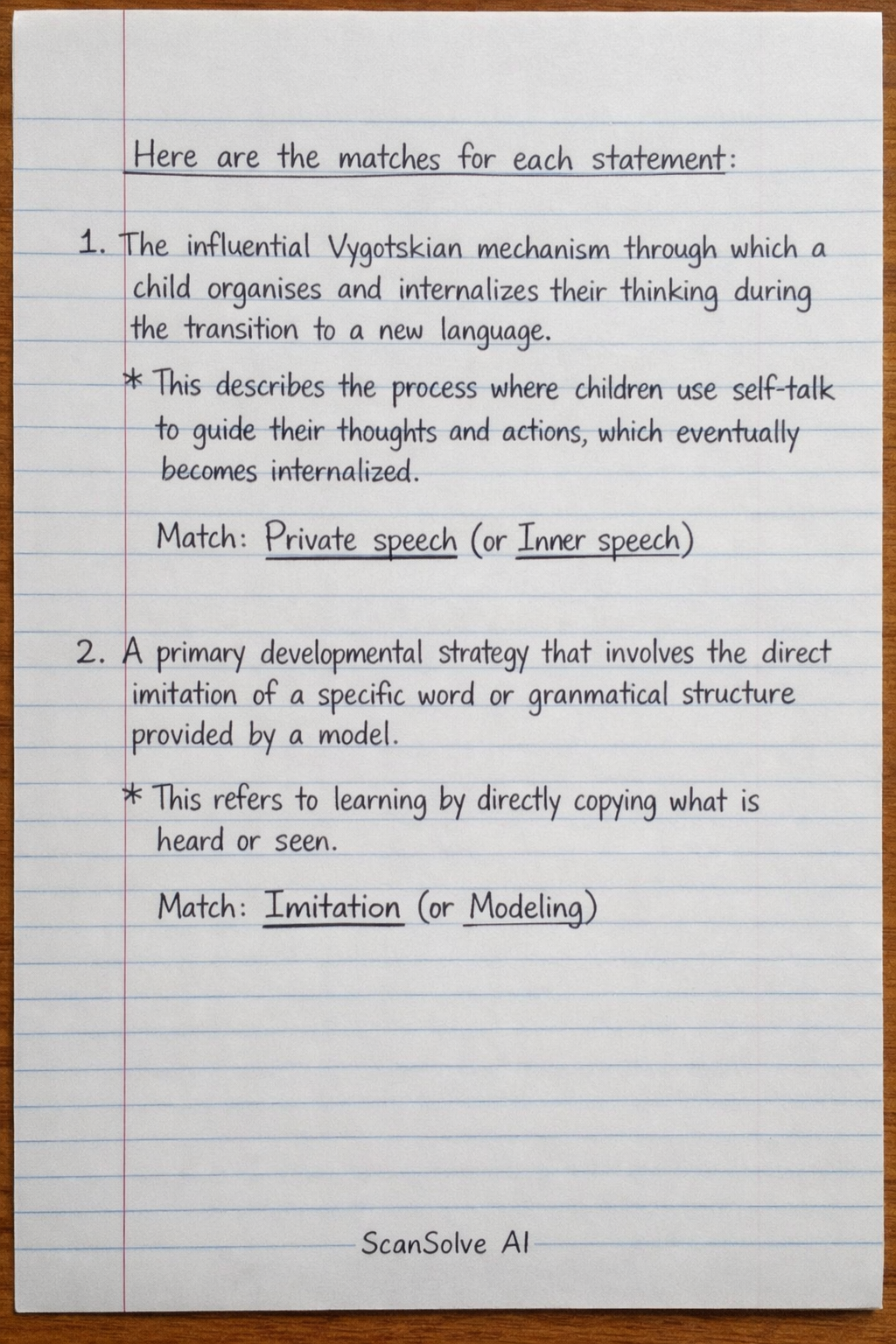
The influential Vygotskian mechanism through which a child organises and internalises their thinking during the transition to a new language.
- This describes the process where children use self-talk to guide their thoughts and actions, which eventually becomes internalised.
- Match: Private speech (or Inner speech)
-
A primary developmental strategy that involves the direct imitation of a specific word or grammatical structure provided by a model.
- This refers to learning by directly copying what is heard or seen.
- Match: Imitation (or Modeling)
-
The linguistic phenomenon of creating unique, simplified language forms due to a lack of contact with native speakers of one's mother tongue.
- This describes the developing linguistic system of a second language learner, which is often unique and simplified compared to the target language. The phrase "lack of contact with native speakers of one's mother tongue" might be interpreted as a factor influencing the learner's overall linguistic environment.
- Match: Interlanguage
-
Tactile resources that allow shy learners to bypass affective filters by projecting their speech onto an external object.
- This refers to using physical objects to reduce anxiety and encourage speaking, often used in language classrooms.
- Match: Puppets (or Masks)
-
An external variable that does not change the nature of the acquisition process but significantly affects the learner's ultimate achievement.
- This describes factors like motivation, aptitude, or learning environment that influence how successful a learner will be, without altering the fundamental cognitive process of language acquisition.
- Match: Motivation (or Individual differences, Learner variables)
Here are the likely matches:
- The influential Vygotskian mechanism through which a child organises and internalises their thinking during the transition to a new language: Private speech
- A primary developmental strategy that involves the direct imitation of a specific word or grammatical structure provided by a model: Imitation
- The linguistic phenomenon of creating unique, simplified language forms due to a lack of contact with native speakers of one's mother tongue: Interlanguage
- Tactile resources that allow shy learners to bypass affective filters by projecting their speech onto an external object: Puppets
- An external variable that does not change the nature of the acquisition process but significantly affects the learner's ultimate achievement: Motivation
Still stuck on this one?
Ask a follow-up, and the answer starts from this question.
More Languages Questions
Handwritten Step-by-Step Solution
Get this as a handwritten image on WhatsApp — like a tutor wrote it for you.
Try on WhatsApp