
This languages problem is solved step by step below, with detailed explanations to help you understand the method and arrive at the correct answer.
ScanSolve AI Answer
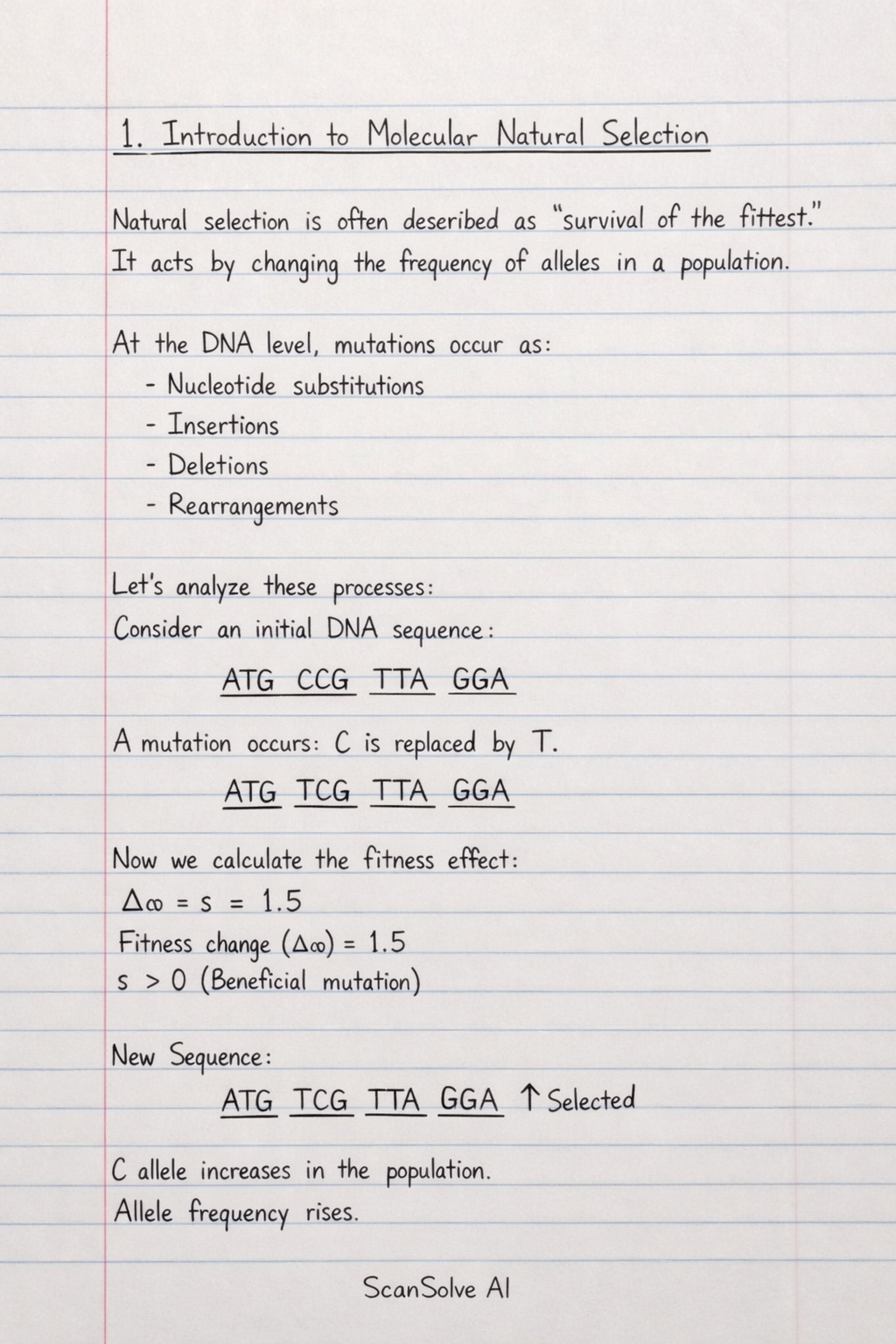
This discourse provides a comprehensive analysis of the types of molecular and genotypic natural selection that act on mutations at the DNA level, constituting a crucial component of population genetics and molecular evolution. 1. Introduction to Molecular Natural Selection Natural selection, typically understood as the survival of the fittest organism, operates primarily by altering the frequency of alleles (variant forms of genes) within a population’s gene pool. At the DNA level, these changes are driven by mutations—nucleotide substitutions, insertions, deletions, or rearrangements. Molecular natural selection refers to the deterministic processes that increase or decrease the frequency of these genetic variants based on their effect on an organism’s fitness. Mutations can be classified as advantageous (beneficial), deleterious (harmful), or neutral. The fate of a new mutation is determined by the balance between genetic drift (random changes in allele frequency due to chance) and selection pressures (directed changes favoring or disfavoring specific alleles). Understanding these forces is key to deciphering the evolutionary history and adaptive potential of species. 2. Purifying (Negative) Selection Purifying selection, often termed negative selection, is the most prevalent form of molecular selection. It acts to eliminate deleterious mutations from a population, thereby maintaining the integrity and functionality of essential genes and genomic regions. Mechanism at DNA Level: The vast majority of random mutations that occur in functional DNA regions are harmful. These mutations disrupt existing, optimized biological functions, such as altering protein structure, impairing enzyme activity, or disrupting crucial regulatory elements. Purifying selection acts against these mutations by reducing the reproductive success of individuals carrying them. This process ensures the stability of biological structures and functions that are critical for survival and reproduction. Over time, deleterious alleles are removed or kept at very low frequencies, preventing their fixation. Molecular Signatures: Low (dN)/(dS) Ratio: In protein-coding genes, purifying selection is characterized by a low ratio of non-synonymous (amino acid-changing) substitution rate (dN) to synonymous (silent) substitution rate (dS). A (dN)/(dS) ratio significantly less than 1 indicates that amino acid changes are generally deleterious and are being purged. A ratio close to 0 suggests strong purifying selection on highly conserved genes. Reduced Polymorphism: This selection reduces the amount of genetic variation within a population, leading to a lower effective population size and lower levels of polymorphism (genetic diversity) in regions under strong constraint. Excess of Low-Frequency Variants: Purifying selection often results in an excess of rare, low-frequency variants in a population, as new deleterious mutations are continuously introduced but quickly removed before they can rise to high frequencies. Background Selection: As a subset of negative selection, purifying selection against a deleterious mutation can inadvertently eliminate adjacent neutral or slightly advantageous mutations due to tight physical linkage on the chromosome. This phenomenon, known as background selection, reduces overall genetic variation in regions of low recombination. Codon Usage Bias: Purifying selection can also act at the codon level, favoring "optimal" codons that are translated more efficiently and accurately by the cellular machinery. This bias helps avoid toxic protein misfolding and ensures efficient protein synthesis, especially in highly expressed genes. 3. Positive (Directional) Selection Positive selection, a type of directional selection, favors the proliferation of new, advantageous mutations that enhance an individual's survival and reproduction, leading to adaptation. Mechanism at DNA Level: When a novel mutation arises and provides a fitness advantage—such as improved environmental adaptability (e.g., resistance to a toxin, better nutrient utilization), enhanced reproductive success, or disease resistance—it is selected for. Individuals carrying this beneficial mutation will, on average, produce more viable offspring. Consequently, the frequency of this advantageous allele increases within the population over generations, potentially leading to its fixation. This process is the primary driver of adaptive evolution. Molecular Signatures: High (dN)/(dS) Ratio: Positive selection is identified by a molecular evolution rate where the rate of non-synonymous substitutions (dN) significantly exceeds the rate of synonymous substitutions (dS), resulting in a (dN)/(dS) ratio greater than 1. This indicates that amino acid changes are being actively favored, leading to accelerated protein evolution. Selective Sweep: A strong positive selection event results in a "selective sweep," where the beneficial allele rapidly increases in frequency and sweeps through the population. During this process, neighboring neutral DNA sequences that are physically linked to the beneficial allele are also carried along, leading to a significant reduction in overall genetic variation (haplotype homozygosity) in that specific genomic region. Increased Frequency of Specific Alleles: The most direct signature is the rapid rise in the frequency of the advantageous allele, often reaching fixation within a relatively short evolutionary timescale. Reduced Linkage Disequilibrium: While a selective sweep initially creates strong linkage disequilibrium, recombination can eventually break down these associations, leaving a signature of reduced genetic variation around the selected locus. Examples: Antibiotic Resistance in Bacteria: Mutations in bacterial genes that confer resistance to antibiotics are rapidly and strongly positively selected in environments where antibiotics are present. Lactase Persistence in Humans: Mutations in the regulatory region of the LCT* gene, allowing adults to digest lactose, have been strongly positively selected in populations with a history of dairy farming. 4. Balancing Selection Balancing selection is a type of selection that actively maintains multiple alleles (genetic polymorphism) within a population over long periods. Unlike directional selection, which reduces polymorphism, balancing selection preserves it. Mechanism at DNA Level: Balancing selection operates through various mechanisms that prevent any single allele from becoming fixed or lost, thereby maintaining genetic diversity. Types and Molecular Signatures: Heterozygote Advantage (Overdominance): This occurs when the heterozygous genotype has a higher fitness than either homozygous genotype. Both alleles are maintained in the population because the heterozygote is favored. Example: The most famous example is the sickle-cell trait in humans. The mutation causing sickle cell disease (HbS allele) is deleterious in homozygotes (HbSS), leading to severe anemia. However, heterozygotes (HbAS) are resistant to malaria, providing a significant fitness advantage in malaria-prone regions. This maintains both the normal (HbA) and sickle cell (HbS) alleles in these populations at intermediate frequencies. Frequency-Dependent Selection: In some cases, the fitness of a genotype depends on its frequency in the population. For instance, rarer genotypes may have a selective advantage, ensuring they are not lost. This often occurs in host-parasite interactions, where a rare host resistance allele might be highly effective against common parasite strains, but as it becomes common, parasites evolve to overcome it. Environmental Heterogeneity (Spatially or Temporally Varying Selection): In fluctuating environments, different alleles may be advantageous at different times or in different geographic locations. If a population experiences a mosaic of environmental conditions, multiple alleles can be maintained in the gene pool, as each allele is favored under specific circumstances. Molecular Signatures: Balancing selection often leads to a high level of polymorphism at the selected locus, with alleles showing deep evolutionary divergence. It can also result in an elevated (dN)/(dS) ratio if the selection favors amino acid changes that maintain diversity, and the maintenance of alleles at intermediate frequencies. 5. Neutral Evolution and Genetic Drift While not a form of selection, neutral evolution (or neutral theory) is critical to understanding molecular selection. It posits that a significant portion of molecular variation is functionally neutral, and its fate is primarily determined by genetic drift, not selection. Mechanism at DNA Level: Synonymous Mutations: Nucleotide substitutions that do not change the amino acid sequence (silent mutations) are often functionally neutral because they do not alter the protein product. Neutral Substitutions: Many mutations in non-coding regions (e.g., introns, intergenic regions) or those with very minor fitness effects are also considered neutral. These mutations do not significantly impact survival or reproduction. Genetic Drift: The fate of these neutral mutations is governed by genetic drift—random fluctuations in allele frequencies from one generation to the next due to chance events in finite populations. In any given generation, some alleles may be passed on more than others purely by chance, regardless of their fitness effect. Over time, this random sampling can lead to the increase or decrease of allele frequencies, and eventually to the fixation (becoming 100% prevalent) or loss* (disappearing) of alleles, even if they are neutral. The smaller the population size, the stronger the effect of genetic drift. Molecular Clock: The rate of accumulation of neutral mutations can be relatively constant over long evolutionary periods, providing a "molecular clock" to estimate divergence times between species. Contrast with Selection: Selection is a deterministic force that favors specific alleles based on their fitness effects, while genetic drift is a random, non-directional process. Both forces act simultaneously, with their relative importance depending on the strength of selection, population size, and the fitness effect of the mutation. 6. Summary of Molecular Signatures of Selection The distinct patterns left on DNA sequences allow researchers to infer the type of natural selection acting on a gene or genomic region: Purifying (Negative) Selection: Characterized by a low (dN)/(dS) ratio (typically (dN)/(dS) < 1), low levels of polymorphism near the site, and an excess of rare variants. Positive (Directional) Selection: Indicated by a high (dN)/(dS) ratio ((dN)/(dS) > 1), reduced genetic variation (selective sweep) and strong linkage disequilibrium around the selected locus, and an increased frequency of specific advantageous alleles. Balancing Selection: Evidenced by a high level of polymorphism, often with deep evolutionary divergence between alleles, an elevated (dN)/(dS) ratio (if amino acid changes are involved in maintaining diversity), and the maintenance of multiple alleles at intermediate frequencies. Neutral Evolution (Genetic Drift): Characterized by (dN)/(dS) ≈ 1 (for mutations with no fitness effect), high levels of polymorphism in non-coding or synonymous sites, and allele frequency changes that are largely independent of fitness. In conclusion, the interplay of these molecular forces—purifying, positive, and balancing selection, alongside genetic drift—sculpts the genetic landscape of populations, driving adaptation, maintaining essential functions, and preserving diversity, ultimately shaping the evolutionary trajectory of life.