
We read your photo as:
Simplify the left-hand side (LHS) by multiplying the numerator and denominator by the conjugate of the denominator.
Languages
ScanSolve AI Answer
Answer
Step-by-step solution
5 stepsTo solve the equation , we need to simplify both sides and then equate the real and imaginary parts.
Simplify the left-hand side (LHS) by multiplying the numerator and denominator by the conjugate of the denominator.
The conjugate of is .
Perform the multiplication in the numerator and denominator.
Numerator:
Since , this becomes .
Denominator: .
So, the LHS simplifies to:Simplify the right-hand side (RHS).
Since , this becomes:
Equate the simplified LHS and RHS.
Equate the real parts and the imaginary parts of both sides.
Equating the real parts:
Equating the imaginary parts:
Thus, the values of and are:
Was this helpful?
Try one yourself
A new problem that tests the same skill.
Still stuck on this one?
Ask a follow-up, and the answer starts from this question.
Got a different question?Ask your own question
More Languages Questions
QRationalise the denominator by multiplying the numerator and denominator by the conjugate of the…QMultiply the numerator and the denominator by the conjugate of the denominator.QSimplify the expression in the numerator on the left side.QSimplify the numerator of the fraction.QSimplify the fraction on the right side.
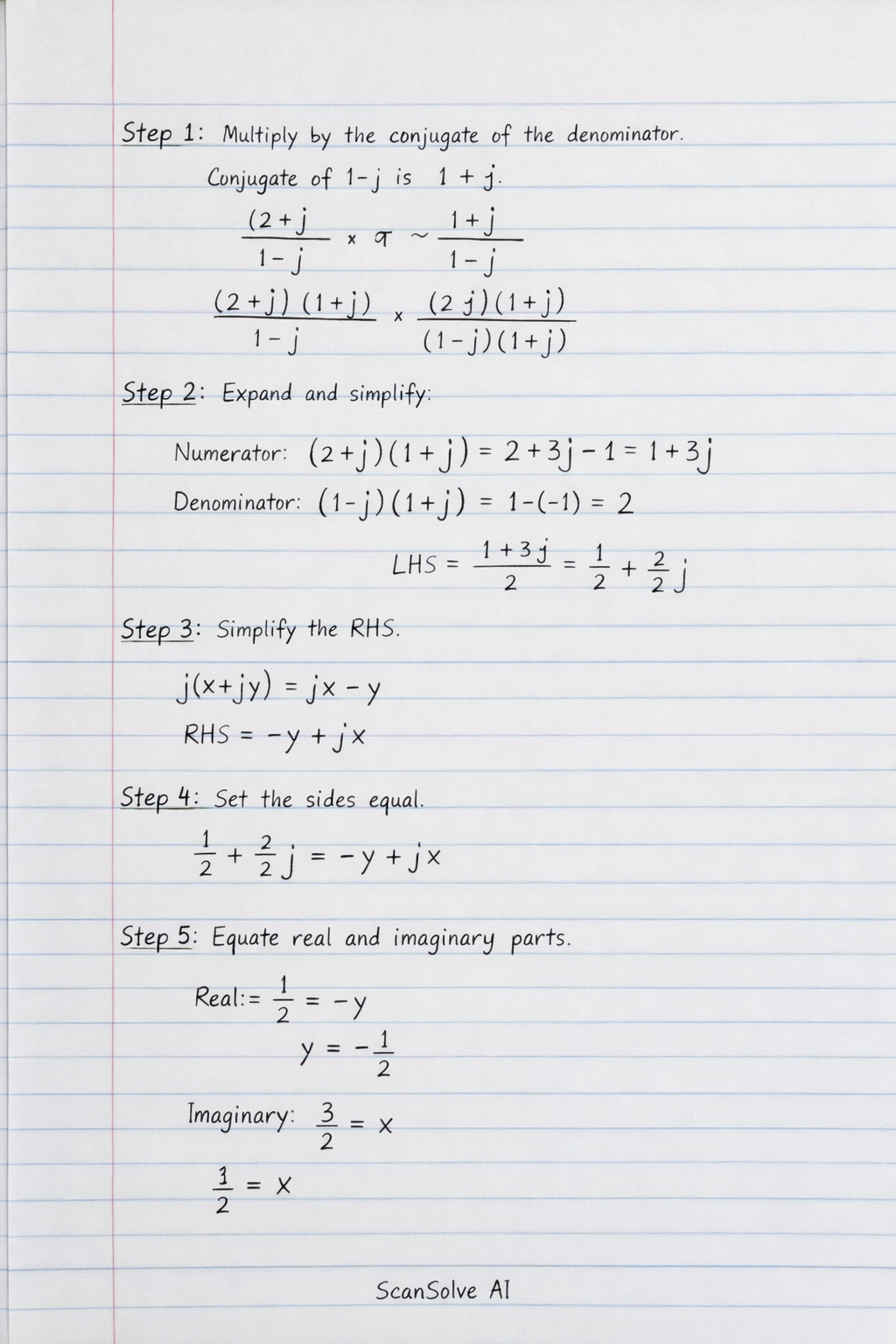
Handwritten Step-by-Step Solution
Get this as a handwritten image on WhatsApp — like a tutor wrote it for you.
Try on WhatsApp