
We read your photo as:
To prepare a buffer solution with a specific pH using a weak base and its conjugate acid, we use the Henderson-Hasselbalch equation for bases. The buffer system consists of ammonia (NH3) as the wea
ScanSolve AI Answer
Answer
Step-by-step solution
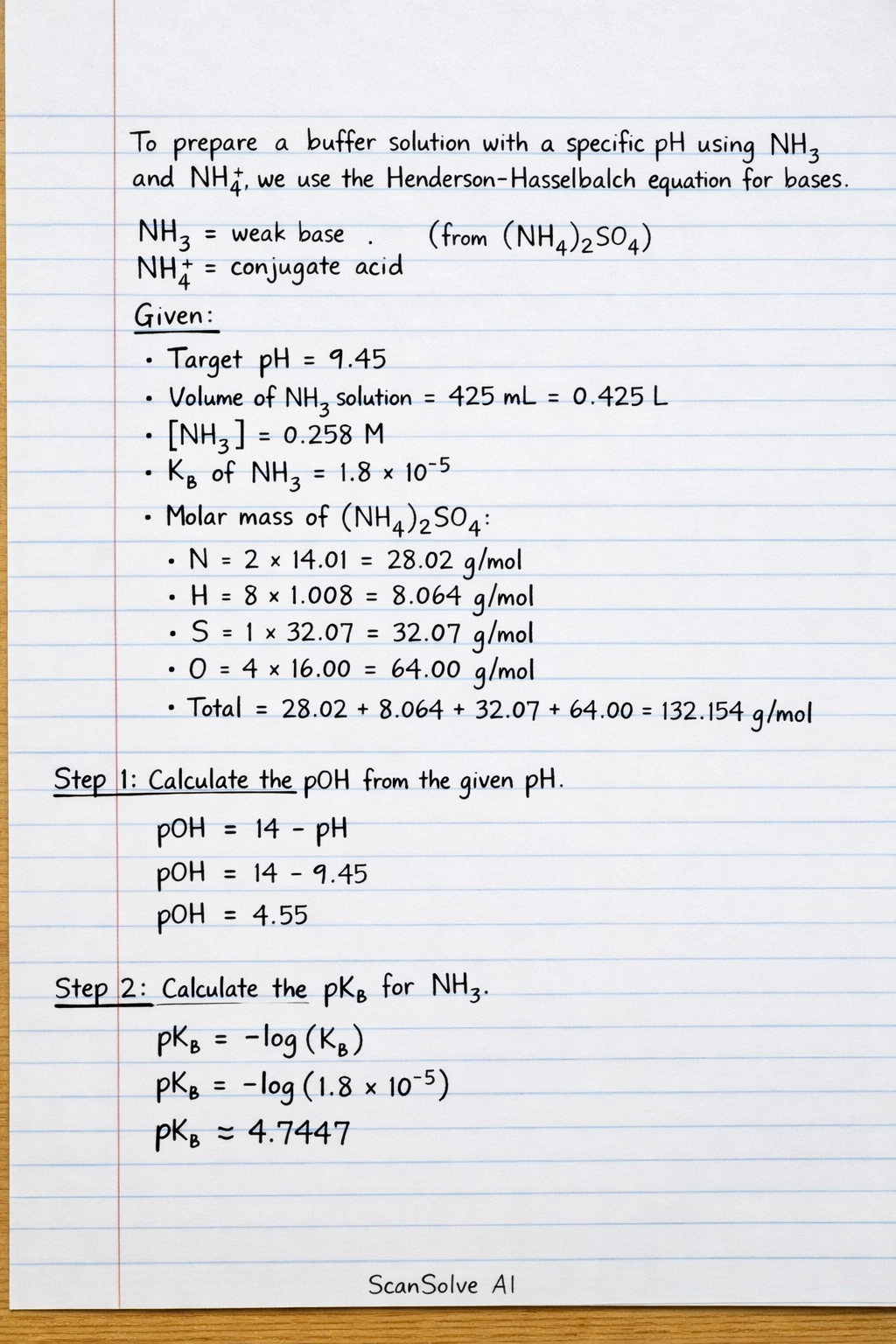
6 stepsTo prepare a buffer solution with a specific pH using a weak base and its conjugate acid, we use the Henderson-Hasselbalch equation for bases. The buffer system consists of ammonia () as the weak base and ammonium ion () as its conjugate acid, which comes from ammonium sulfate ().
Given:
- Target pH = 9.45
- Volume of solution = 425 mL = 0.425 L
- Concentration of = 0.258 M
- The base dissociation constant () for is .
- Molar mass of :
- N: g/mol
- H: g/mol
- S: g/mol
- O: g/mol
- Total molar mass = g/mol
Calculate the from the given .
Calculate the for ammonia ().
Use the Henderson-Hasselbalch equation to find the required concentration of the conjugate acid ().
The Henderson-Hasselbalch equation for a basic buffer is:
Substitute the known values:
Rearrange to solve for the logarithm term:
Take the antilog (10 to the power of both sides):
Solve for :
Calculate the total moles of needed.
Determine the moles of required.
Ammonium sulfate, , dissociates to produce two ions for every one formula unit:
Therefore, the moles of needed are half the moles of :
Calculate the mass of needed.
Rounding to three significant figures (consistent with 0.258 M and 425 mL):
Still stuck on this one?
Ask a follow-up, and the answer starts from this question.
More Languages Questions
Handwritten Step-by-Step Solution
Get this as a handwritten image on WhatsApp — like a tutor wrote it for you.
Try on WhatsApp