
We read your photo as:
1a. Define Citizenry, b. State eight functions of Citizenry, 2a. What is Representative Democracy, b. Explain five characteristics representative Democracy, 3a. Explain five limitation of Rule of Law, b. Mention seven principles of Rule of Law, 4a. Define Pillars of Democracy, b. Enumerate six roles of Constitution as pillar of Democracy, 5a. What is the full meaning of UDHR, b. State five roles of the government in the UDHR, 6. Write short notes on: i. Federalism, ii. State, iii. Local Government
ScanSolve AI Answer
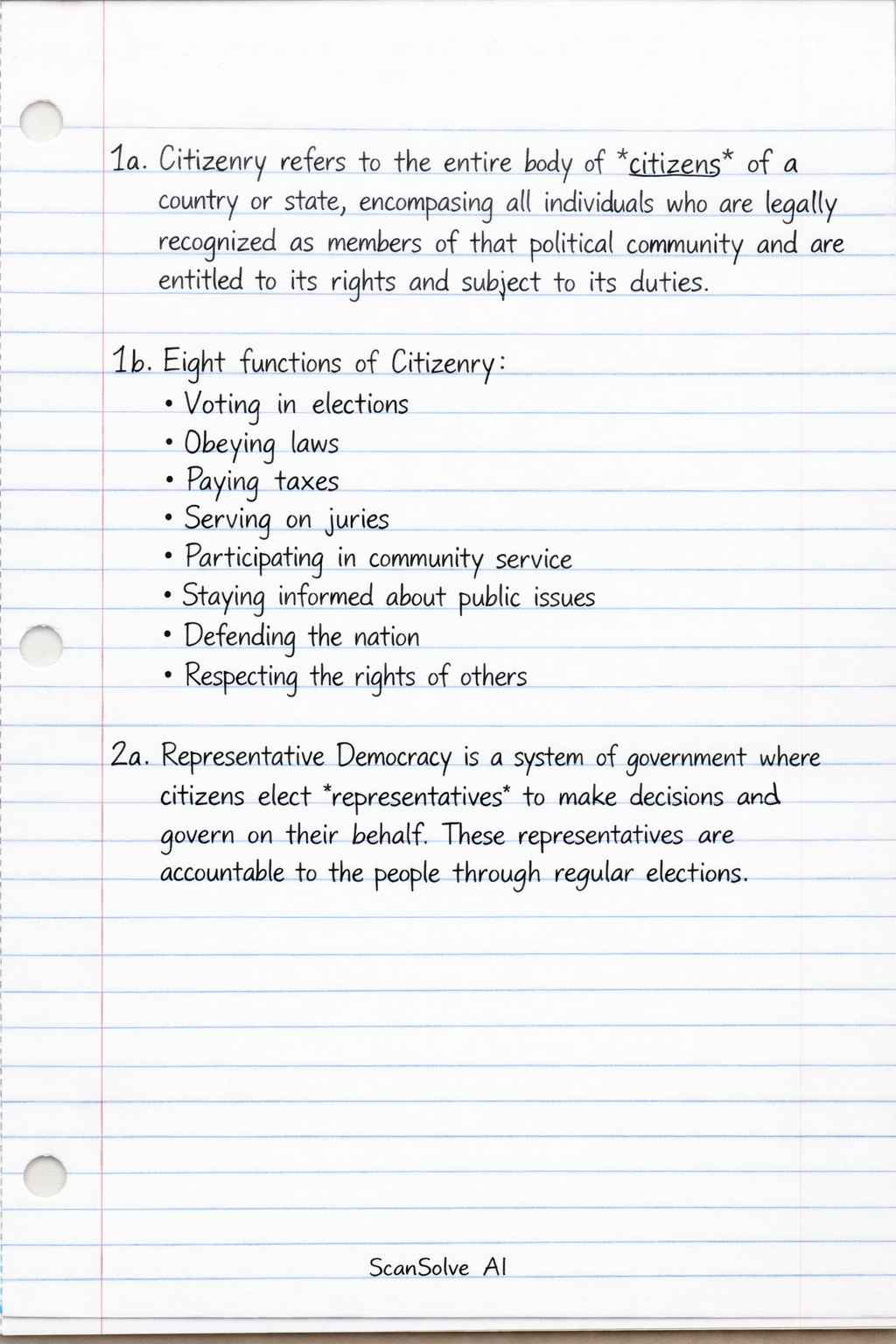
1a. Citizenry refers to the entire body of citizens of a country or state, encompassing all individuals who are legally recognized as members of that political community and are entitled to its rights and subject to its duties.
1b. Eight functions of Citizenry:
- Voting in elections
- Obeying laws
- Paying taxes
- Serving on juries
- Participating in community service
- Staying informed about public issues
- Defending the nation
- Respecting the rights of others
2a. Representative Democracy is a system of government where citizens elect representatives to make decisions and govern on their behalf. These representatives are accountable to the people through regular elections.
2b. Five characteristics of Representative Democracy:
- Free and Fair Elections: Citizens have the right to vote and stand for office in elections that are regularly held, competitive, and free from manipulation.
- Protection of Human Rights: Fundamental rights and freedoms of individuals are guaranteed and protected by law.
- Rule of Law: All individuals, including those in power, are subject to and accountable under the law.
- Accountability and Transparency: Elected representatives are held responsible for their actions and decisions, and government operations are open to public scrutiny.
- Political Pluralism: Multiple political parties and diverse viewpoints are allowed to exist and compete for power, ensuring a range of choices for citizens.
3a. Five limitations of Rule of Law:
- Emergency Powers: In times of crisis, governments may invoke emergency powers that temporarily suspend certain legal rights or processes.
- Political Influence: The judiciary, though ideally independent, can sometimes be influenced by political pressures or appointments.
- Corruption: Bribery and illicit practices can undermine the impartial application of laws.
- Lack of Access to Justice: High legal costs or geographical barriers can prevent some citizens from effectively seeking legal redress.
- Discretionary Powers: Public officials often have discretionary powers that, if not properly checked, can lead to arbitrary decisions.
3b. Seven principles of Rule of Law:
- Supremacy of Law: No one is above the law.
- Equality before the Law: All individuals are treated equally under the law.
- Accountability to the Law: Government and private actors are accountable under the law.
- Fairness in the Application of Law: Laws are clear, publicized, stable, and just.
- Separation of Powers: Government powers are divided among different branches to prevent abuse.
- Legal Certainty: Laws are predictable and consistently applied.
- Access to Justice: Mechanisms are available for resolving disputes peacefully and fairly.
4a. Pillars of Democracy refer to the fundamental institutions, principles, and practices that support and sustain a democratic system of government. These elements work together to ensure the effective functioning of democracy.
4b. Six roles of Constitution as pillar of Democracy:
- Establishes Government Structure: It defines the framework of government, including the powers and responsibilities of its branches.
- Guarantees Rights and Freedoms: It protects the fundamental rights and liberties of citizens.
- Limits Government Power: It sets boundaries on what the government can and cannot do, preventing tyranny.
- Provides for Rule of Law: It establishes the principle that all are subject to the law, including those in power.
- Ensures Stability and Order: It provides a stable legal framework for governance and dispute resolution.
- Reflects National Values: It embodies the core values, aspirations, and identity of the nation.
5a. The full meaning of UDHR is Universal Declaration of Human Rights.
5b. Five roles of the government in the UDHR:
- Protect Human Rights: Governments are obligated to protect the human rights of all individuals within their jurisdiction.
- Promote Human Rights: Governments should actively work to advance and educate about human rights.
- Fulfill Human Rights: Governments must take steps to ensure that individuals can enjoy their economic, social, and cultural rights.
- Prevent Human Rights Violations: Governments are responsible for preventing abuses by state actors and, in some cases, non-state actors.
- Provide Remedies for Violations: Governments must ensure that victims of human rights violations have access to effective remedies and redress.
6i. Federalism is a system of government where power is divided between a central authority and various constituent units (like states or provinces). Both levels of government have their own distinct powers and responsibilities, as defined by a constitution, and neither is subordinate to the other in its own sphere of authority.
6ii. A State, in political science, refers to a political organization that occupies a definite territory, has a permanent population, possesses a government, and enjoys sovereignty (the supreme power within its territory, free from external control). It is the primary unit of international relations.
6iii. Local Government refers to the lowest tier of public administration within a particular state or country, responsible for governing a specific local area such as a city, town, or county. It typically provides essential services like sanitation, local infrastructure, and public safety, and is accountable to the local population.
Still stuck on this one?
Ask a follow-up, and the answer starts from this question.
More Law Questions
Handwritten Step-by-Step Solution
Get this as a handwritten image on WhatsApp — like a tutor wrote it for you.
Try on WhatsApp