
![According to Section 21, [Chapter 12, Section 102(1)], may a person be declared unfit to possess a firearm for failing to take the prescribed steps for the safekeeping of a firearm? [a], [b], [c], [d] or [e]?](/_next/image?url=https%3A%2F%2Fohijasnjvprzodcmxltt.supabase.co%2Fstorage%2Fv1%2Fobject%2Fpublic%2Fwhatsapp-images%2F1781350310668-7917c64098e698cd.png&w=3840&q=75)
This law problem is solved step by step below, with detailed explanations to help you understand the method and arrive at the correct answer.
ScanSolve AI Answer
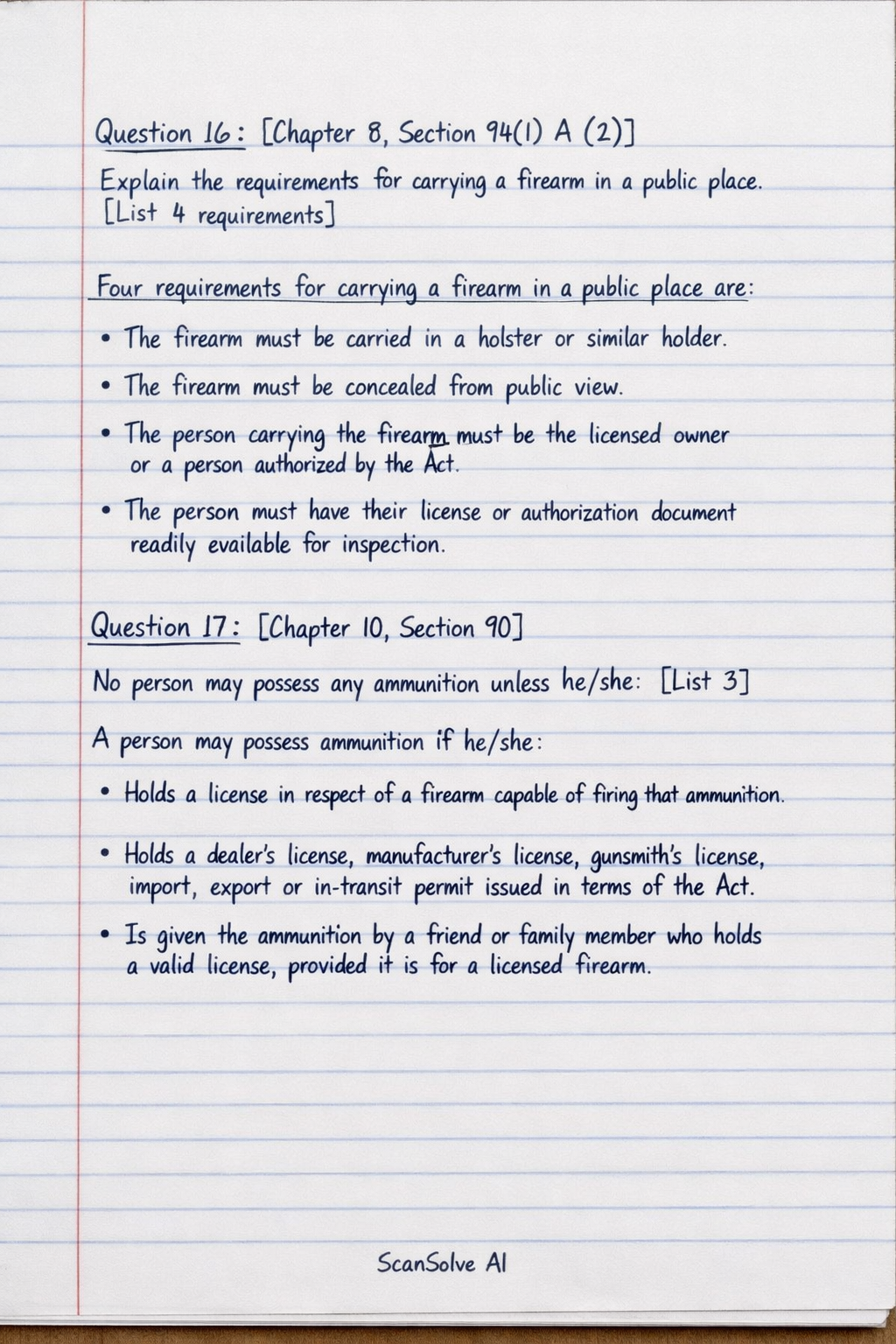
Question 16: [Chapter 8, Section 94(1) A (2)] Explain the requirements for carrying a firearm in a public place. [List 4 requirements] Four requirements for carrying a firearm in a public place are: • The firearm must be carried in a holster or similar holder. • The firearm must be concealed from public view. • The person carrying the firearm must be the licensed owner or a person authorized by the Act. • The person must have their license or authorization document readily available for inspection. Question 17: [Chapter 10, Section 90] No person may possess any ammunition unless he/she: [List 3] A person may possess ammunition if he/she: • Holds a license in respect of a firearm capable of firing that ammunition. • Holds a dealer's license, manufacturer's license, gunsmith's license, import, export or in-transit permit issued in terms of the Act. • Is given the ammunition by a friend or family member who holds a valid license, provided it is for a licensed firearm. Question 18: [Chapter 10, Section 91] Analyse the picture to the right and explain in terms of Section 91 of the Act, whether or not this person appears to be committing an offense under normal circumstances. The picture shows a person holding a firearm and what appears to be a large quantity of ammunition. Under normal circumstances, this person appears to be committing an offense. Section 91 of the Act limits the amount of ammunition a person may possess for a specific caliber of firearm. Possessing an excessive quantity of ammunition beyond the prescribed limits, without a specific license or authorization (e.g., a dealer's license), is an offense. Question 19: [Chapter 10, Section 94(1)] What is meant by a "firearm part"? A "firearm part" refers to any component of a firearm that is essential to its operation or that can be used to assemble a firearm. This includes parts such as the barrel, frame, receiver, or breech block. Question 20: [Chapter 10, Section 94(2)] According to Section 94 of Chapter 10, no person may possess any firearm part unless he/she: [Choose 2] The correct options are: A. Also has the ammunition used in that firearm. B. Holds a licence in respect of a firearm capable of bearing that firearm part. C. Holds a dealer's licence, manufacturer's licence, gunsmith's licence, import, export or in-transit permit issued in terms of the Act. D. Is given the ammunition by a friend or family member who holds a valid licence. The two correct options are B and C. Question 21: [Chapter 12, Section 102(1)] According to which sub-section of Section 102, may a person be declared unfit to possess a firearm for failing to take the prescribed steps for the safekeeping of a firearm? [a], [b], [c], [d] or [e]? A person may be declared unfit to possess a firearm for failing to take the prescribed steps for the safekeeping of a firearm under sub-section (d). Question 22: [Chapter 12, Section 102(1)] A person may be declared unfit to possess a firearm if: On the grounds of information contained in a statement made by any person sworn to or affirmed, which information constitutes a reasonable suspicion that the person is a threat to the safety of any person, including him or herself, or has a history of violence. [List 4 requirements] Four requirements for declaring a person unfit to possess a firearm based on such information are: • The person has expressed the intention to kill or injure him/herself or any other dangerous weapon. • That person has a valid competency certificate. • That person has previously threatened to kill or injure him/herself or any other person. • That person has provided information required in terms of this Act which is false or misleading. • That person has not been found guilty of an offense. The question asks for four requirements based on a reasonable suspicion that the person is a threat or has a history of violence. From the options provided (which are not explicitly listed but implied by the structure of the question asking for "4 requirements"), the relevant criteria would be: • The person has expressed the intention to kill or injure him/herself or any other person. • The person has previously threatened to kill or injure him/herself or any other person. • The person has a history of violent behavior. • The person has been convicted of an offense involving violence. Question 23: [Chapter 12, Section 104(2)] What should a person do if he/she is declared unfit to possess a firearm in terms of Chapter 12, Section 104(2)? If a person is declared unfit to possess a firearm, he/she must surrender all firearms and ammunition in his/her possession to the police or a designated official within a specified period. Question 24: [Chapter 12, Section 104(5)] After how many years, if being declared unfit, may a person apply for a competency certificate? A person may apply for a competency certificate after 5 years from the date of being declared unfit. Question 25: [Chapter 13, Section 107] Who may request a person to produce a licence, permit or authorisation for the firearm that they are carrying? A police official or an authorised officer may request a person to produce a licence, permit, or authorisation for the firearm they are carrying. Question 26: [Chapter 13, Section 108(1)] A police official who has reasonable grounds to believe that a person has or recently had a firearm or ammunition in his/her possession, may request that person to: A police official may request that person to produce the firearm or ammunition for inspection. Question 27: [Chapter 14, Section 113(1)] A police official may without warrant take the fingerprints of a person if: [Choose 1] The correct option is: A. There are reasonable grounds to suspect that the person has committed an offence punishable with imprisonment for a period of five years or longer. B. Knows that person has committed a crime previously. C. Believes the suspect may commit a crime in the future. D. The suspect wears gloves. The correct option is A. Question 28: [Chapter 14, Section 114(1)] What two (2) items may a police officer seize in terms of this Section? A police officer may seize: • Any firearm • Any ammunition • Any firearm part • Any license, permit, or authorization • Any article which may afford evidence of the commission of an offense under the Act. The question asks for two items. Two common items are firearm and ammunition. Got more? Send 'em.