
We read your photo as:
Analyze a labor law violation scenario: identify the specific law broken, explain the role of trade union representatives, name three types of employees likely affected by minimum wage violations, and
ScanSolve AI Answer
Step-by-step solution
6 stepsIdentify the labour law violated.
The labour law violated is the National Minimum Wage Act, 2018 (Act 9 of 2018). This law is relevant because the employer in the scenario explicitly paid workers below the minimum salary required by this Act, as stated in the passage.
Explain the role of trade union representatives/shop stewards.
Trade union representatives or shop stewards act as a link between employees and management. Their role in this scenario would be to advocate for the underpaid workers, negotiate with the employer for fair wages, and ensure the employer complies with labour laws like the National Minimum Wage Act. They also provide support and guidance to employees regarding their rights.
Name three types of employees likely not paid according to the National Minimum Wage Act of 2018 in your area.
Three types of employees often vulnerable to underpayment include:
- Domestic workers
- Farm workers
- Informal sector workers (e.g., street vendors, casual labourers)
Discuss one way the Employment Equity Act (EEA), 55 of 1998, provides for redress.
The Employment Equity Act (EEA) provides for redress by allowing employees who believe they have been unfairly discriminated against or exploited to lodge a complaint with the Commission for Conciliation, Mediation and Arbitration (CCMA). The CCMA can then mediate, conciliate, or arbitrate the dispute, potentially leading to a resolution or referral to the Labour Court.
Assess two possible reasons why some workers are still exploited and not being paid according to the National Minimum Wage Act.
Two possible reasons are:
- Lack of awareness of rights: Many workers, especially those in vulnerable positions, may not be fully aware of their legal right to a minimum wage or how to report violations, making them susceptible to exploitation.
- Fear of job loss: High unemployment rates can make workers desperate to retain their jobs, even if it means accepting wages below the legal minimum, as they fear being replaced if they complain.
Suggest three practical ways that could ensure employers abide by the labour laws in our country, and motivate each answer.
Three practical ways are:
- Increased labour inspections: Regular and unannounced inspections by the Department of Labour can deter employers from violating wage laws, as they face a higher risk of being caught and penalised.
- Worker education and awareness campaigns: Educating employees about their rights, including the minimum wage and how to report violations, empowers them to demand fair treatment and hold employers accountable.
- Stricter penalties for non-compliance: Imposing significant fines and legal consequences for employers who violate labour laws can serve as a strong deterrent, encouraging adherence to regulations.
Still stuck on this one?
Ask a follow-up, and the answer starts from this question.
More Law Questions
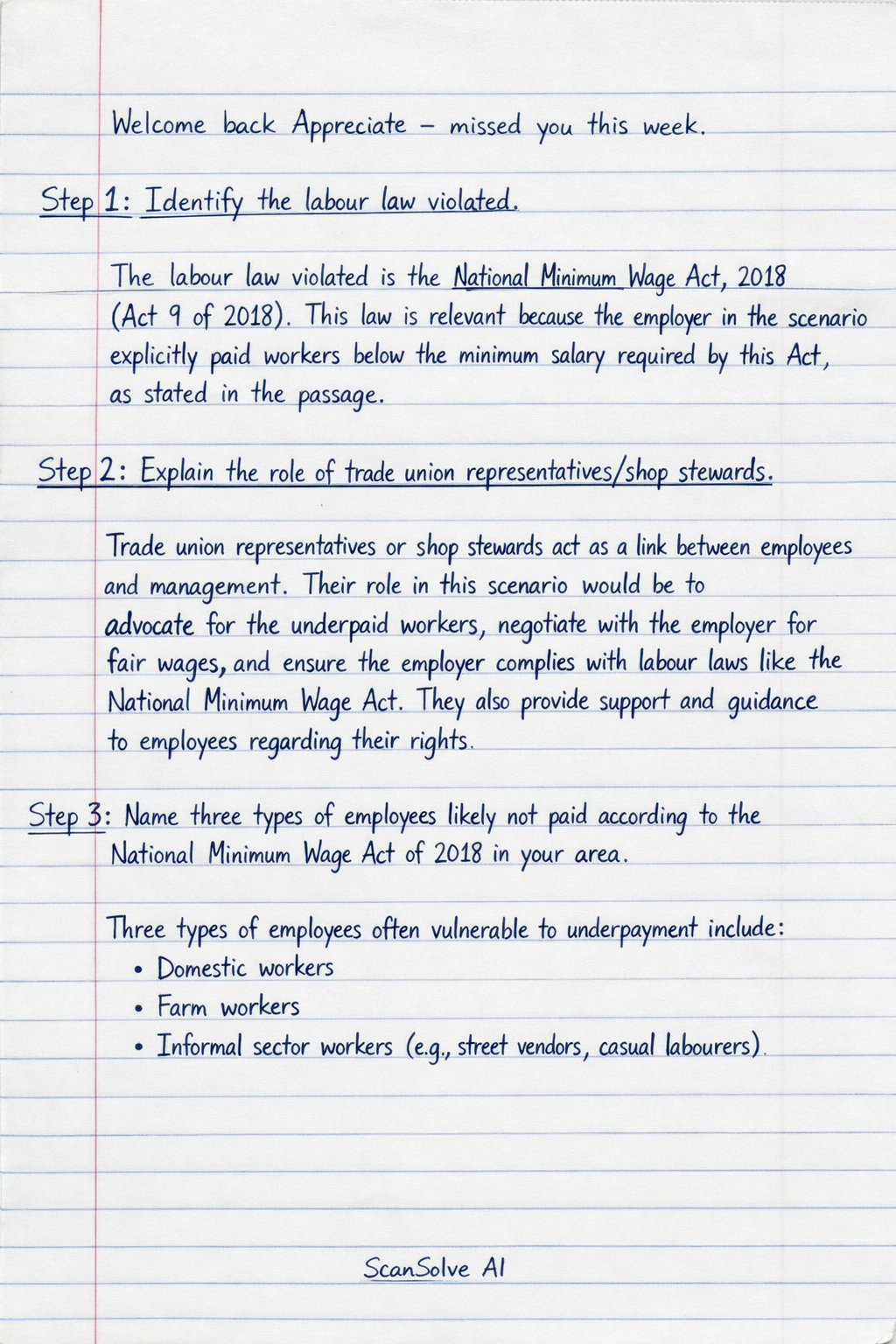
Handwritten Step-by-Step Solution
Get this as a handwritten image on WhatsApp — like a tutor wrote it for you.
Try on WhatsApp