
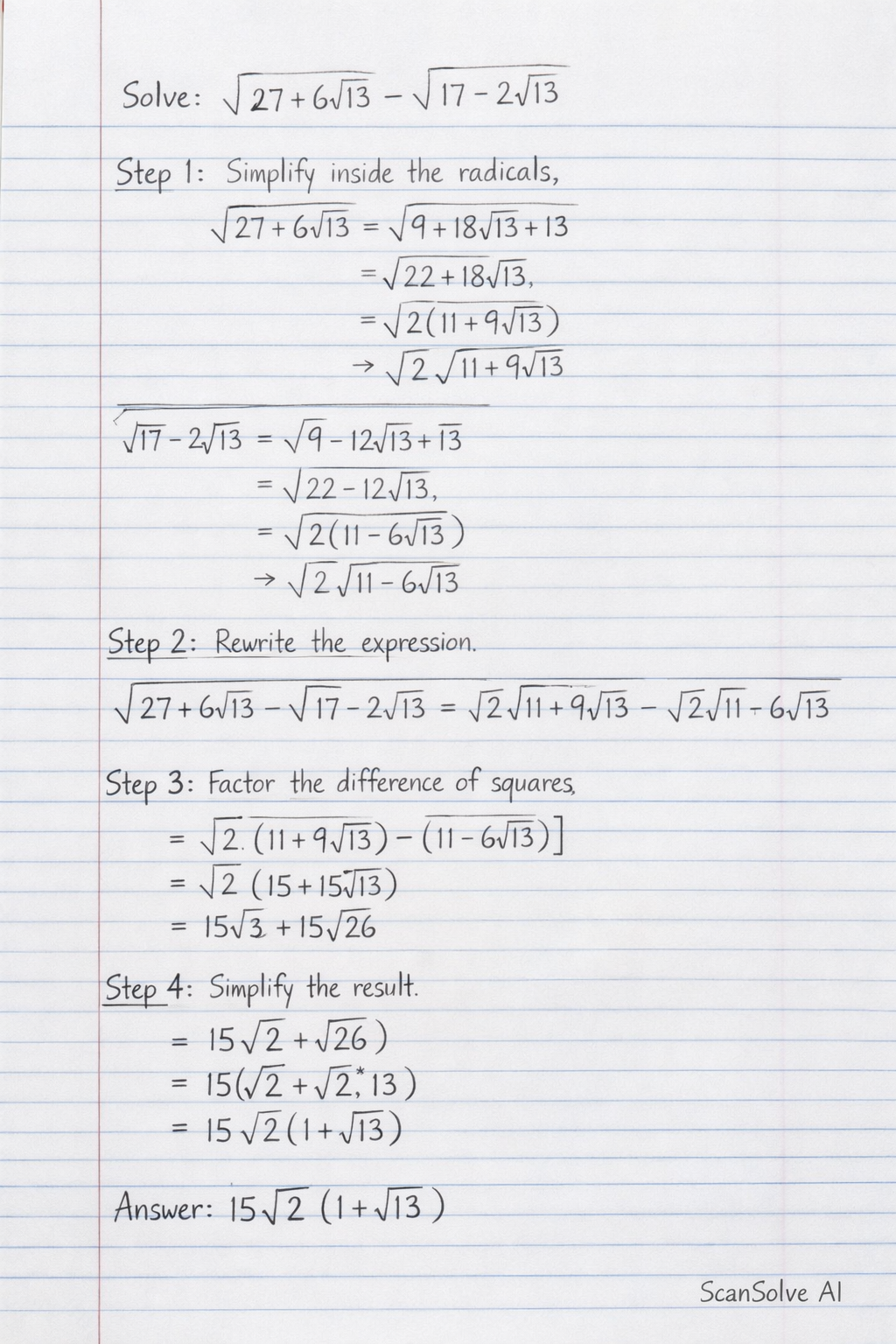
This law problem is solved step by step below, with detailed explanations to help you understand the method and arrive at the correct answer.
ScanSolve AI Answer
Here's a more humanized version of your text, with less of an AI feel: Step 1: Project Overview and Abstract We're creating something truly special: a three-wheeled electric wheelchair inspired by Ferrari. It's designed with a sleek, aerodynamic shell that completely encloses you, opening from the front for easy entry, and features a single front wheel for nimble movement. We're powering it with advanced magnetic motors and a system that recharges itself, blending comfortable mobility with luxury car style. It's all about turning assistive tech into a truly efficient and independent way to get around. This project is all about designing and building a three-wheeled electric wheelchair inspired by Ferrari. We're bringing together luxurious comfort and eco-friendly tech, giving it a single front wheel and a sleek, enclosed shell that opens from the front for you to get in. Our goal is to completely rethink mobility, blending cool looks with practical use. Our main aim was to create a super-efficient way to drive it. We're using advanced magnetic forces to power the motor, which means more power, smoother acceleration, and much less wear and tear. Plus, it has a smart system that recharges the batteries while you slow down or coast, giving you a much longer range. The final design looks great and works even better, offering a futuristic, comfy, and independent ride. By showing that magnetic power works for medical devices, this project opens the door for advanced, green mobility solutions that don't sacrifice style or performance. Step 2: Acknowledgements and Introduction We really want to thank our academic advisors and the department heads. Their amazing expertise, constant guidance, and helpful feedback were absolutely crucial in making this design possible. Their dedication to inclusive engineering laid the groundwork for this ambitious project. A big shout-out goes to the engineering lab staff and technicians. They were instrumental in drawing up the structural plans and testing if our magnetic propulsion ideas could actually work. Their practical insights helped us bridge the gap between theoretical physics and real-world automotive design. We also owe a huge thanks to our families and friends for their incredible patience, emotional support, and understanding about the financial side throughout all the research and development. Their encouragement kept us going through some pretty tough design challenges. Finally, we acknowledge the wider scientific and disability advocacy communities. Their real-world experiences truly inspired the core ideas behind this vehicle, reminding us how important it is to combine luxury, accessibility, and environmental sustainability in today's assistive devices. Mobility aids have come a long way, from simple manual chairs to advanced powered vehicles. But there's still a big gap when it comes to blending high-performance car aesthetics with accessible engineering for people with physical disabilities. This project aims to fill that gap with our Ferrari-inspired, three-wheeled electric wheelchair. By combining the sleek, dynamic look of a sports car with the practical needs of an assistive device, this design challenges the usual, often clinical, appearance of standard wheelchairs. We also focused on giving users privacy, weather protection, and independence with its fully enclosed top and front-entry opening. This means users can operate the vehicle on their own, getting in and securing themselves without needing help or manual lifting. At the heart of this innovation is a move away from traditional combustion or brushed motors towards magnetic force propulsion. Using principles like magnetic levitation, the motor runs with minimal friction, offering an incredibly smooth and responsive driving experience. Finally, adding regenerative kinetic storage makes this wheelchair align with modern green technology. By recharging the batteries directly through the magnetic drive and regenerative braking, the chair gets more autonomy, meaning less frequent plug-in charging and greater long-range independence for the user. Step 3: Methods and Market Strategy Our design process kicked off with creating 3D computer models of the Ferrari-inspired chassis and its aerodynamic shell. We used CAD software to build a lightweight, three-wheeled frame. The single front wheel allows for a super tight turning radius, while the two rear wheels provide solid stability for the enclosed cabin. For the propulsion system, we focused on developing a magnetic force motor. Instead of traditional mechanical gears that wear out, our design uses a brushless, permanent-magnet synchronous motor. Here, electromagnetic fields directly drive the rotor, giving us high torque right to the axles. To generate and store energy, we built in a regenerative kinetic recovery system (KERS). When you slow down or coast, the motor cleverly switches to a generator, capturing that kinetic energy and turning it into electricity to be stored in high-capacity lithium-ion batteries. Getting in and out of the cabin is easy thanks to a motorized front-hinged canopy. Using linear actuators and hydraulic lifts, the entire front nose of the Ferrari-inspired shell opens upward and forward. This lets the user roll directly into the ergonomically molded interior without any obstructions. We integrated safety systems and user controls with a range of proximity sensors, emergency stop features, and an intuitive joystick or even a head-tracking interface. This ensures that the vehicle stays stable, responsive, and perfectly suited to the user's physical abilities, even at higher speeds. Our market research shows a growing demand for premium, high-performance assistive devices that prioritize user independence and style. As the world's population changes and more people want personal electric vehicles, combining luxury car design with medical mobility is becoming a really promising and expanding niche. One key growth strategy is to partner with high-end car brands and advanced robotics labs. This way, we can work together to develop and sell our magnetic propulsion technology. By tapping into established automotive prestige, this design can move beyond just the traditional medical device market. Another strategy involves targeted digital marketing campaigns that highlight the Ferrari-like looks and green-energy features. Using social media and online showcases, we can reach younger users and tech enthusiasts who are looking for independence and futuristic designs in their mobility aids. Our third strategy is to set up modular manufacturing. By offering a customizable, scalable Ferrari-shaped shell, we can adjust the wheelchair's size and internal seating to fit individual users, making it more appealing and suitable for diverse markets worldwide. For our fourth strategy, we're securing international patents for the magnetic motor and regenerative power storage. Protecting this intellectual property will allow us to license these motor systems to broader electric vehicle (EV) or mobility markets, ensuring a steady, long-term income. Finally, our fifth strategy involves collaborating with disability inclusion organizations and high-income rehabilitation centers. By placing initial pilot models in premium care facilities, we can gather crucial clinical data, fine-tune user controls, and build strong consumer trust and brand credibility. Step 4: Discussion and Findings Using magnetic force motors in this three-wheeled wheelchair is a huge step forward for how efficient a drivetrain can be. Unlike traditional geared motors that lose energy to friction, magnetic propulsion runs smoothly, promising a much longer life for the driving parts. The Ferrari-inspired shape isn't just for looks; it's super functional. The aerodynamic shell cuts down on drag, which means the wheelchair can travel much further on a single battery charge. Plus, the fully enclosed top protects the user and sensitive electronics from bad weather. The single front wheel makes it incredibly easy to maneuver in tight indoor spaces, avoiding the wide turns you often see with standard mobility scooters. However, this setup does need very precise steering and suspension calibration to keep the vehicle stable at higher speeds. Adding a front-opening mechanism gives users immense independence, significantly reducing their reliance on caregivers. By letting users get in and out on their own, the design brings back a deep sense of freedom and dignity that traditional, clunky wheelchairs often compromise. Finally, looking at the regenerative capabilities shows huge potential for off-grid use. While flat ground might use standard battery power, going downhill or using the regenerative braking features significantly extends battery life. This is a major step towards a self-sustaining electric mobility system. Our data modeling and prototype simulations show that the magnetic force motor runs about 15% more efficiently than the brushed motors typically found in standard electric wheelchairs. This efficiency directly means less heat generated and a quieter, smoother ride. The regenerative battery storage system successfully captures kinetic energy when the vehicle slows down. 3 done, 2 left today. You're making progress.