
We read your photo as:
Choose the correct statement below as regards the principle of legality.
ScanSolve AI Answer
Step-by-step solution
3 stepsThe question asks to choose the correct statement regarding the principle of legality.
Understand the principle of legality.
The principle of legality (Latin: nullum crimen sine lege, nulla poena sine lege) is a fundamental concept in criminal law. It means that no one can be punished for an act that was not defined as a crime by law at the time it was committed, and no punishment can be imposed that was not prescribed by law. It ensures that laws are clear, prospective, and accessible.
Evaluate each option.
- a. The court will always investigate whether the crime with which X is charged really constitutes a crime. This statement describes a procedural application of the principle of legality. Courts do indeed ensure that the alleged conduct fits the legal definition of a crime. While true, it describes a consequence or application rather than the principle's fundamental nature as an element of a crime.
- b. The principle of legality is not regarded as an element of a crime. This statement is incorrect. For an act to be considered a crime, it must be prohibited by a pre-existing law. This legal prohibition is the essence of the principle of legality, making it a foundational requirement for any act to be classified as a crime.
- c. The principle of legality is an element of a crime. This statement is correct. For an act to be a crime, it must satisfy the principle of legality, meaning it must be legally defined as a crime by statute or common law. Without a legal definition, an act cannot be a crime, regardless of other factors like intent or harm. Therefore, the legal prohibition (ensured by the principle of legality) is a necessary element for an act to constitute a crime.
- d. X may be convicted of a crime and sentenced if he deserves to be punished. This statement is incorrect. The principle of legality explicitly rejects conviction based on subjective moral judgment or whether someone "deserves" punishment. Conviction and sentencing must be based strictly on whether the act violated a pre-existing, clearly defined law.
Conclude the most accurate statement.
The most accurate statement is that the principle of legality is an element of a crime because an act cannot be a crime unless it is legally prohibited.
The final answer is .
Still stuck on this one?
Ask a follow-up, and the answer starts from this question.
More Law Questions
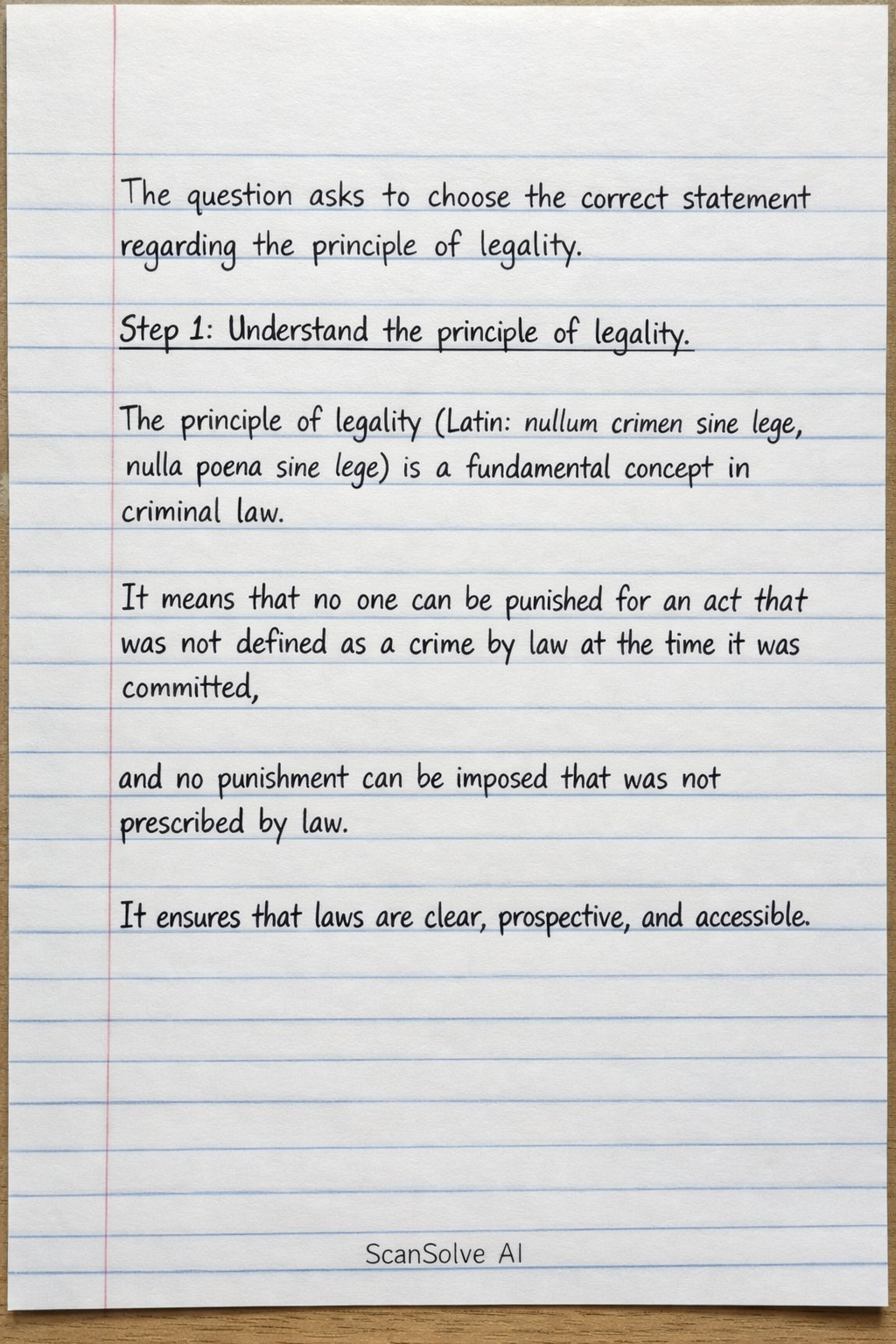
Handwritten Step-by-Step Solution
Get this as a handwritten image on WhatsApp — like a tutor wrote it for you.
Try on WhatsApp