
We read your photo as:
Conduct an interview with five learners about human rights violations and the justice system, then present and analyze the data using Annexure A.
Law
ScanSolve AI Answer
Step-by-step solution
4 stepsThis question requires you to conduct an interview and then present and analyze the data. Since I cannot perform the interview or draw the graph for you, I will guide you through the steps to complete Activity 4.1.
Conduct the Interview
- Obtain the "attached questionnaire template – Annexure A."
- Approach five (5) learners at your school.
- Clearly explain the purpose of the interview (to gather their knowledge on human rights violations and the role of the Justice system).
- Ask each learner all the questions from the questionnaire and record their responses accurately. Ensure you note down whether their answers are "Yes," "No," or other specific responses for each question.
Collect and Organize Data
- After interviewing all five learners, compile their responses. For each question in your questionnaire (let's assume there are Q1, Q2, Q3, Q4 as in the example), count how many learners gave a "Yes" response and how many gave a "No" response (or other relevant categories).
- Example of organized data (hypothetical):
- Q1: "Do you know what human rights are?" (Yes: 4, No: 1)
- Q2: "Are human rights violations common in your community?" (Yes: 3, No: 2)
- Q3: "Do you think media plays a role in reporting human rights violations?" (Yes: 5, No: 0)
- Q4: "Is the justice system effective in addressing human rights violations?" (Yes: 2, No: 3)
Draw the Bar Graph
- Heading: Create a clear and descriptive heading for your graph, such as: "Learners' Knowledge of Human Rights Violations and the Role of Media/Justice System."
- Y-axis (vertical): Label this axis "Number of participants." The scale should range from 0 to 5 (since you interviewed 5 learners). Mark increments clearly (e.g., 1, 2, 3, 4, 5).
- X-axis (horizontal): Label this axis "Responses to questions." For each question from your questionnaire, create a distinct section. You can label these "Q1," "Q2," "Q3," "Q4," or use short descriptive phrases for each question.
- Bars: For each question, draw two bars (or more, depending on your response categories). One bar will represent the "Yes" responses and the other the "No" responses.
- Use different shading or colors for "Yes" and "No" bars, as indicated in the example legend.
- The height of each bar should correspond to the number of participants who gave that specific response.
- Legend: Include a legend to explain what each bar color/shading represents (e.g., "Yes" and "No").
Provide Data Analysis
- Analyze the data presented in your bar graph for each question.
- For each question (Q1, Q2, Q3, Q4, etc.):
- State the question.
- Describe the distribution of responses (e.g., "For Q1, 4 out of 5 learners responded 'Yes,' indicating a high level of awareness...").
- Interpret what the responses suggest about the learners' knowledge or perceptions regarding human rights violations, the role of media, or the justice system.
- Look for patterns or significant findings. For example, if most learners believe the media plays a crucial role (Q3 in our hypothetical example), discuss why this might be the case. If many feel the justice system is ineffective (Q4 in our hypothetical example), explore potential reasons.
- Conclude with an overall summary of your findings, linking them back to the sub-topic of human rights and the role of media in reporting violations.
Was this helpful?
Still stuck on this one?
Ask a follow-up, and the answer starts from this question.
Got a different question?Ask your own question
More Law Questions
QDescribe how to gather data from questionnaires, analyze a specific law's relevance to victim…QAnalyze the human rights issues presented in the provided images and text snippets, referencing…QDiscuss responsible citizenship, how a Grade 12 learner can demonstrate it, reasons for youth…QGive real life situation s where you have experienced the violation of the human rightsQThis document is an assessment framework for a Grade 12 project on Democracy and Human Rights in…
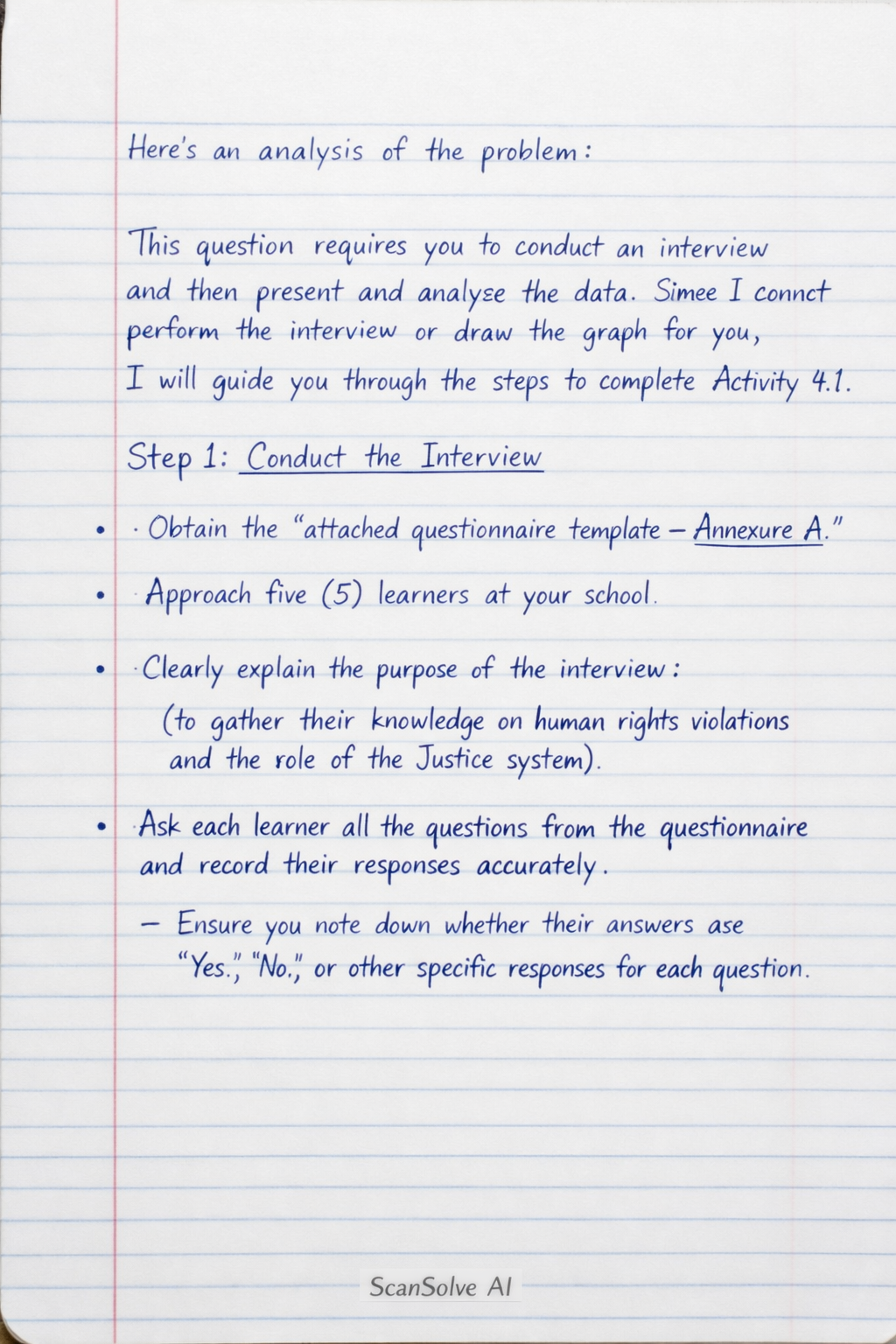
Handwritten Step-by-Step Solution
Get this as a handwritten image on WhatsApp — like a tutor wrote it for you.
Try on WhatsApp