
We read your photo as:
Which Act mandates efficient records management for accountability and transparency in public bodies?
ScanSolve AI Answer
Answer
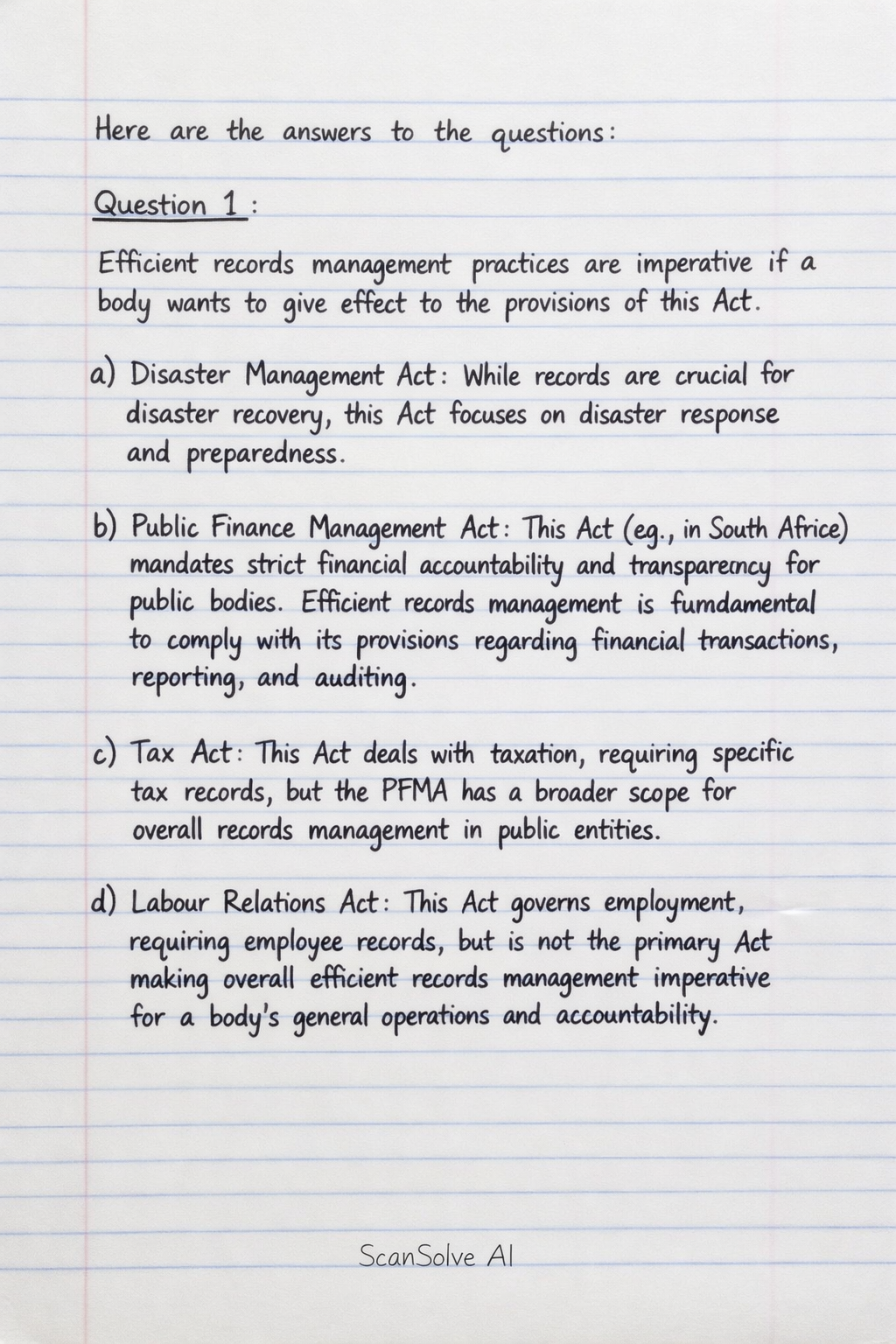
Here are the answers to the questions:
Question 1:
Efficient records management practices are imperative if a body wants to give effect to the provisions of this Act.
- a) Disaster Management Act: While records are crucial for disaster recovery, this Act focuses on disaster response and preparedness.
- b) Public Finance Management Act: This Act (e.g., in South Africa) mandates strict financial accountability and transparency for public bodies. Efficient records management is fundamental to comply with its provisions regarding financial transactions, reporting, and auditing.
- c) Tax Act: This Act deals with taxation, requiring specific tax records, but the PFMA has a broader scope for overall records management in public entities.
- d) Labour relations Act: This Act governs employment, requiring employee records, but is not the primary Act making overall efficient records management imperative for a body's general operations and accountability.
The Public Finance Management Act places a comprehensive requirement on public bodies for efficient records management to ensure accountability and transparency in financial matters.
The correct option is b.
Question 2:
Estimation of potential disasters should ideally include which of the following:
- a) What is the quality of the fire precautions system? This should be checked periodically. This is an assessment of a mitigation measure, which is part of disaster preparedness, but not the primary estimation of the disaster itself.
- b) What is the likelihood of flooding? Information in this regard can be obtained from local emergency services who will be able to identify vulnerable areas. This directly addresses identifying a specific potential disaster (flooding) and assessing its likelihood and impact, which is a core component of disaster estimation.
- c) Is any work of the organisation of a sensitive nature that might not attract theft or bomb threats? The phrasing "might not attract" is contradictory if the intent is to identify risks. If sensitive work could attract threats, it would be a risk, but as written, this option is unclear.
- d) What is the volume of the identified non- vital records? While knowing record volume is part of inventory, focusing on non-vital records is less critical for disaster estimation than identifying the actual threats.
Identifying the likelihood of specific hazards like flooding and understanding vulnerable areas is a direct part of estimating potential disasters.
The correct option is b.
Try one yourself
A new problem that tests the same skill.
Still stuck on this one?
Ask a follow-up, and the answer starts from this question.
More Law Questions
Handwritten Step-by-Step Solution
Get this as a handwritten image on WhatsApp — like a tutor wrote it for you.
Try on WhatsApp