
We read your photo as:
What are dangerous goods and how are they classified according to the RID system?
ScanSolve AI Answer
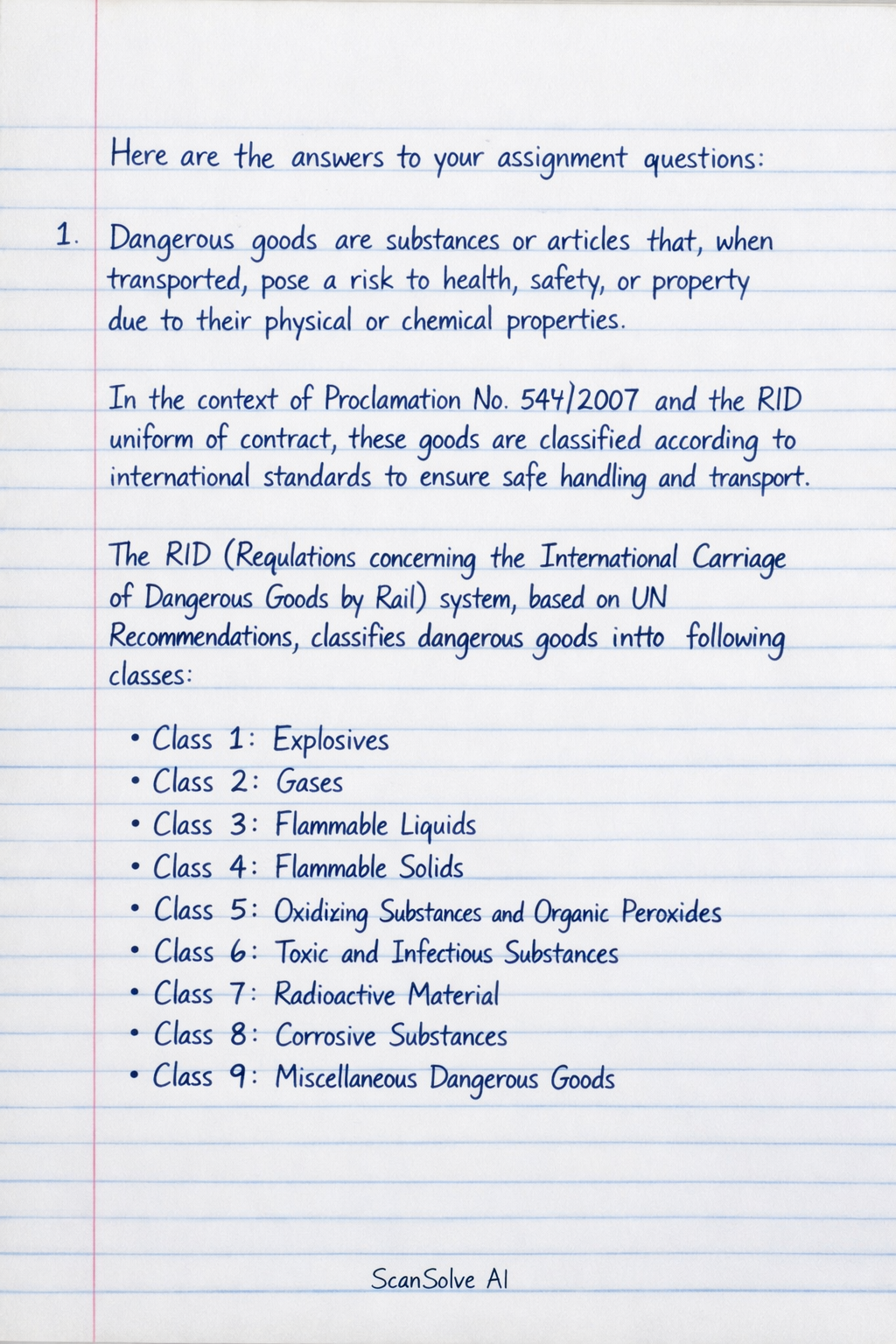
Here are the answers to your assignment questions:
-
Dangerous goods are substances or articles that, when transported, pose a risk to health, safety, or property due to their physical or chemical properties. In the context of Proclamation No. 547/2007 and the RID uniform of contract, these goods are classified according to international standards to ensure safe handling and transport.
The RID (Regulations concerning the International Carriage of Dangerous Goods by Rail) system, based on UN Recommendations, classifies dangerous goods into the following classes:
- Class 1: Explosives
- Examples: Dynamite, Fireworks
- Class 2: Gases
- Examples: Propane, Compressed oxygen
- Class 3: Flammable Liquids
- Examples: Gasoline (petrol), Ethanol
- Class 4.1: Flammable Solids, Self-Reactive Substances, and Solid Desensitized Explosives
- Examples: Matches, Sulfur
- Class 4.2: Substances Liable to Spontaneous Combustion
- Examples: White phosphorus, Charcoal
- Class 4.3: Substances Which, in Contact with Water, Emit Flammable Gases
- Examples: Sodium, Calcium carbide
- Class 5.1: Oxidizing Substances
- Examples: Hydrogen peroxide, Potassium permanganate
- Class 5.2: Organic Peroxides
- Examples: Methyl ethyl ketone peroxide, Benzoyl peroxide
- Class 6.1: Toxic Substances
- Examples: Cyanide, Pesticides
- Class 6.2: Infectious Substances
- Examples: Medical waste, Pathogen samples
- Class 7: Radioactive Material
- Examples: Uranium, Medical isotopes
- Class 8: Corrosive Substances
- Examples: Sulfuric acid, Sodium hydroxide
- Class 9: Miscellaneous Dangerous Substances and Articles
- Examples: Lithium batteries, Dry ice
- Class 1: Explosives
-
The scope of application of Proclamation No. 547/2007 typically covers the carriage of dangerous goods by rail within the jurisdiction, including the classification, packaging, labeling, documentation, loading, unloading, and handling procedures. It aims to regulate all aspects of transporting such goods to prevent accidents and ensure safety for people, property, and the environment.
-
Typically, at least three original copies of the consignment note shall be prepared. These copies are usually distributed to the consignor, the carrier, and the consignee to ensure all parties involved in the transport have a record of the goods and the terms of carriage.
-
If the impossibility of delivery occurs, the carrier shall notify the consignor without delay and request instructions. If instructions are not received within a reasonable time, or if the goods are perishable or dangerous, the carrier may take appropriate measures such as storing the goods, returning them to the consignor, or, under specific conditions, selling or disposing of them.
-
The carrier may sell the goods if conditions such as the goods being perishable, dangerous, or if storage costs are disproportionate to their value are met, and if the consignor fails to provide instructions within a reasonable period after notification. The sale is typically conducted by public auction or, if circumstances warrant, by private sale. The proceeds, after deducting costs, are held for the rightful owner.
-
If the consignor does not inform the carrier about the exact nature of the danger and does not indicate the necessary precautions, the carrier has the right to refuse carriage of the goods. If the goods are already in transit, the carrier may, at any time and place, unload, destroy, or render them harmless without liability, and the consignor shall be liable for all damages and expenses arising from such action.
-
The period of limitation for an action arising out of carriage under the provisions of Proclamation 547/2007 is typically one year. This period shall begin to run from the date the goods were delivered, or in the case of non-delivery, from the date they should have been delivered. For actions related to loss or damage, it usually starts from the date of delivery or the date the goods should have been delivered.
Still stuck on this one?
Ask a follow-up, and the answer starts from this question.
More Law Questions
Handwritten Step-by-Step Solution
Get this as a handwritten image on WhatsApp — like a tutor wrote it for you.
Try on WhatsApp