

This law problem is solved step by step below, with detailed explanations to help you understand the method and arrive at the correct answer.
ScanSolve AI Answer
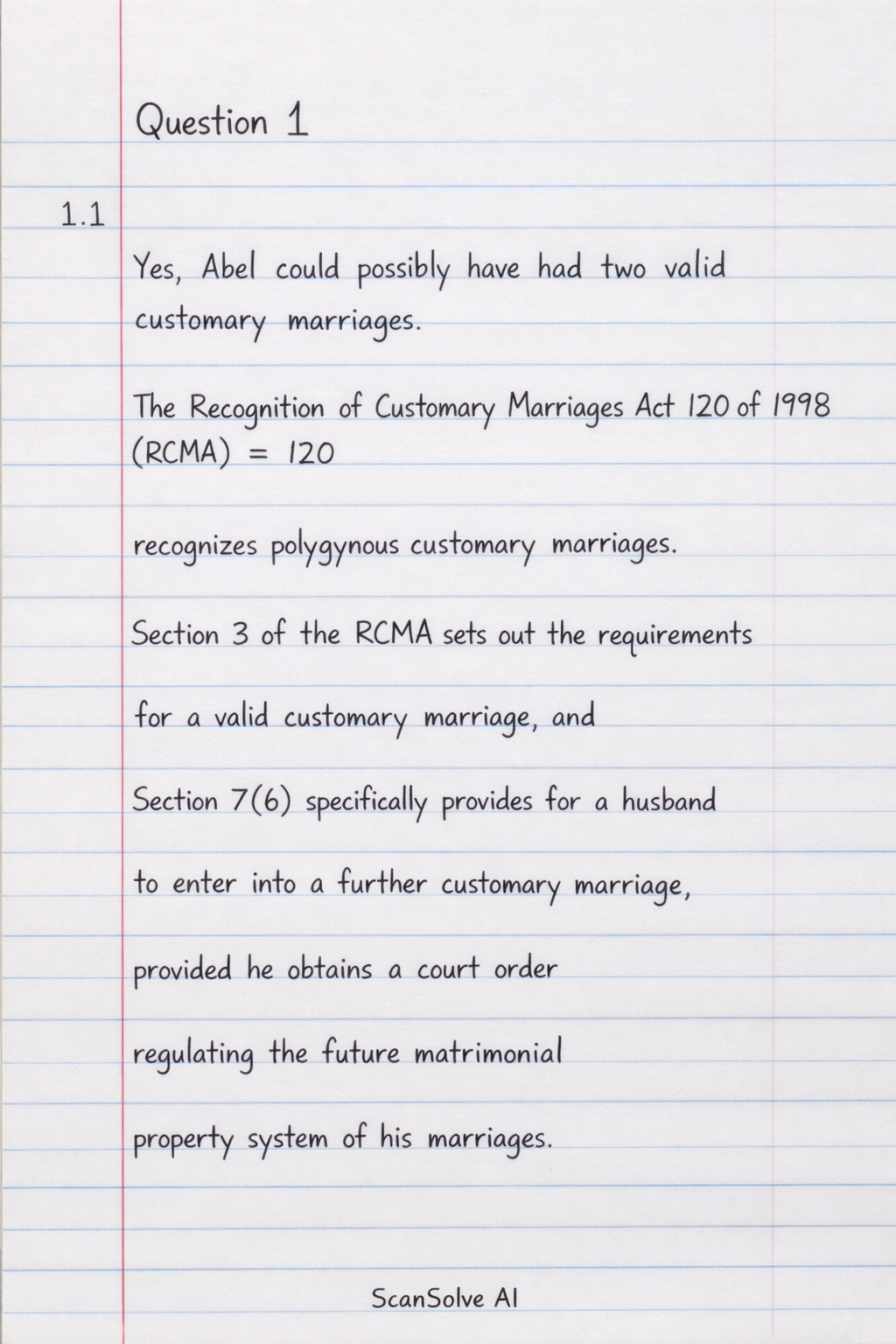
Question 1 1.1 Yes, Abel could possibly have had two valid customary marriages. The Recognition of Customary Marriages Act 120 of 1998 (RCMA) recognizes polygynous customary marriages. Section 3 of the RCMA sets out the requirements for a valid customary marriage, and Section 7(6) specifically provides for a husband to enter into a further customary marriage, provided he obtains a court order regulating the future matrimonial property system of his marriages. 1.2 If Beauty claims Abel never told her about Pumla's marriage and that Tsonga customary law does not recognize further marriages without the senior wife's consent, her position is significant. Section 7(6) of the RCMA requires a husband to apply to court for approval of a written contract regulating the future matrimonial property system of the marriages. The court must consider the interests of all existing spouses. While the RCMA does not explicitly require the consent of the existing wife for a further marriage, her interests must be protected, and she must be involved in the court application process. If Tsonga customary law explicitly prohibits further marriages without the senior wife's consent, this would create a conflict that the court would need to address, potentially impacting the validity of the subsequent marriage if the RCMA's procedural requirements were not met. 1.3 Khumu's non-recognition of the marriages because he never negotiated them might not automatically invalidate them. While negotiation and celebration in accordance with customary law are requirements under Section 3(1)(b) of the RCMA, the primary emphasis is on the consent of the spouses themselves. The extent of family involvement in negotiations can vary between different customary laws, and courts have generally moved towards emphasizing the spouses' consent over strict adherence to all traditional rituals, especially where the core elements like lobolo agreement and integration have occurred. Khumu's objection alone may not be sufficient to invalidate the marriages if other statutory and customary law requirements were met. 1.4 Yes, Beauty's and Pumla's situation could be different if the invalidity stemmed from the non-observance of necessary imvume/ukumekeza traditions. Section 3(1)(b) of the RCMA requires a customary marriage to be "entered into or celebrated in accordance with customary law." The imvume or ukumekeza (integration of the bride into the groom's family) is often considered a crucial and non-negotiable element of the "celebration" of a customary marriage in many customs. If this tradition, which signifies the acceptance of the bride by the groom's family, was not observed, it could lead to the marriage being deemed invalid, depending on the specific customary law applicable and judicial interpretation of its essential requirements. 1.5 Beauty's marriage (lobolo not paid in full): The non-payment of lobolo in full does not necessarily invalidate a customary marriage. Courts have held that an agreement on lobolo and at least partial payment, or an agreement to defer full payment, can be sufficient for a valid customary marriage under the RCMA. Therefore, Qunu's claim regarding incomplete lobolo payment for Beauty's marriage might not succeed in invalidating it. Pumla's marriage (never delivered to groom's family): The non-delivery of Pumla to the groom's family (which relates to the ukumekeza* tradition) is a more significant issue. As discussed in 1.4, the delivery of the bride is often considered a fundamental part of the "celebration" or "entering into" a customary marriage, signifying her integration into the new family. If this essential tradition was entirely omitted, it could lead to the invalidity of Pumla's marriage, depending on the specific customary law applicable. Qunu's claim as descendant: Qunu's claim to be the only descendant from an earlier relationship would be relevant for inheritance purposes, particularly if both Beauty's and Pumla's marriages are found to be invalid. However, the validity of the marriages themselves is determined by the RCMA and applicable customary law, not by Qunu's assertions.