
We read your photo as:
Discuss two possible actions that a community may take to address forced child marriages and describe the roles of traditional and religious leaders in addressing forced marriages and protection of ch
ScanSolve AI Answer
Here are the answers to the questions based on the provided extract:
-
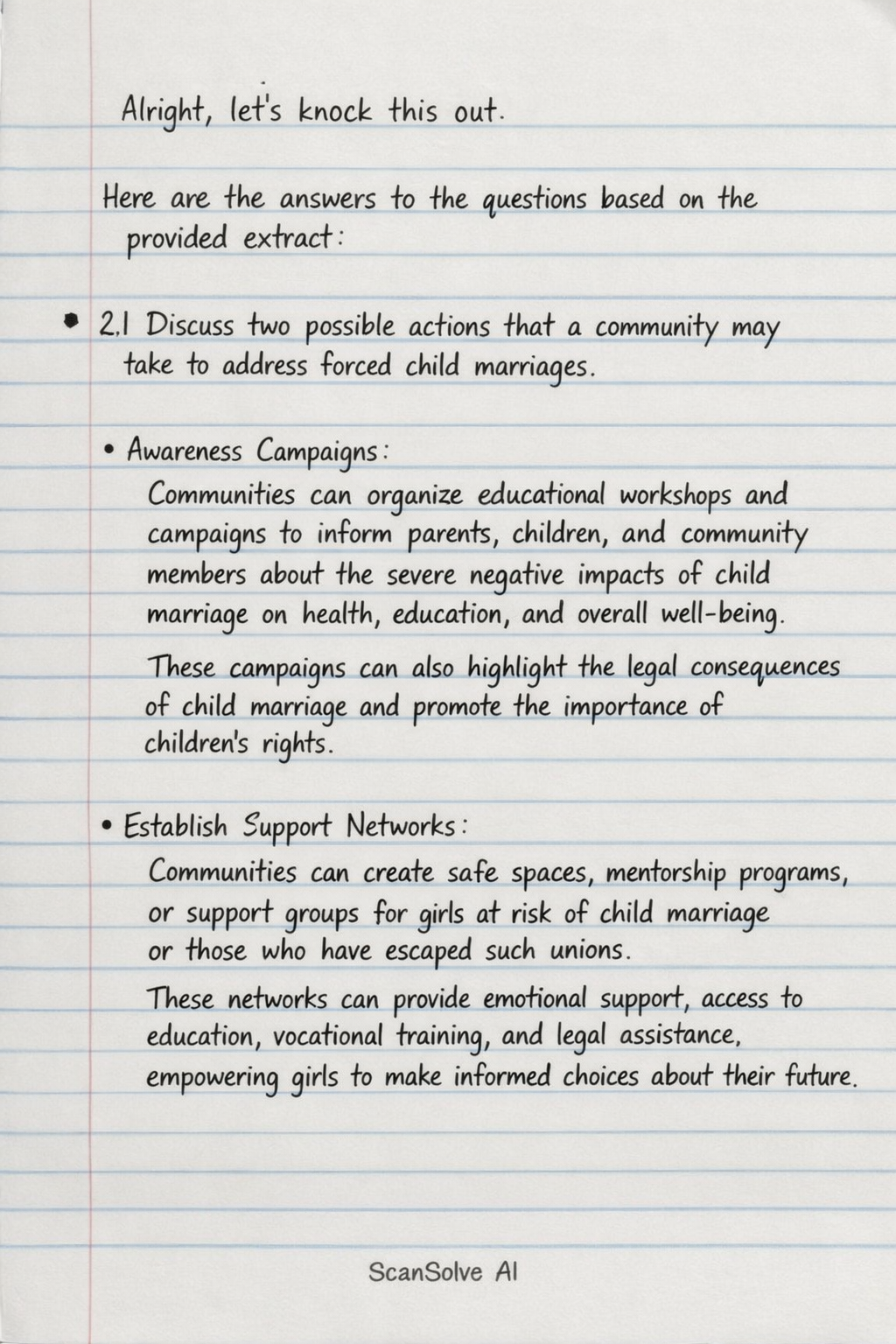
2.1 Discuss two possible actions that a community may take to address forced child marriages.
- Awareness Campaigns: Communities can organize educational workshops and campaigns to inform parents, children, and community members about the severe negative impacts of child marriage on health, education, and overall well-being. These campaigns can also highlight the legal consequences of child marriage and promote the importance of children's rights.
- Establish Support Networks: Communities can create safe spaces, mentorship programs, or support groups for girls at risk of child marriage or those who have escaped such unions. These networks can provide emotional support, access to education, vocational training, and legal assistance, empowering girls to make informed choices about their future.
-
2.2 Describe the roles of traditional and religious leaders in addressing forced marriages and protection of children's rights.
- Traditional Leaders: Traditional leaders hold significant influence and authority within their communities. They can use their position to advocate against forced child marriages by publicly condemning the practice, enforcing customary laws that align with national legislation against child marriage, and mediating family disputes to prevent such unions. They can also promote education for girls and ensure community practices respect children's rights.
- Religious Leaders: Religious leaders can play a crucial role by interpreting religious texts in ways that uphold children's rights and condemn child marriage. They can preach against the practice during sermons, educate their congregations on the harms of child marriage, and refuse to solemnize marriages involving minors. By promoting a rights-based understanding of their faith, they can shift community norms and protect children.
-
2.3 Assess to what extent the Commission for Gender Equality can protect children and minimize forced child marriages in our communities. The Commission for Gender Equality (CGE) can significantly protect children and minimize forced child marriages, but its impact has limitations.
- Protection: The CGE can protect children by investigating complaints of forced child marriage, advocating for victims, and referring cases to relevant law enforcement and social services. It can also monitor the implementation of laws designed to protect children and promote gender equality, ensuring that the state fulfills its obligations.
- Minimization: To minimize forced child marriages, the CGE conducts public awareness campaigns to educate communities about the illegality and harms of the practice. It also advocates for policy and legislative reforms to strengthen protections for children and address the root causes of child marriage, such as poverty and lack of education.
- Extent of Impact: While the CGE has a strong mandate, its effectiveness can be limited by factors such as resource constraints, lack of public awareness of its services, and the deeply entrenched cultural or traditional norms that perpetuate child marriage in some communities. Its role is primarily advocacy, monitoring, and investigation, rather than direct intervention in every case.
Still stuck on this one?
Ask a follow-up, and the answer starts from this question.
More Law Questions
Handwritten Step-by-Step Solution
Get this as a handwritten image on WhatsApp — like a tutor wrote it for you.
Try on WhatsApp