

This law problem is solved step by step below, with detailed explanations to help you understand the method and arrive at the correct answer.
ScanSolve AI Answer
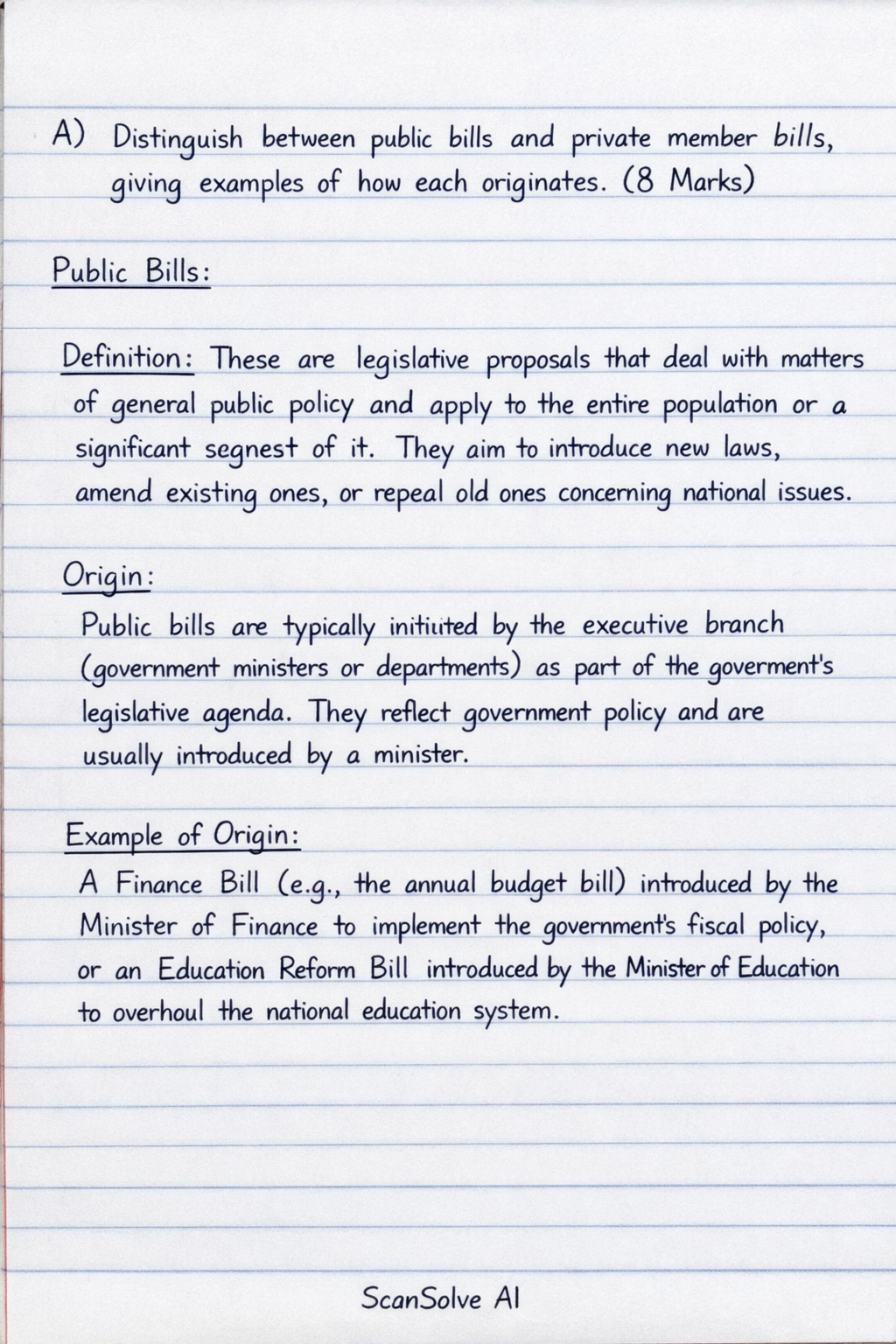
A) Distinguish between public bills and private member bills, giving examples of how each originates. (8 Marks) Public Bills: Definition: These are legislative proposals that deal with matters of general public policy and apply to the entire population or a significant segment of it. They aim to introduce new laws, amend existing ones, or repeal old ones concerning national issues. Origin: Public bills are typically initiated by the executive branch* (government ministers or departments) as part of the government's legislative agenda. They reflect government policy and are usually introduced by a minister. Example of Origin: A Finance Bill (e.g., the annual budget bill) introduced by the Minister of Finance to implement the government's fiscal policy, or an Education Reform Bill* introduced by the Minister of Education to overhaul the national education system. Private Member Bills: Definition: These are legislative proposals introduced by individual legislators (members of parliament/assembly) who are not part of the executive branch (i.e., not ministers). They often address specific issues, local concerns, or matters of conscience that may not be on the government's agenda. Origin: Private member bills originate from the initiative of an individual legislator* who wishes to bring a particular issue to the attention of the legislature and seek its resolution through law. Example of Origin: A bill introduced by a backbench legislator to designate a new national holiday, or a bill to amend a specific section of an environmental protection act* to protect a local ecosystem, proposed by a member representing that constituency. B) Critically assess the role of legislative committees in law-making and oversight. (7 Marks) Legislative committees play a crucial and multifaceted role in both law-making and oversight, acting as the engine room of the legislature. Role in Law-Making: • Detailed Scrutiny: Committees provide a specialized forum for in-depth, clause-by-clause examination of bills, which is impractical in the full legislative chamber. This allows for thorough analysis of proposed legislation. • Expert Input and Public Participation: They conduct public hearings, inviting experts, stakeholders, and the public to provide input, evidence, and diverse perspectives. This enriches the legislative process and ensures that laws are well-informed and responsive to societal needs. • Amendment and Refinement: Committees propose amendments, correct technical flaws, and refine the language of bills, making them more effective, coherent, and implementable. • Specialization: Members of committees often develop expertise in specific policy areas (e.g., finance, health, agriculture), leading to more informed and nuanced legislative decisions. Role in Oversight: • Monitoring Executive Action: Committees monitor the implementation of laws and policies by government ministries, departments, and agencies, ensuring they operate within their mandate and use public funds appropriately. • Investigative Powers: They have powers to conduct investigations into government operations, financial irregularities, and allegations of misconduct, acting as a check on executive power. • Holding Officials Accountable: Ministers and civil servants are frequently called before committees to explain their actions, justify spending, and answer questions, thereby promoting transparency and accountability. • Budgetary Scrutiny: Specialized committees, such as Public Accounts Committees, scrutinize government expenditure and audit reports, ensuring financial probity. Critical Assessment (Strengths and Limitations): Strengths: • Efficiency and Expertise: Committees enable the legislature to handle a large volume of complex legislation and oversight tasks efficiently, leveraging specialized knowledge. • Enhanced Scrutiny: They provide a level of detailed scrutiny that is impossible in plenary sessions, leading to better-quality legislation and more effective oversight. • Democratic Participation: Public hearings offer a vital avenue for citizen engagement and ensure that diverse voices are heard in the legislative process. Limitations: • Party Politics: Committee decisions can often be heavily influenced by party discipline, potentially undermining independent scrutiny and leading to partisan outcomes rather than objective analysis. • Executive Dominance: In systems where the executive branch holds a strong majority, committees may struggle to effectively challenge government proposals or hold ministers accountable, as their recommendations can be overridden. • Resource Constraints: Committees may sometimes lack sufficient staff, research capacity, or time to conduct truly thorough investigations or detailed bill analyses, especially for complex issues. • Information Asymmetry: The executive often possesses more detailed information and technical expertise, which can create an imbalance and make it challenging for committees to fully scrutinize government actions. • Implementation of Recommendations: Committee recommendations are not always binding and may be ignored by the executive or the full chamber, limiting their ultimate impact.