
We read your photo as:
Explain advocacy, list five qualities of an advocator, and outline five forms of advocacy.
ScanSolve AI Answer
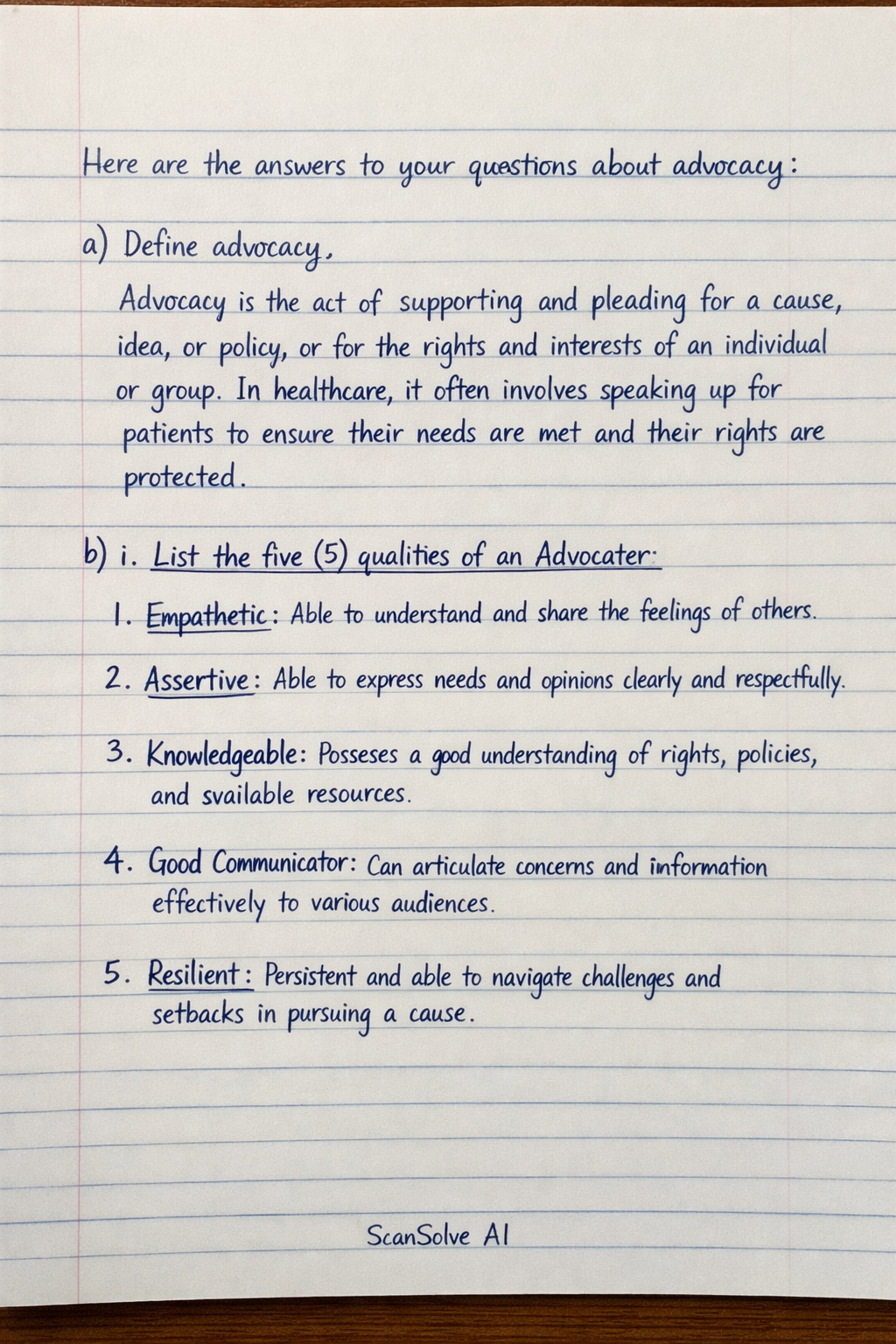
Here are the answers to your questions about advocacy:
a) Define advocacy.
Advocacy is the act of supporting and pleading for a cause, idea, or policy, or for the rights and interests of an individual or group. In healthcare, it often involves speaking up for patients to ensure their needs are met and their rights are protected.
b) i. List the five (5) qualities of an Advocater
- Empathetic: Able to understand and share the feelings of others.
- Assertive: Able to express needs and opinions clearly and respectfully.
- Knowledgeable: Possesses a good understanding of rights, policies, and available resources.
- Good Communicator: Can articulate concerns and information effectively to various audiences.
- Resilient: Persistent and able to navigate challenges and setbacks in pursuing a cause.
ii. Outline any five (5) forms of advocacy
- Self-Advocacy: Individuals speak up for themselves and their own rights and interests.
- Individual Advocacy: An advocate supports a single person to ensure their rights are respected and needs are met.
- Systemic Advocacy: Aims to change laws, policies, or practices that affect a group of people or the entire community.
- Legal Advocacy: Involves using legal processes and the justice system to protect rights and achieve justice.
- Community Advocacy: Mobilizing and empowering a community to address shared issues and bring about collective change.
c) Explain the three (3) Strategies that you would use to advocate for your Subordinates in improving the condition of service with relevant examples.
-
Direct Communication and Negotiation: Engage in direct discussions with management or relevant authorities to present the subordinates' concerns and propose solutions.
- Example: If subordinates are overworked due to understaffing, you would schedule a meeting with the ward manager or hospital administration to present data on workload, patient-to-staff ratios, and the impact on patient care and staff well-being, then negotiate for additional staffing or workload redistribution.
-
Documentation and Evidence Gathering: Collect concrete evidence, data, and testimonials to support the need for improved conditions. This strengthens the case and provides a factual basis for advocacy.
- Example: If subordinates complain about outdated equipment leading to inefficiencies and safety risks, you would document specific incidents, collect maintenance records, gather staff statements on the impact, and research the cost-effectiveness of new equipment versus potential errors or delays caused by old equipment.
-
Coalition Building and Collective Action: Form alliances with other departments, unions, or professional organizations to amplify the voice of subordinates and exert greater influence.
- Example: If subordinates are facing issues with inadequate training opportunities, you could collaborate with nursing educators, other unit supervisors, or the hospital's human resources department to collectively advocate for a standardized, funded professional development program across the institution.
d) State the five (5) principles of advocacy.
- Empowerment: Supporting individuals to speak for themselves and make their own decisions.
- Confidentiality: Maintaining the privacy of the individual or group being advocated for.
- Independence: The advocate acts solely in the best interest of the person or cause, free from conflicts of interest.
- Accountability: The advocate is responsible for their actions and decisions to the person or group they represent.
- Accessibility: Advocacy services should be available and reachable to all who need them.
Still stuck on this one?
Ask a follow-up, and the answer starts from this question.
More Law Questions
Handwritten Step-by-Step Solution
Get this as a handwritten image on WhatsApp — like a tutor wrote it for you.
Try on WhatsApp