
🚨🚨🚨🚨FOOD SCIENCE A LEVEL NW MOCK P1 1. The meal for a patient suffering from goiter should not be lacking in A. Calcium B. Iodine C. Magnesium D. Iron 2. Antibiotics in agriculture helps in A. Soil treatment only B. Animal treatment only C. Water and soil irrigation D. Crops and livestock treatment 3. In the ‘lock and key’ hypothesis on enzyme sensitivity, the enzyme is the A. Key B. Activator C. Lock D. Inhibitor 4. Ideas and beliefs about food that are wrong and can lead to malnutrition are food A. Fallacies B. Taboos C. Habits D. Fads 5. The key difference between the monosaccharide glucose and fructose is A. Sweetness B. Solubility C. Functional group D. Number of carbons 6. HIDL is considered as good cholesterol because A. Carries bad fat from liver to tissues B. Helps in metabolism C. Can be stored D. Carries bad fats from the tissues to the liver 7. A food quality assessment that relies on opinions, feelings and bias to evaluate food is A. Trial test B. Subjective test C. Food test D. Objective test 8. Wet heat on starch will result in A. Gelatinisation B. Caramelisation C. Dextrinisation D. Maillard reaction 9. In order to secure food, the household must A. Buy without planning B. Eat out of season C. Manage total income D. Buy in small quantities 10. A nutrient that is not digested in the alimentary canal is A. Carbohydrates B. Vitamins C. Proteins D. Fats 11. A negative digestive tract reaction to food is known as food A. Allergy B. Sensitivity C. Allergen D. Intolerance 12. Enzymes speed up chemical reactions because they A. reduce the activation energy of the reaction B. are protein in nature C. are affected by pH D. remain unchanged 13. Bouquet garni is A. Bundle of flower B. Cloves of garlic C. Bundle of herbs D. Bundle of leaves 14. In testing for starch, what will be the colour observed if starch is added to iodine and not iodine added to starch? A. Brown B. Blue black C. Yellow D. Orange 15. A restaurant owner intends to boost his meals with antioxidants. Which nutrients is more likely to be added to the meals A. Proteins B. Carbohydrates C. Minerals D. Vitamins 16. A student ate a slice of pizza containing 20g of proteins, 10g of fats and 70g of carbohydrates. What is the total energy generated from the meal? A. 100kcal B. 450kcal C. 190kcal D. 400kcal 17. Which food group helps to insulate the body A. Fruits and vegetables B. Cereals and products C. Fats and oils D. milk, meat and products 18. A nutritional disease caused by high intake of purines in food A. Gout B. Peptic ulcers C. Goitre D. Diabetes 19. Salad dressing is an A. Emulsifying agent B. Thickening agent C. Appetizers D. Emulsion 20. Food laws regulate A. Processing firms only B. Consumption only C. Processing and consumption D. The entire processing chain --- 21. Amino acids that cannot be produced by the body are called: A. Essential amino acids B. Non-essential amino acids C. Available amino acids D. Non-available amino acids 22. Which mineral is responsible for carrying oxygen to body tissues? A. Iodine B. Iron C. Zinc D. Potassium 23. The use of absorbed food for growth and energy is known as: A. Assimilation B. Digestion C. Ejection D. Ingestion 24. Reading labels before buying a food product helps consumers to: A. Waste time B. Understand product quality and safety C. Buy more than needed D. Impress the seller 25. Food quality refers to: A. The colour of food only B. How expensive food is C. The characteristics that make food safe and acceptable D. How attractive food is 26. Food additives that prevent the drying out of food: A. Humectants B. Antioxidants C. Foaming agents D. Stabilizers 27. A condition in which the child’s muscles are wasted due to food shortage is known as: A. Beri beri B. Rickets C. Kwashiorkor D. Marasmus 28. Identify the VITAMIN that can help in the prevention of Rickets: A. Vitamin K B. Vitamin A C. Vitamin D D. Vitamin B 29. The induced-fit model suggests that: A. The enzyme is rigid B. The enzyme changes shape slightly to fit the substrate C. The substrate changes shape to fit the enzyme D. No shape change occurs 30. Emulsifying agents work by: A. Increasing the viscosity of water B. Reducing the surface tension between two liquids C. Dissolving oil in water D. Freezing the mixture 31. Oedema in kwashiorkor occurs because: A. Excess salt is eaten B. The child drinks too much water C. Fat accumulates in the tissues D. Low protein reduces blood osmotic pressure 32. Which factor mainly influences food choices from childhood? A. Family traditions B. Climate C. Agriculture D. Food labels 33. The following are examples of anti-nutrients except: A. Goitrogen B. Phytates C. Amino acids D. Tannins 34. The undesirable changes that occur in lipids during storage that produce disagreeable sensory properties is known as: A. Caramelization B. Rancidity C. Browning D. Denaturation 35. It is a vitamin with strong anti-oxidant effects A. Tocopherol B. Riboflavin C. Calicferol D. Thiamin 36. One of the following is a micro mineral A. Manganese B. Magnesium C. Calcium D. Iron 37. It is an example of a saturated fatty acid A. Steric acid B. Linolenic acid C. Linoleic acid D. Oleic acid 38. The following will respond positively to Fehling’s test except: A. Glucose B. Maltose C. Sucrose D. Galactose 39. The following is not of means of consumers’ education A. Labelling B. Packaging C. Advertisement D. Misbranding 40. The following is NOT a test for proteins A. Million test B. Foam test C. Buriet test D. Sudan III test --- 41. A substance which binds on an enzyme’s active site and prevents the enzyme from carrying out its function is a . A. Prosthetic group B. Competitive inhibitor C. Non-competitive inhibitor D. Cofactor 42. The role of screening in the industrial purification of water is toSoil tre A. Remove large debris B. Absorbs organic compounds and taste-giving molecules C. Remove microorganisms D. Remove salts 43. The process of adding back nutrients into foods that were lost during food processing is called irrigat A. Enrichment B. Enhancement C. Fortification D. Amelioration 44. An example of a chemical method of preserving food isntibioti A. Pasteurization B. Refrigeration C. Irradiation D. Salting 45. Which Agency is responsible for food Quality Control in Cameroon? A. ISO 9001 B. Codex Alimentarius C. WHO/FAO D. ANOR 46. The presence of unwanted substances or organisms in food is called foodent 3. A. Spoilage B. Contamination C. Fortification D. Enrichment 47. An example of a oil-in-water emulsion ism D. Iro A. Margarine B. Achu soup C. Butter D. Creams 48. A body of rules governing the manufacture and sales of food products in a given locality isure help A. Quality control B. Food Standards C. Food laws D. Food Legislation 49. The following is not a cardiovascular disease A. Obesity B. Hypertension C. Stroke D. Heart attack 50. One of the following is a digestive disorder A. Diabetes B. Anaemia C. Stroke D. Diarrhoea
ScanSolve AI Answer
This answer stops before the end.
It was cut off when it was first written. Ask ScanSolve this question again for the full working.
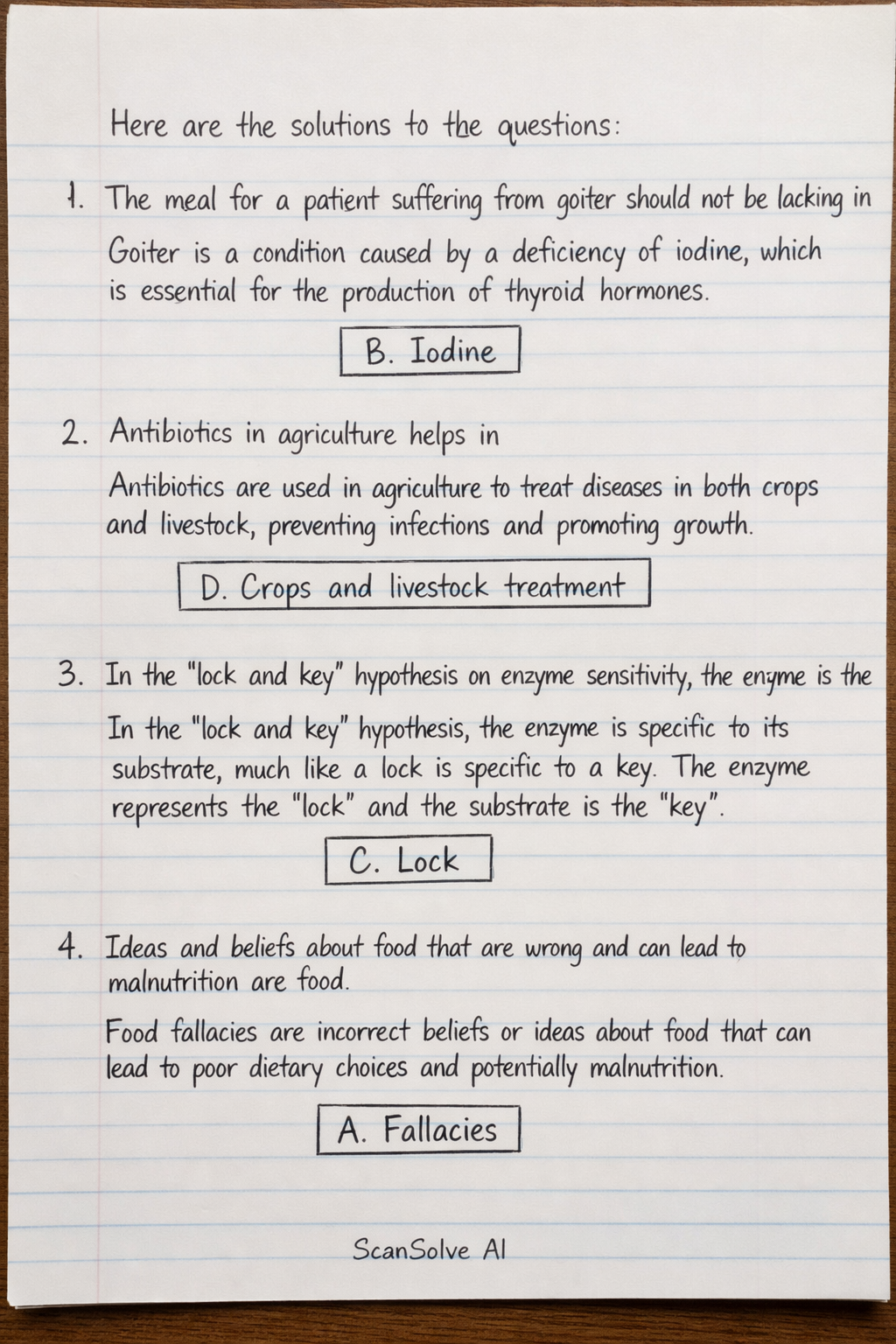
Here are the solutions to the questions:
1. The meal for a patient suffering from goiter should not be lacking in
Goiter is a condition caused by a deficiency of iodine, which is essential for the production of thyroid hormones.
2. Antibiotics in agriculture helps in
Antibiotics are used in agriculture to treat diseases in both crops and livestock, preventing infections and promoting growth.
3. In the ‘lock and key’ hypothesis on enzyme sensitivity, the enzyme is the
In the 'lock and key' hypothesis, the enzyme is specific to its substrate, much like a lock is specific to a key. The enzyme represents the "lock" and the substrate is the "key".
4. Ideas and beliefs about food that are wrong and can lead to malnutrition are food
Food fallacies are incorrect beliefs or ideas about food that can lead to poor dietary choices and potentially malnutrition.
5. The key difference between the monosaccharide glucose and fructose is
Glucose is an aldohexose (contains an aldehyde functional group), while fructose is a ketohexose (contains a ketone functional group). They have the same chemical formula but different structures.
6. HIDL is considered as good cholesterol because
High-Density Lipoprotein (HDL) is considered "good cholesterol" because it helps remove excess cholesterol from the body's tissues and transport it back to the liver for excretion.
7. A food quality assessment that relies on opinions, feelings and bias to evaluate food is
Subjective tests involve human sensory evaluation, which inherently includes personal opinions, feelings, and potential biases.
8. Wet heat on starch will result in
When starch is heated in the presence of water, it absorbs water, swells, and thickens, a process known as gelatinisation.
9. In order to secure food, the household must
Managing total income effectively allows a household to plan and allocate resources for food purchases, ensuring a secure food supply.
10. A nutrient that is not digested in the alimentary canal is
Vitamins are micronutrients that are absorbed directly into the bloodstream without undergoing digestion in the alimentary canal.
11. A negative digestive tract reaction to food is known as food
Food intolerance refers to a negative digestive reaction to a food, often due to the body's inability to properly digest it, rather than an immune response.
12. Enzymes speed up chemical reactions because they
Enzymes act as biological catalysts by lowering the activation energy required for a chemical reaction to occur, thereby speeding up the reaction rate.
13. Bouquet garni is
A bouquet garni is a bundle of herbs, typically tied together with string, used to flavor soups, stews, and stocks.
14. In testing for starch, what will be the colour observed if starch is added to iodine and not iodine added to starch?
Regardless of the order of addition, the presence of starch reacts with iodine to produce a characteristic blue-black color.
15. A restaurant owner intends to boost his meals with antioxidants. Which nutrients is more likely to be added to the meals
Vitamins, particularly Vitamin C (ascorbic acid) and Vitamin E (tocopherol), are well-known for their antioxidant properties.
16. A student ate a slice of pizza containing 20g of proteins, 10g of fats and 70g of carbohydrates. What is the total energy generated from the meal?
Step 1: Calculate energy from proteins.
Step 2: Calculate energy from fats.
Step 3: Calculate energy from carbohydrates.
Step 4: Sum the energies.
17. Which food group helps to insulate the body
Fats and oils provide a layer of insulation under the skin, helping to regulate body temperature and protect against cold.
18. A nutritional disease caused by high intake of purines in food
Gout is a type of arthritis caused by the accumulation of uric acid crystals in the joints, often resulting from a high intake of purine-rich foods.
19. Salad dressing is an
Salad dressing, such as vinaigrette, is typically an emulsion, a mixture of two immiscible liquids (like oil and vinegar) where one is dispersed in the other.
20. Food laws regulate
Food laws are comprehensive regulations that govern the entire processing chain of food, from production and manufacturing to distribution, labeling, and consumption, to ensure safety and quality.
21. Amino acids that cannot be produced by the body are called:
Essential amino acids are those that the human body cannot synthesize on its own and must be obtained through diet.
22. Which mineral is responsible for carrying oxygen to body tissues?
Iron is a crucial component of hemoglobin, the protein in red blood cells responsible for transporting oxygen from the lungs to body tissues.
23. The use of absorbed food for growth and energy is known as:
Assimilation is the process by which absorbed nutrients are incorporated into the body's cells and used for growth, repair, and energy production.
24. Reading labels before buying a food product helps consumers to:
Food labels provide important information about a product's ingredients, nutritional content, allergens, and expiry dates, helping consumers make informed choices about quality and safety.
25. Food quality refers to:
Food quality encompasses all the characteristics of food that make it safe, acceptable, and desirable to consumers, including sensory attributes, nutritional value, and absence of contaminants.
26. Food additives that prevent the drying out of food:
Humectants are food additives that help to retain moisture in food products, preventing them from drying out and maintaining their texture.
27. A condition in which the child’s muscles are wasted due to food shortage is known as:
Marasmus is a severe form of malnutrition characterized by extreme wasting of muscle and fat, resulting from a severe deficiency of calories and protein due to overall food shortage.
28. Identify the VITAMIN that can help in the prevention of Rickets:
Rickets is a bone disease in children caused by a deficiency of Vitamin D, which is essential for calcium absorption and bone mineralization.
Still stuck on this one?
Ask a follow-up, and the answer starts from this question.
More Law Questions
Handwritten Step-by-Step Solution
Get this as a handwritten image on WhatsApp — like a tutor wrote it for you.
Try on WhatsApp