
We read your photo as:
State FOUR ways in which the Bill of Rights assists in preventing human rights violations. Analyse why human rights violations still exist in the country despite various government projects aimed at e
ScanSolve AI Answer
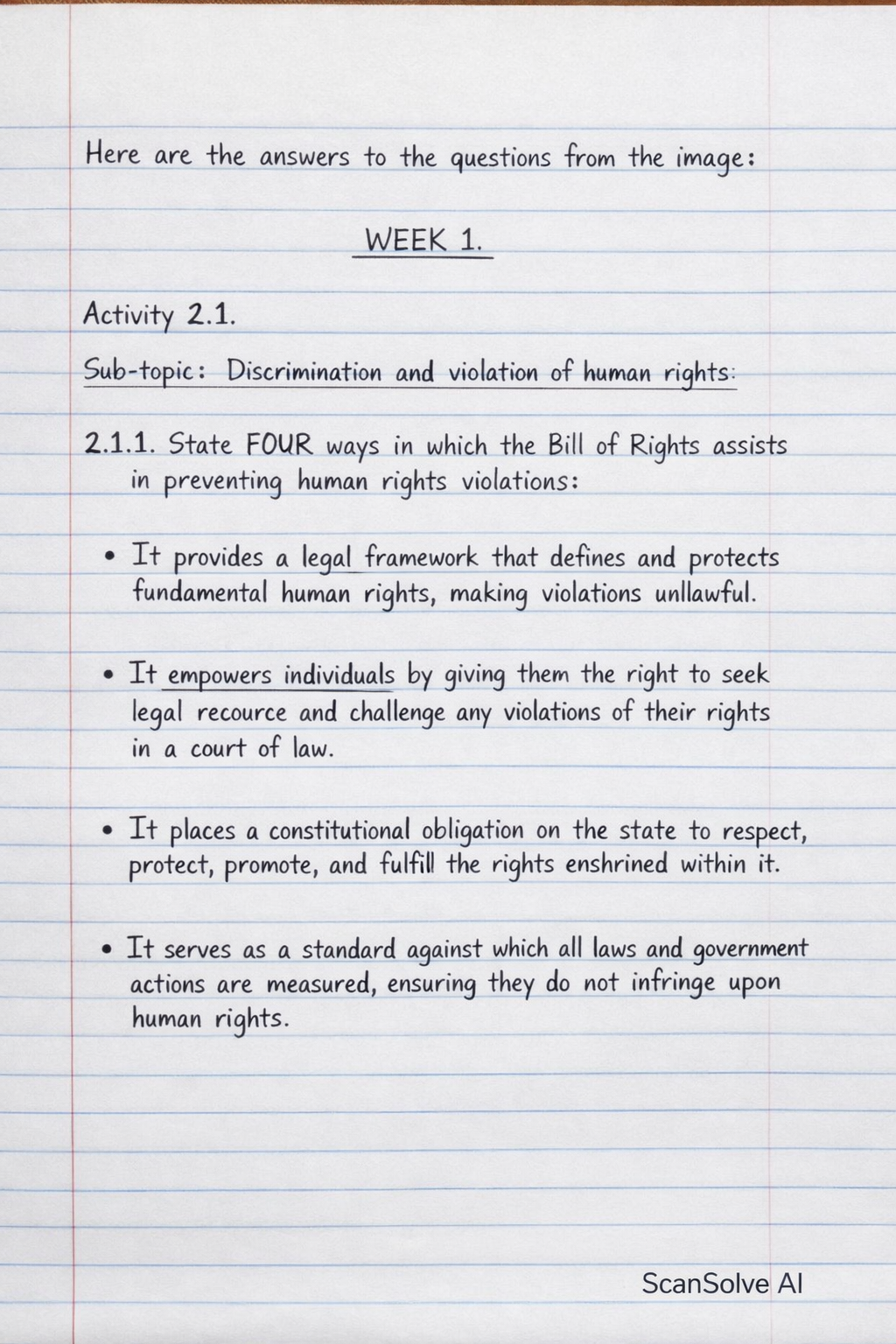
Here are the answers to the questions from the image:
WEEK 1
Activity 2.1
Sub-topic: Discrimination and violation of human rights
-
2.1.1 State FOUR ways in which the Bill of Rights assists in preventing human rights violations.
- It provides a legal framework that defines and protects fundamental human rights, making violations unlawful.
- It empowers individuals by giving them the right to seek legal recourse and challenge any violations of their rights in a court of law.
- It places a constitutional obligation on the state to respect, protect, promote, and fulfill the rights enshrined within it.
- It serves as a standard against which all laws and government actions are measured, ensuring they do not infringe upon human rights.
-
2.1.2 Analyse why human rights violations still exist in the country despite various government projects aimed at eliminating these practices.
- Deep-rooted systemic issues: Historical inequalities, poverty, and lack of access to basic services (like education, healthcare, and housing) persist, creating conditions where human rights violations, such as economic exploitation or lack of dignity, are more likely to occur. Government projects often struggle to address these complex, entrenched problems comprehensively.
- Lack of awareness and education: Many citizens, particularly in marginalized communities, may not be fully aware of their rights or the mechanisms available to report violations. This lack of knowledge can lead to a failure to challenge abuses, allowing violations to continue unchecked despite government efforts.
- Corruption and impunity: In some instances, corruption within state institutions or a lack of accountability for those who commit violations can undermine government projects. When perpetrators are not held responsible, it perpetuates a cycle of abuse and erodes public trust in the justice system.
- Ineffective implementation and monitoring: Government projects, while well-intentioned, may suffer from poor implementation, insufficient funding, or inadequate monitoring and evaluation. This can lead to projects failing to reach their intended beneficiaries or achieve their objectives, allowing human rights violations to persist.
-
2.1.3 Discuss in detail how the youth could contribute to the success of community campaigns intended to promote safe living environments as a basic human right.
- Advocacy and awareness creation: Youth can leverage social media platforms, peer networks, and community events to raise awareness about the importance of safe living environments and human rights. They can share information, personal stories, and calls to action, mobilizing their peers and older generations to participate in campaigns.
- Active participation and volunteering: Young people can actively volunteer in community clean-up initiatives, neighbourhood watch programs, and local safety patrols. Their energy and presence can significantly boost the effectiveness of these campaigns, making communities cleaner, safer, and more vibrant.
- Reporting and monitoring: Youth can play a crucial role in identifying and reporting unsafe conditions, criminal activities, or human rights abuses in their communities to relevant authorities. By being vigilant and using reporting mechanisms, they contribute to data collection that can inform targeted interventions and improve safety.
- Innovation and creative solutions: With their fresh perspectives and digital literacy, youth can develop innovative solutions and creative campaigns to address specific safety challenges. This could include designing educational materials, organizing workshops, or using technology to map unsafe areas and propose improvements.
WEEK 2
Activity 2.2
Sub-topic: The media
-
2.2.1 Give a definition for the term print media and state THREE examples of print media.
- Definition: Print media refers to forms of media that are physically printed on paper and distributed to the public.
- Examples: Newspapers, magazines, and books.
-
2.2.2 Explain TWO ways in which the media could contribute to a democratic society.
- Informing citizens: The media provides essential information about political issues, government policies, elections, and public debates, enabling citizens to make informed decisions and participate meaningfully in the democratic process.
- Holding power accountable: It acts as a watchdog, investigating corruption, scrutinizing government actions, and exposing abuses of power by public officials and institutions, thereby ensuring transparency and accountability.
-
2.2.3 Discuss THREE ways in which the media often fails to fulfill their responsibilities to society.
- Bias and sensationalism: Media outlets sometimes present information in a biased or sensationalized manner to attract viewers or readers, distorting facts and manipulating public opinion rather than providing objective reporting. This can lead to a misinformed populace.
- Lack of in-depth investigative journalism: Due to commercial pressures or resource constraints, some media outlets may shy away from thorough investigative journalism, leading to superficial reporting. This failure to delve deep into complex issues means that important stories of corruption or injustice may go uncovered.
- Commercialization and profit motive: When profit becomes the primary driver, media content can be dictated by what sells rather than what is socially responsible or informative. This can lead to a focus on entertainment over education, or the promotion of certain agendas that benefit advertisers or owners, compromising journalistic integrity.
-
2.2.4 Suggest TWO ways in which media access to different geographical areas such as deep rural areas could be improved. In your answer, also indicate how EACH suggestion could assist to counteract inequalities of access to commercial media.
- Establishment and support of community radio stations:
- Improvement: These stations are locally owned and operated, broadcasting in local languages and focusing on issues relevant to the community. They are often low-cost and accessible via basic radio sets.
- Counteracting inequality: Community radio provides an affordable and culturally relevant alternative to commercial media, which often has limited reach or content tailored for urban audiences. It ensures that local news, public service announcements, and educational content reach those without internet or television.
- Investment in affordable mobile internet infrastructure and public access points:
- Improvement: Expanding mobile network coverage and providing subsidized data plans or free public Wi-Fi hotspots in rural areas would significantly increase access to online news, information, and digital services.
- Counteracting inequality: This bridges the digital divide, allowing rural communities to access a vast array of information beyond traditional commercial media. It provides opportunities for online learning, e-health services, and digital literacy, which are often unavailable through commercial channels due to cost or infrastructure limitations.
- Establishment and support of community radio stations:
-
2.2.5 Evaluate the significance of print media in an advancing digital world.
- Credibility and in-depth analysis: Print media often retains a perception of higher credibility and offers more in-depth analysis compared to the fast-paced, often superficial nature of digital news. For complex topics, many readers still prefer the focused, uninterrupted experience of print.
- Accessibility for non-digital users: In areas with limited internet access or for populations less digitally literate, print media remains a crucial source of information, ensuring that these groups are not excluded from important news and public discourse.
- Tangibility and archival value: Print publications offer a tangible experience that some readers prefer, and they serve as important historical records and archives. Unlike digital content which can be easily altered or deleted, print provides a more permanent record.
- Reduced digital fatigue: In an age of constant digital bombardment, print media offers a break from screens, allowing for a different kind of engagement with information that can reduce digital fatigue.
BIWEEKLY TEST 2.1
- 2.1.1 Responsible citizenship: The active participation of individuals in their community and country, characterized by upholding laws, respecting the rights of others, contributing to the common good, and engaging in civic duties.
- 2.1.2 Discrimination: The unfair or prejudicial treatment of different categories of people or things, especially on the grounds of race, age, sex, disability, religion, or other characteristics, leading to unequal opportunities or outcomes.
- 2.1.3 Human rights: The fundamental rights and freedoms inherent to all human beings, regardless of their nationality, place of residence, sex, national or ethnic origin, colour, religion, language, or any other status, which are universal, inalienable, and interdependent.
- 2.1.4 Bill of Rights: A section of a country's constitution that enumerates the fundamental rights and freedoms guaranteed to its citizens and serves as a supreme law that limits the power of the state, ensuring that all laws and government actions comply with these rights.
Still stuck on this one?
Ask a follow-up, and the answer starts from this question.
More Law Questions
Handwritten Step-by-Step Solution
Get this as a handwritten image on WhatsApp — like a tutor wrote it for you.
Try on WhatsApp