
We read your photo as:
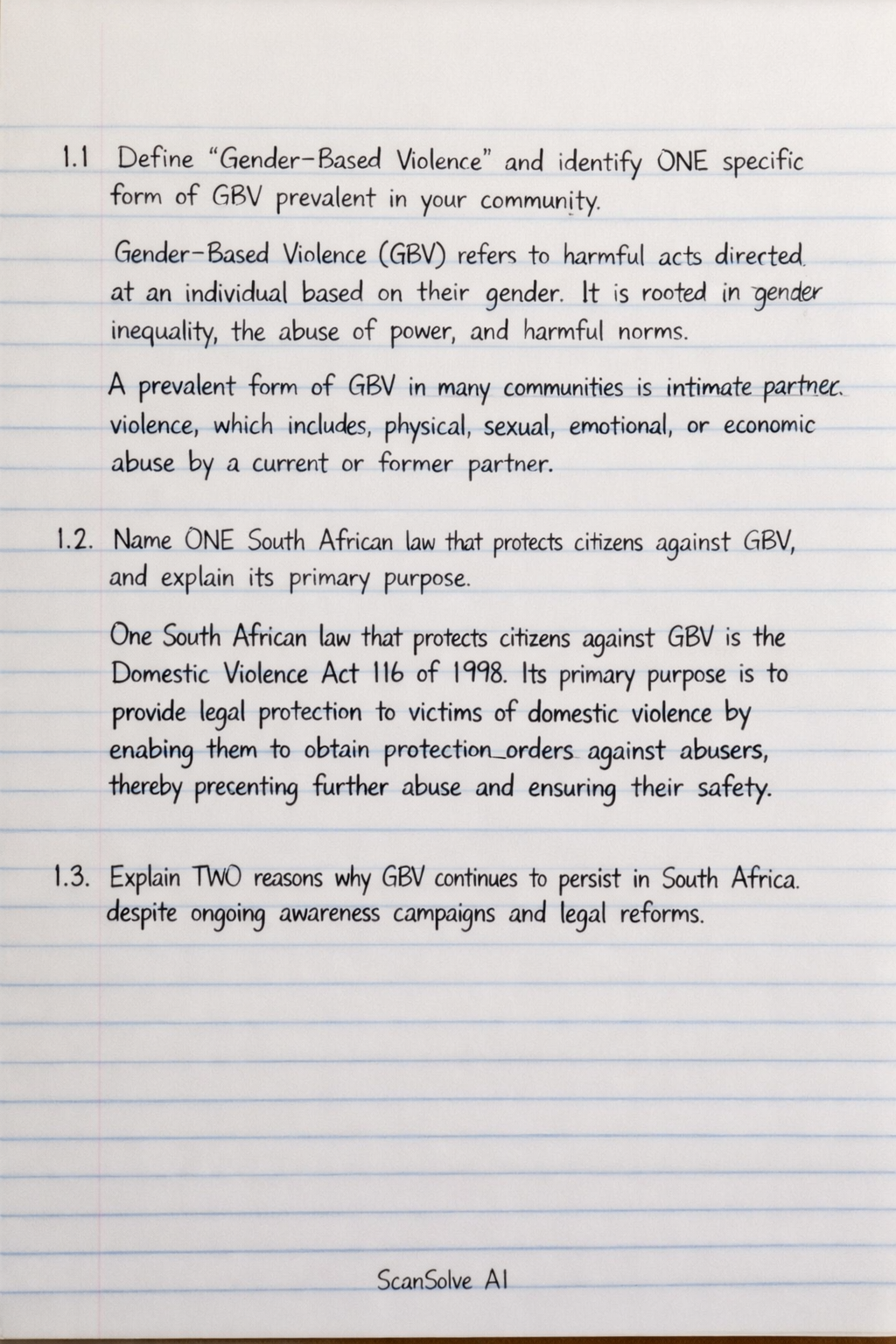
Define 'Gender-Based Violence' and identify ONE specific form of GBV prevalent in your community. Name ONE South African law that protects citizens against GBV, and explain its primary purpose. Explai
ScanSolve AI Answer
1.1 Define 'Gender-Based Violence' and identify ONE specific form of GBV prevalent in your community.
- Gender-Based Violence (GBV) refers to harmful acts directed at an individual based on their gender. It is rooted in gender inequality, the abuse of power, and harmful norms. A prevalent form of GBV in many communities is intimate partner violence, which includes physical, sexual, emotional, or economic abuse by a current or former partner.
1.2 Name ONE South African law that protects citizens against GBV, and explain its primary purpose.
- One South African law that protects citizens against GBV is the Domestic Violence Act 116 of 1998. Its primary purpose is to provide legal protection to victims of domestic violence by enabling them to obtain protection orders against abusers, thereby preventing further abuse and ensuring their safety.
1.3 Explain TWO reasons why GBV continues to persist in South Africa despite ongoing awareness campaigns and legal reforms.
- One reason for the persistence of GBV is deeply entrenched patriarchal norms and traditional gender roles that perpetuate male dominance and justify violence against women. These societal attitudes are difficult to change through campaigns alone. Another reason is the lack of effective implementation and enforcement of existing laws, coupled with systemic failures in the justice system, which often results in low conviction rates and a lack of accountability for perpetrators, thus failing to deter future violence.
2.1 Discuss TWO socio-economic or cultural causes of GBV in the South African context.
- One significant socio-economic cause of GBV in South Africa is poverty and unemployment. Economic dependency often traps individuals, particularly women, in abusive relationships as they lack the financial means to leave. This economic vulnerability can also lead to increased stress and frustration within households, sometimes escalating to violence. A prominent cultural cause is the persistence of harmful traditional practices and patriarchal beliefs that normalize male control over women and children. These beliefs often diminish the value of women and girls, making them more susceptible to violence and less likely to report it due to fear of social stigma or retaliation.
2.2 Explain TWO long-term social effects GBV has on victims and their families.
- One long-term social effect on victims is severe psychological trauma, including chronic depression, anxiety, PTSD, and suicidal ideation. This trauma can impair their ability to form healthy relationships, maintain employment, and participate fully in social life, leading to prolonged isolation and diminished quality of life. For families, especially children exposed to GBV, a significant long-term effect is the intergenerational cycle of violence. Children who witness or experience violence are at a higher risk of perpetrating or becoming victims of violence themselves later in life, perpetuating harmful patterns across generations and disrupting family stability and well-being.
2.3 Critically discuss how local community structures (e.g., NGOs) and the government can better support survivors of violence.
- Local community structures and NGOs can better support survivors by establishing more accessible and culturally sensitive safe houses and shelters, providing comprehensive psychosocial support services like counseling and therapy, and offering legal aid and advocacy to navigate the justice system. They should also focus on economic empowerment programs to help survivors achieve independence. The government can improve support by strengthening the enforcement of existing laws, ensuring quicker and more victim-centric judicial processes, and increasing funding for survivor support services. Additionally, investing in public education campaigns that challenge harmful norms and promote gender equality from an early age can create a more supportive environment for survivors and prevent future violence.
2.4 Evaluate the effectiveness of community-led "Stop GBV" campaigns. How can these be improved to change public attitudes?
- Community-led "Stop GBV" campaigns have shown mixed effectiveness. While they successfully raise awareness and mobilize local action, their impact on deeply ingrained public attitudes can be limited if they do not address the root causes of violence or if messaging is not sustained and consistent. They often empower survivors and foster a sense of collective responsibility, but may struggle to reach resistant segments of the population. To improve these campaigns and change public attitudes, they should adopt a more holistic and long-term approach. This includes engaging men and boys as allies, integrating GBV education into school curricula, utilizing diverse media platforms to reach broader audiences, and collaborating with traditional and religious leaders to challenge harmful norms. Campaigns should also focus on promoting positive masculinities and fostering empathy, moving beyond mere awareness to behavioral change.
Still stuck on this one?
Ask a follow-up, and the answer starts from this question.
More Law Questions
Handwritten Step-by-Step Solution
Get this as a handwritten image on WhatsApp — like a tutor wrote it for you.
Try on WhatsApp