
We read your photo as:
Indicate whether the following statements are TRUE or FALSE regarding negotiable instruments, public law, spontaneous agency, criminal procedure, and criminal attempts. Additionally, list and define t
ScanSolve AI Answer
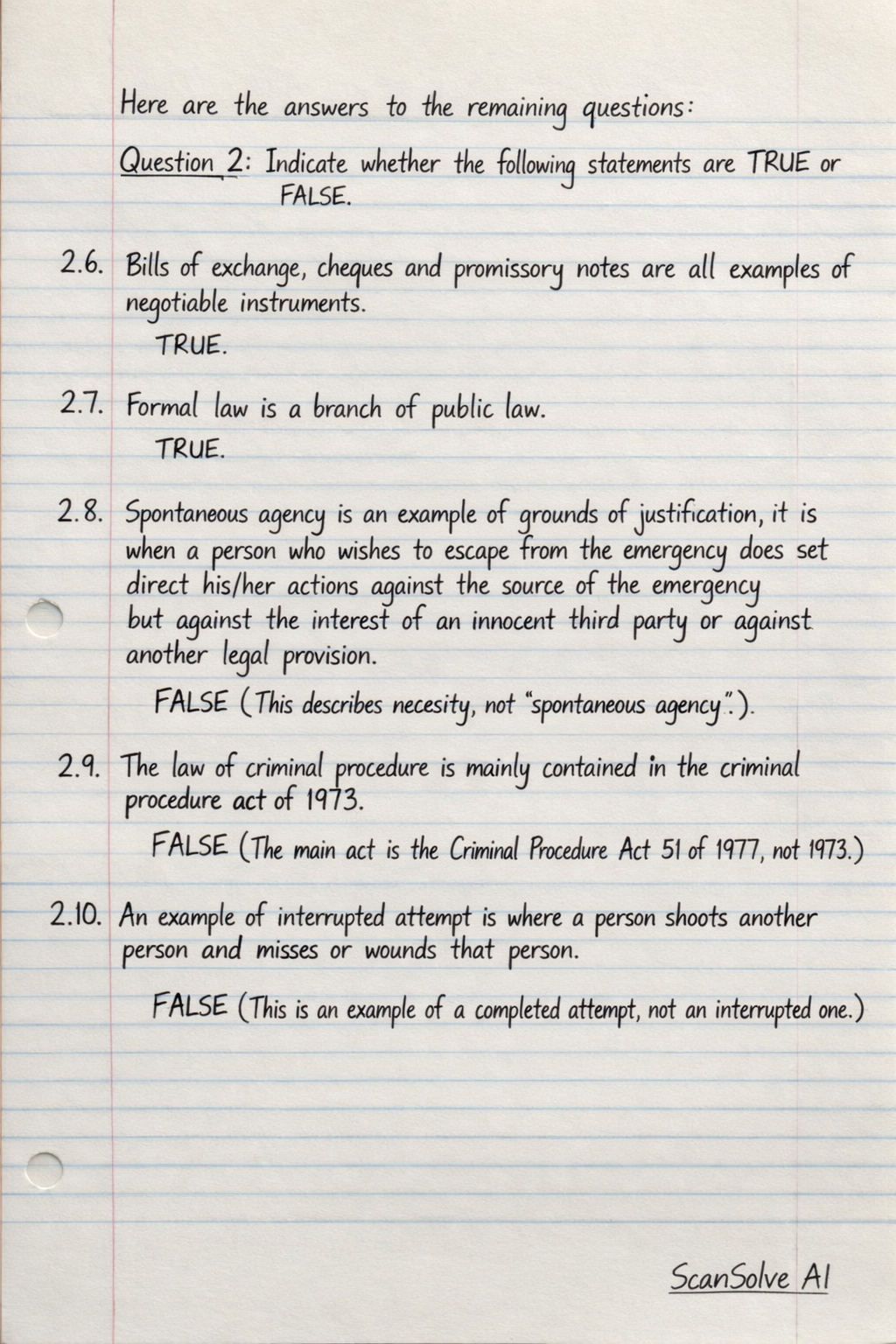
Here are the answers to the remaining questions:
Question 2: Indicate whether the following statements are TRUE or FALSE.
2.6. Bills of exchange, cheques and promissory notes are all examples of negotiable instruments. * TRUE
2.7. Formal law is a branch of public law. * TRUE
2.8. Spontaneous agency is an example of grounds of justification, it is when a person who wishes to escape from the emergency does not direct his/her actions against the source of the emergency but against the interest of an innocent third party or against another legal provision. * FALSE (This describes necessity, not "spontaneous agency".)
2.9. The law of criminal procedure is mainly contained in the criminal procedure act of 1973. * FALSE (The main act is the Criminal Procedure Act 51 of 1977, not 1973.)
2.10. An example of interrupted attempt is where a person shoots another person and misses or wounds that person. * FALSE (This is an example of a completed attempt, not an interrupted one.)
Question 3:
3.1. The law recognizes three types of mental deficiency list and define them. * Mental illness/Insanity: A severe mental disorder that impairs a person's cognitive or volitional faculties to such an extent that they cannot understand the nature of their actions or act in accordance with that understanding. This can affect criminal capacity, contractual capacity, and the ability to litigate. * Intellectual disability: A condition characterized by significant limitations both in intellectual functioning and in adaptive behavior, which originates before the age of 18. Individuals with severe intellectual disability may be deemed incapable of managing their own affairs. * Prodigality: A person who, through a defect in judgment or character, squanders their assets in an irresponsible and extravagant manner, thereby jeopardizing their own or their family's financial well-being. Such a person can be declared a prodigal by a court and placed under curatorship.
3.2. Who is the upper guardian of all children and has greater authority over them than do parents or guardians? * The High Court is the upper guardian of all children.
3.3. There are three types of partnership list them. * Ordinary partnership (or General partnership): All partners are jointly and severally liable for the partnership's debts. * Partnership en commandite: A type of limited partnership where one or more partners (the en commandite partners) are silent partners whose names are not disclosed to third parties, and their liability is limited to their agreed capital contribution. * Special partnership: Similar to a partnership en commandite, but the limited partner's name may be disclosed to third parties, and their liability is limited to their agreed contribution.
Still stuck on this one?
Ask a follow-up, and the answer starts from this question.
More Law Questions
Handwritten Step-by-Step Solution
Get this as a handwritten image on WhatsApp — like a tutor wrote it for you.
Try on WhatsApp