When interpreting a will, which of the following sources may NOT be used?

Law
When interpreting a will, which of the following sources may NOT be used?

ScanSolve AI Answer

Answer

testators join their estates or portions of their estates, with the purpose of disposing of the joint unit in a will and the surviving testator then accepts a benefit in terms of the will.

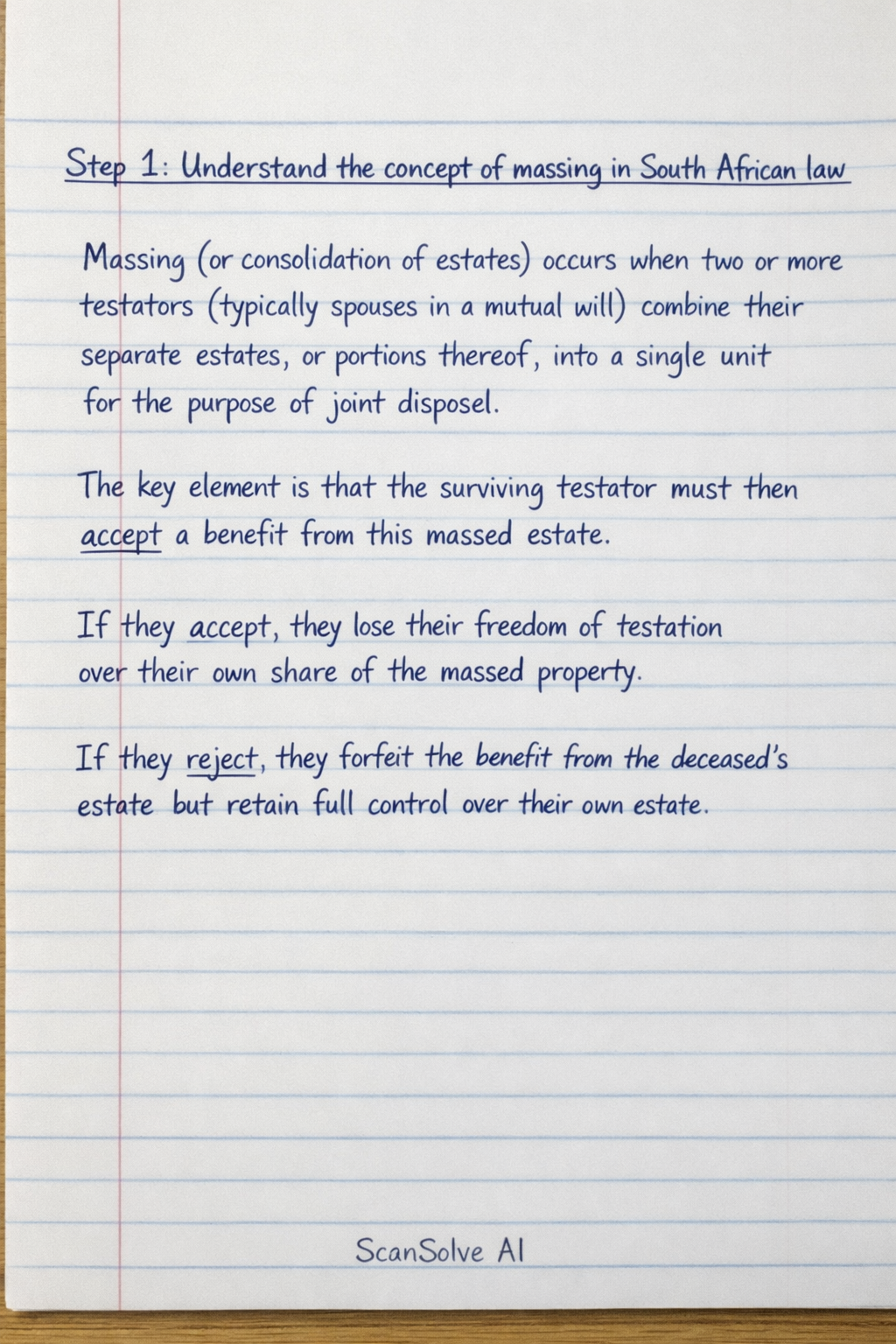
Step 1: Understand the concept of massing in South African law. Massing (or consolidation of estates) occurs when two or more testators (typically spouses in a mutual will) combine their separate estates, or portions thereof, into a single unit for the purpose of joint disposal. The key element is that the surviving testator must then accept a benefit from this massed estate. If they accept, they lose their freedom of testation over their own share of the massed property. If they reject, they forfeit the benefit from the deceased's estate but retain full control over their own estate.

Step 2: Analyze the options in light of Rhode v Stubbs 2005.

  • [1] the surviving testator accepts a benefit in terms of a mutual will, irrespective of the intention of the parties to the mutual will. This is incorrect. The intention of the testators to mass their estates is a crucial prerequisite for massing to occur.
  • [2] a testator in a mutual will disposes of his or her own estate as well as of the estate of the other testator. This describes a characteristic of a mutual will that enables massing, but it doesn't fully explain when massing takes place, particularly the role of the surviving testator's acceptance.
  • [3] testators join their estates or portions of their estates, with the purpose of disposing of the joint unit in a will and the surviving testator then accepts a benefit in terms of the will. This option accurately captures the essential elements of massing: the intention to consolidate estates into a joint unit for disposal, and the subsequent acceptance of a benefit by the surviving testator, which makes the massing legally effective. This aligns with the principles confirmed in Rhode v Stubbs.
  • [4] testators married in community of property mutually benefit each other in a mutual will. While massing often involves spouses married in community of property and mutual benefit, this option is too general and does not describe the specific legal mechanism of massing, which involves the consolidation of estates and the surviving testator's election.

Step 3: Conclude the correct option. Option [3] provides the most comprehensive and accurate description of when massing takes place according to South African law, as affirmed by the case of Rhode v Stubbs.

The correct option is [3]. testatorsjointheirestatesorportionsoftheirestates,withthepurposeofdisposingofthejointunitinawillandthesurvivingtestatorthenacceptsabenefitintermsofthewill.\boxed{testators join their estates or portions of their estates, with the purpose of disposing of the joint unit in a will and the surviving testator then accepts a benefit in terms of the will.} What's next? 📸

Was this helpful?

Need help with your own homework?

Get instant step-by-step solutions to any question. Free to start.

Ask Your Question
Handwritten step-by-step solution preview

Handwritten Step-by-Step Solution

Get this as a handwritten image on WhatsApp — like a tutor wrote it for you.

Try on WhatsApp

Still have questions?

Quick Answer

Understand the concept of massing in South African law.

When interpreting a will, which of the following sources may NOT be used?
Law

This law problem is solved step by step below, with detailed explanations to help you understand the method and arrive at the correct answer.

ScanSolve AI Answer
Step 1: Understand the concept of massing in South African law. Massing (or consolidation of estates) occurs when two or more testators (typically spouses in a mutual will) combine their separate estates, or portions thereof, into a single unit for the purpose of joint disposal. The key element is that the surviving testator must then accept a benefit from this massed estate. If they accept, they lose their freedom of testation over their own share of the massed property. If they reject, they forfeit the benefit from the deceased's estate but retain full control over their own estate. Step 2: Analyze the options in light of Rhode v Stubbs 2005. [1] the surviving testator accepts a benefit in terms of a mutual will, irrespective of the intention of the parties to the mutual will. This is incorrect. The intention of the testators to mass their estates is a crucial prerequisite for massing to occur. [2] a testator in a mutual will disposes of his or her own estate as well as of the estate of the other testator. This describes a characteristic of a mutual will that enables massing, but it doesn't fully explain when* massing takes place, particularly the role of the surviving testator's acceptance. [3] testators join their estates or portions of their estates, with the purpose of disposing of the joint unit in a will and the surviving testator then accepts a benefit in terms of the will. This option accurately captures the essential elements of massing: the intention to consolidate estates into a joint unit for disposal, and the subsequent acceptance of a benefit by the surviving testator, which makes the massing legally effective. This aligns with the principles confirmed in Rhode v Stubbs*. [4] testators married in community of property mutually benefit each other in a mutual will. While massing often involves spouses married in community of property and mutual benefit, this option is too general and does not describe the specific legal mechanism of massing, which involves the consolidation of estates and the surviving testator's election. Step 3: Conclude the correct option. Option [3] provides the most comprehensive and accurate description of when massing takes place according to South African law, as affirmed by the case of Rhode v Stubbs. The correct option is [3]. testators join their estates or portions of their estates, with the purpose of disposing of the joint unit in a will and the surviving testator then accepts a benefit in terms of the will. What's next? 📸