

This law problem is solved step by step below, with detailed explanations to help you understand the method and arrive at the correct answer.
ScanSolve AI Answer
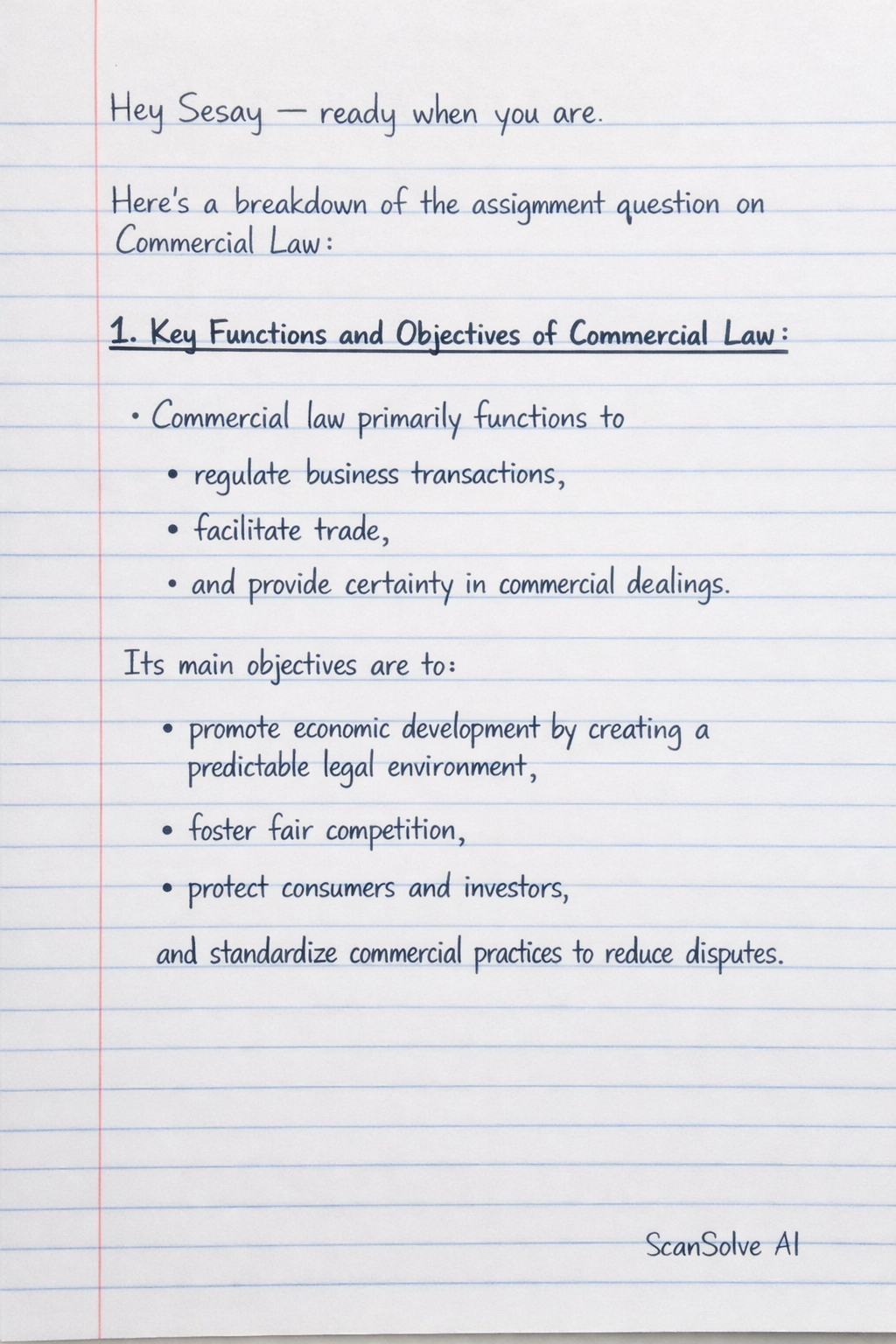
Hey Sesay — ready when you are. Here's a breakdown of the assignment question on Commercial Law: 1. Key Functions and Objectives of Commercial Law: Commercial law primarily functions to regulate business transactions, facilitate trade, and provide certainty in commercial dealings. Its main objectives are to promote economic development by creating a predictable legal environment, foster fair competition, protect consumers and investors, and standardize commercial practices to reduce disputes. 2. Five Major Challenges Affecting Commercial Law: Outdated Legal Frameworks: Many commercial laws in common law jurisdictions, including Sierra Leone, are based on colonial statutes that may not adequately address modern business practices like e-commerce, digital contracts, or intellectual property in the digital age. This creates legal gaps and uncertainty. Weak Enforcement and Judicial Capacity: Inadequate judicial training, insufficient resources for commercial courts, and issues of corruption can lead to slow dispute resolution, inconsistent judgments, and a lack of confidence in the legal system. This undermines the effectiveness of commercial law. Lack of Harmonization: Different commercial laws and regulations across various jurisdictions (even within a region like ECOWAS) create complexities for cross-border trade and investment. Businesses face higher compliance costs and legal risks when operating internationally. Limited Access to Justice: The high cost of litigation, geographical barriers to legal services, and a lack of awareness about legal rights and remedies often prevent small and medium-sized enterprises (SMEs) and individuals from effectively utilizing commercial law to protect their interests. Dominance of the Informal Sector: A significant portion of economic activity in many developing common law countries, including Sierra Leone, occurs in the informal sector. These businesses often operate outside formal legal structures, making it challenging for commercial law to regulate their activities, enforce contracts, or ensure compliance with standards. 3. Illustration with Examples (Sierra Leone/Common Law Jurisdictions): Outdated Laws: Sierra Leone's Companies Act, while updated, still faces challenges in fully integrating provisions for digital-first businesses compared to more advanced common law jurisdictions. Weak Enforcement: Delays in commercial court proceedings are a common issue in many African common law nations, including Sierra Leone, where cases can drag on for years, hindering business operations and investment. Lack of Harmonization: A business operating in Sierra Leone and then expanding to Ghana (both common law) might encounter different company registration requirements or contract enforcement nuances, despite both being in ECOWAS. Limited Access to Justice: A small vendor in Freetown might find the legal fees for pursuing a breach of contract case prohibitively expensive, effectively denying them justice. Informal Sector: The vibrant street markets in Sierra Leone largely operate without formal contracts or adherence to commercial regulations, making it difficult to apply commercial law principles. 4. Practical Legal and Institutional Reforms: Legal Reforms: Modernize commercial statutes to incorporate digital economy aspects (e.g., e-commerce laws, digital signatures). Simplify complex regulations and promote regional harmonization of commercial laws to facilitate cross-border trade. Institutional Reforms: Strengthen judicial capacity through specialized training for commercial court judges and staff. Establish dedicated, well-resourced commercial courts. Promote and support Alternative Dispute Resolution (ADR) mechanisms like mediation and arbitration to offer faster, more cost-effective dispute resolution. Implement anti-corruption measures within the judiciary and regulatory bodies. Practical Reforms: Increase legal aid services for SMEs. Launch public awareness campaigns to educate businesses on commercial law. Develop policies to incentivize and facilitate the formalization of informal businesses, integrating them into the regulated economy. What's next?