
We read your photo as:
Explain the meaning of due process.
ScanSolve AI Answer
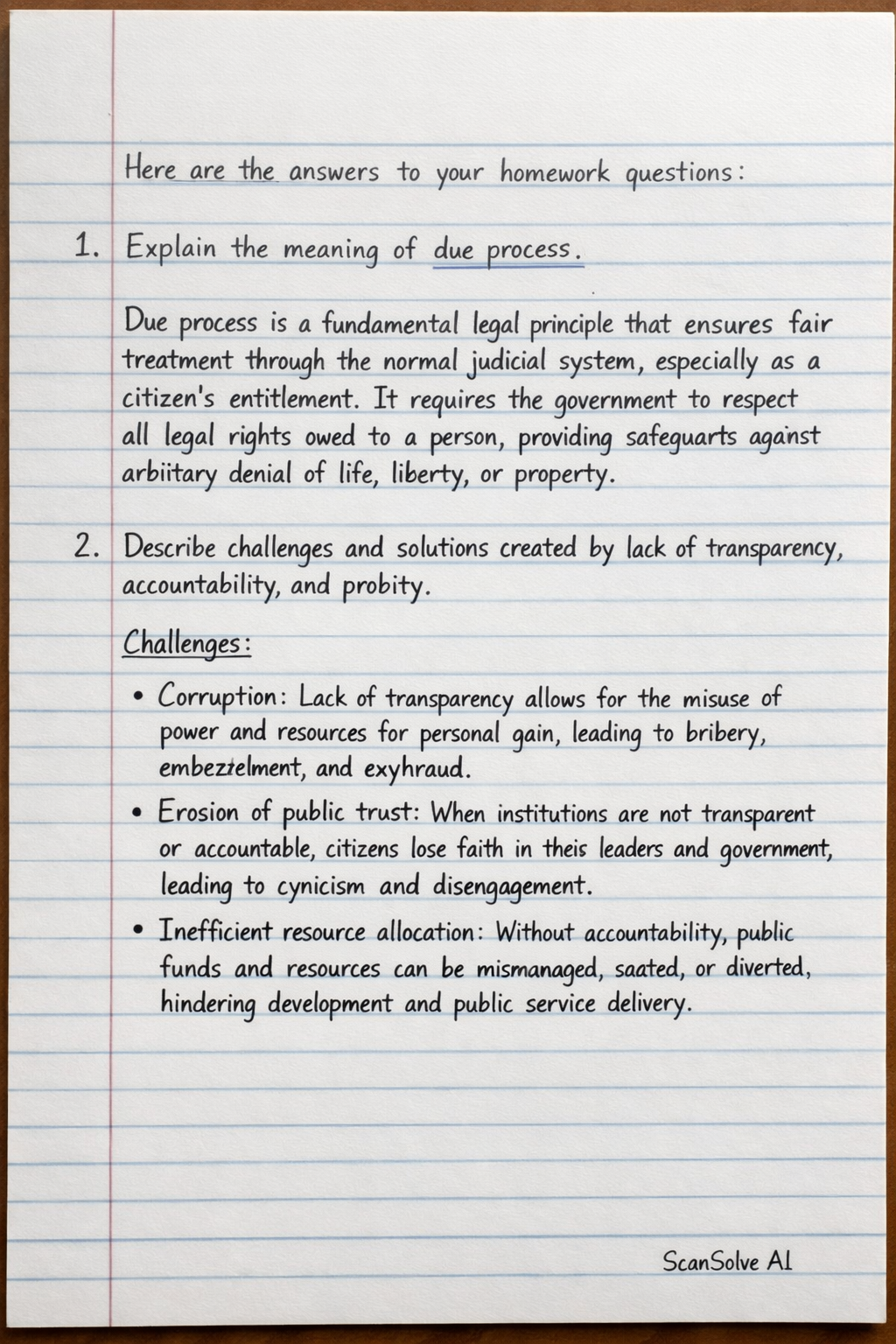
Here are the answers to your homework questions:
-
Explain the meaning of due process. Due process is a fundamental legal principle that ensures fair treatment through the normal judicial system, especially as a citizen's entitlement. It requires the government to respect all legal rights owed to a person, providing safeguards against arbitrary denial of life, liberty, or property.
-
Describe challenges and solutions created by lack of transparency, accountability, and probity.
- Challenges:
- Corruption: Lack of transparency allows for the misuse of power and resources for personal gain, leading to bribery, embezzlement, and fraud.
- Erosion of public trust: When institutions are not transparent or accountable, citizens lose faith in their leaders and government, leading to cynicism and disengagement.
- Inefficient resource allocation: Without accountability, public funds and resources can be mismanaged, wasted, or diverted, hindering development and public service delivery.
- Poor governance: Decisions may be made without public input, oversight, or adherence to ethical standards, resulting in policies that do not serve the public interest.
- Solutions:
- Strengthening legal and regulatory frameworks: Enacting and enforcing laws that promote transparency, combat corruption, and ensure accountability.
- Establishing independent oversight bodies: Creating institutions like anti-corruption commissions, ombudsmen, and audit offices to monitor government actions.
- Promoting public access to information: Implementing Freedom of Information (FOI) laws to allow citizens to scrutinize government data and decisions.
- Encouraging whistleblower protection: Safeguarding individuals who report misconduct to foster a culture of integrity.
- Challenges:
-
Write three solutions to the problems of lack of transparency, accountability, and probity.
- Enacting and enforcing robust anti-corruption laws: This provides a legal framework to deter and punish corrupt practices, ensuring that those who act without probity face consequences.
- Establishing independent oversight institutions: Creating bodies such as anti-corruption agencies, ombudsmen, and independent audit offices to monitor government activities and hold officials accountable for their actions.
- Implementing and strengthening Freedom of Information (FOI) laws: These laws empower citizens to access government data and records, promoting transparency by allowing public scrutiny of decision-making and resource management.
Still stuck on this one?
Ask a follow-up, and the answer starts from this question.
More Law Questions
Handwritten Step-by-Step Solution
Get this as a handwritten image on WhatsApp — like a tutor wrote it for you.
Try on WhatsApp