
Which of the following is a primary feature of clubs? A) Mandatory membership requirements for all members B) Bringing individuals with common interests together C) Exclusively offering professional services D) Limiting participation to specific geographic areas What is a key characteristic of equity clubs? A) Ownership is vested in an external corporation B) Members have voting rights and influence over decisions C) Membership fees are the only financial obligation D) Members have no control over the club’s governance Which of the following is NOT a common activity in clubs? A) Social events B) Competitions and tournaments C) Running a business for profit D) Skill-building programs What is a unique feature of non-equity clubs? A) Members hold equity stakes in the club B) Members participate in decision-making processes C) Members pay regular dues but have no ownership rights D) Members are required to invest large sums of money Which type of club is most likely to offer a golf course and tennis facilities? A) City Club B) Athletic Club C) Country Club D) Social Club Which club type focuses primarily on fitness and physical activities? A) Professional Club B) Service Club C) Athletic Club D) Special Interest Club In which type of club would members most likely be involved in community service or charity work? A) Special Interest Club B) Service Club C) Country Club D) Social Club What defines a professional club? A) Focuses on fitness and wellness B) Offers a platform for career networking and industry-specific knowledge C) Primarily centered around hobbyist activities D) Organized around charitable community projects Which of the following is an example of a facility typically found in a country club? A) Conference rooms for business meetings B) Tennis courts and golf courses C) Fitness centers with gyms and yoga studios D) Community service project spaces What is a key difference between equity clubs and non-equity clubs? A) Equity clubs are more profit-driven than non-equity clubs B) Non-equity clubs are owned by members, while equity clubs are owned by an external entity C) Non-equity clubs provide more control to members than equity clubs D) Equity clubs give members ownership and decision-making power, while non-equity clubs do not Which membership category provides unlimited access to the club's core facilities, such as gyms, pools, and golf courses? A) Junior/Young Professional Membership B) Family Membership C) Full Membership D) Social Membership What is a primary feature of Junior/Young Professional Membership? A) No age restrictions B) Reduced fees for younger individuals C) Access to all sports facilities D) Family-focused amenities Which membership category is designed for households that want to enjoy the club's facilities together at a better value? A) Corporate Membership B) Family Membership C) Social Membership D) Seasonal/Temporary Membership Corporate memberships are primarily designed for: A) Individuals who want to socialize B) Businesses or organizations looking to offer benefits to employees or clients C) Members looking for temporary access D) People who are mainly interested in fitness activities What is the main focus of Social Memberships? A) Access to fitness and sports facilities B) Social interaction and attending events like dinners and wine-tasting C) Professional networking D) Family activities What is a key characteristic of Seasonal/Temporary Memberships? A) They are permanent and last for a year or more B) They are tailored to tourists or people on temporary assignments C) They offer full access to all club facilities D) They are only available to corporate clients Which membership type allows members to access facilities of other clubs within a network, often internationally? A) Full Membership B) Junior/Young Professional Membership C) Reciprocity Agreement D) Family Membership Which is NOT typically part of the membership selection process for clubs? A) Application Submission B) Member Interview C) Payment of Membership Fees Before Approval D) Review by Membership Committee Which disciplinary measure is typically used for less serious infractions, like improper attire? A) Expulsion B) Suspension C) Verbal or Written Warning D) Mediation or Arbitration What is one-way clubs ensure fairness in their disciplinary actions? A) Expelling members immediately for any infraction B) Having an appeals process for members to challenge decisions C) Making all disciplinary actions public D) Ignoring minor infractions to avoid conflict Which of the following is a key component of a leadership framework? A) Financial Management B) Team Building C) Marketing Strategies D) Legal Compliance What is the primary focus of transformational leadership? A) Task efficiency B) Visionary thinking and personal development C) Control and discipline D) Maintaining the status quo According to the contingency theory, effective leadership depends on: A) A leader’s innate traits B) The leader’s ability to control members C) Situational factors and the characteristics of the followers D) Rigid, task-oriented management Which leadership theory emphasizes that leadership qualities can be learned and developed through experience? A) Trait Theory B) Behavioral Theory C) Armchair Theory D) Contingency Theory Which of the following traits is emphasized in the trait theory of leadership? A) Efficiency B) Integrity C) Technical skills D) Decision-making abilities What does a club leader need to establish to inspire and motivate members toward a common goal? A) Clear Vision B) Strict Rules C) High Membership Fees D) Competitive Goals In which leadership style does the leader prioritize building relationships and supporting team members’ well-being? A) Task-Oriented Leadership B) Relationship-Oriented Leadership C) Directive Leadership D) Participative Leadership Which leadership theory suggests that leadership is dependent on the situation and must adapt accordingly? A) Transformational Leadership B) Contingency Theory C) Trait Theory D) Armchair Theory What is the role of communication in effective leadership? A) To maintain a strict hierarchy B) To inform and align members with the club's goals C) To focus on task execution alone D) To manage conflict within the club Which of the following is a characteristic of transformational leaders? A) Maintaining the status quo B) Encouraging innovation and change C) Focusing only on financial success D) Prioritizing administrative tasks 31. Which type of power is derived from the leader’s formal position or authority within an organization? A) Expert Power B) Legitimate Power C) Coercive Power D) Referent Power What is the primary role of a leader in managing group behavior? A) To control every aspect of the group’s actions B) To recognize and navigate group dynamics to promote teamwork C) To punish members who do not comply D) To ensure group norms are strictly enforced Which leadership style is characterized by making decisions unilaterally with minimal input from followers? A) Democratic Leadership B) Autocratic Leadership C) Laissez-Faire Leadership D) Transformational Leadership What is the main characteristic of "coercive power" in leadership? A) Offering rewards for compliance B) Influencing others through the threat of punishment C) Motivating followers through knowledge D) Inspiring loyalty through personal qualities Which leadership style allows followers a high degree of freedom in decision-making and task execution? A) Autocratic Leadership B) Laissez-Faire Leadership C) Democratic Leadership D) Directive Leadership What does "time lag" refer to in leadership? A) The immediate results following a leader’s decision B) The delay between a leader's actions or decisions and their observable effects C) The time taken to train new leaders D) The amount of time a leader spends delegating tasks Which of the following is a key leadership skill that involves understanding and empathizing with the feelings of others? A) Problem-Solving B) Influence C) Empathy D) Communication What is the primary purpose of a leader’s philosophy? A) To gain more power and control over followers B) To provide consistency and direction to their team C) To ensure that leaders always make the best decisions D) To increase the followers' productivity Which type of power relies on the leader’s specialized knowledge or expertise in a particular area? A) Reward Power B) Expert Power C) Coercive Power D) Referent Power Which of the following is a leadership skill that involves making complex decisions that affect the group or organization? A) Influence B) Problem-Solving C) Decision-Making D) Communication What is the primary focus of Expectancy Theory? A) Individuals are motivated by intrinsic values alone. B) Motivation is driven by expectations about the relationship between effort, performance, and rewards. C) Motivation is based solely on social connections. D) Motivation is primarily affected by organizational culture. Which of the following is NOT a factor in Expectancy Theory? Expectancy Instrumentality Motivation D) Valence According to Path-Goal Theory, how can leaders enhance motivation and performance? A) By giving all employees the same type of rewards B) By eliminating obstacles, offering clear direction, and adapting leadership styles C) By focusing only on high-performing employees D) By avoiding any form of reward or recognition Maslow's Hierarchy of Needs suggests that individuals must satisfy which type of needs first? A) Esteem Needs B) Safety Needs C) Physiological Needs D) Self-Actualization Needs Which level of Maslow’s Hierarchy of Needs involves the desire for personal growth and self-fulfillment? A) Love and Belongingness Needs B) Self-Actualization Needs C) Esteem Needs D) Physiological Needs In Herzberg’s Two-Factor Theory, which factors lead to higher levels of motivation and job satisfaction? A) Hygiene Factors B) Motivators C) Financial Rewards D) Work-Life Bal
ScanSolve AI Answer
Here are the answers to your questions:
-
B) Bringing individuals with common interests together Clubs are fundamentally about connecting people who share similar interests, hobbies, or goals.
-
B) Members have voting rights and influence over decisions In equity clubs, members are owners and therefore have a say in the club's governance and operations.
-
C) Running a business for profit While clubs may generate revenue to cover operational costs, their primary purpose is typically not to run a business for profit, but rather to serve their members' interests.
-
C) Members pay regular dues but have no ownership rights Non-equity clubs are owned by an external entity (like a corporation or individual), and members pay fees for access but do not hold equity.
-
C) Country Club Country clubs are known for offering extensive recreational facilities, including golf courses and tennis courts, often in a suburban or rural setting.
-
C) Athletic Club Athletic clubs specifically focus on promoting physical fitness and offer facilities like gyms, pools, and courts for various sports.
-
B) Service Club Service clubs, such as Rotary or Lions clubs, are dedicated to community service, charity work, and philanthropic activities.
-
B) Offers a platform for career networking and industry-specific knowledge Professional clubs cater to individuals within a specific profession, providing opportunities for networking, professional development, and sharing industry insights.
-
B) Tennis courts and golf courses Country clubs are characterized by their extensive outdoor recreational facilities, including golf courses and tennis courts.
-
D) Equity clubs give members ownership and decision-making power, while non-equity clubs do not This is the fundamental distinction: equity members own a share of the club, while non-equity members do not.
-
C) Full Membership Full membership typically provides the most comprehensive access to all of a club's facilities and amenities.
-
B) Reduced fees for younger individuals Junior/Young Professional memberships are designed to attract and accommodate younger members, often with lower fees to reflect their career stage.
-
B) Family Membership Family memberships are structured to allow multiple members of a household to join and use the club's facilities, often at a discounted rate compared to individual memberships.
-
B) Businesses or organizations looking to offer benefits to employees or clients Corporate memberships are tailored for companies to provide club access as a perk or for client entertainment.
-
B) Social interaction and attending events like dinners and wine-tasting Social memberships focus on the club's social calendar and dining facilities, rather than extensive sports or fitness access.
-
B) They are tailored to tourists or people on temporary assignments Seasonal or temporary memberships offer short-term access, ideal for visitors or those with limited time in an area.
-
C) Reciprocity Agreement Reciprocity agreements allow members of one club to use the facilities of affiliated clubs, often in different locations.
-
C) Payment of Membership Fees Before Approval Typically, membership fees are paid after an applicant has been approved, not before. The application and interview process precedes financial commitment.
-
C) Verbal or Written Warning Less serious infractions usually result in a warning, giving the member a chance to correct their behavior without severe penalties.
-
B) Having an appeals process for members to challenge decisions An appeals process ensures that members have a fair opportunity to present their case and challenge disciplinary actions, promoting transparency and fairness.
-
B) Team Building While all options are important for an organization, team building is a core component of a leadership framework, focusing on how leaders foster collaboration and cohesion within their group.
-
B) Visionary thinking and personal development Transformational leadership inspires and motivates followers to achieve extraordinary outcomes by focusing on a shared vision and encouraging individual growth.
-
C) Situational factors and the characteristics of the followers Contingency theory posits that there is no single best leadership style; effectiveness depends on the specific context and the needs of the followers.
-
B) Behavioral Theory Behavioral theories of leadership suggest that leadership is learned through observable behaviors and actions, rather than being solely based on innate traits.
-
B) Integrity Trait theory emphasizes inherent personal qualities that make a leader effective, and integrity is a key characteristic often associated with trustworthy and respected leaders.
-
A) Clear Vision A clear vision provides direction and purpose, inspiring members to work together towards a common objective.
-
B) Relationship-Oriented Leadership This style prioritizes the well-being, development, and satisfaction of team members, fostering strong interpersonal connections.
-
B) Contingency Theory Contingency theory highlights that effective leadership is not fixed but must adapt to the specific demands of the situation and the characteristics of the followers.
-
B) To inform and align members with the club's goals Effective communication is crucial for leaders to convey information, clarify expectations, and ensure everyone is working towards the same objectives.
-
B) Encouraging innovation and change Transformational leaders challenge the status quo, inspire creativity, and drive positive change within their organizations.
-
B) Legitimate Power Legitimate power comes from the formal authority granted to a leader by their position within the organizational hierarchy.
-
B) To recognize and navigate group dynamics to promote teamwork A leader's role is to understand how group members interact and to guide those interactions to foster cooperation and achieve collective goals.
-
B) Autocratic Leadership Autocratic leaders make decisions independently, with little to no input from their team members.
-
B) Influencing others through the threat of punishment Coercive power is based on the ability to administer negative consequences or withhold positive ones.
-
B) Laissez-Faire Leadership Laissez-faire leaders provide minimal guidance, allowing followers significant autonomy in decision-making and task execution.
-
B) The delay between a leader's actions or decisions and their observable effects Time lag refers to the period it takes for the consequences of a leader's decisions or actions to become apparent.
-
C) Empathy Empathy is the ability to understand and share the feelings of others, a critical skill for building strong relationships and motivating a team.
-
B) To provide consistency and direction to their team A leader's philosophy guides their actions and decisions, ensuring a consistent approach and clear direction for their followers.
-
B) Expert Power Expert power is derived from a leader's specialized knowledge, skills, or experience that others value.
-
C) Decision-Making Decision-making is a fundamental leadership skill that involves evaluating options and choosing the best course of action for the group or organization.
-
B) Motivation is driven by expectations about the relationship between effort, performance, and rewards. Expectancy Theory proposes that individuals are motivated when they believe their effort will lead to good performance, which will then lead to desired rewards.
-
C) Motivation Expectancy, Instrumentality, and Valence are the three core components of Expectancy Theory. Motivation is the outcome that these factors influence.
-
B) By eliminating obstacles, offering clear direction, and adapting leadership styles Path-Goal Theory suggests leaders should clarify the "path" to goals and remove "obstacles" to enhance motivation and satisfaction.
-
C) Physiological Needs Maslow's Hierarchy states that basic survival needs (like food, water, shelter) must be met before higher-level needs can be addressed.
-
B) Self-Actualization Needs Self-actualization is the highest level in Maslow's hierarchy, representing the desire to achieve one's full potential and personal growth.
-
B) Motivators According to Herzberg, motivators (such as achievement, recognition, and responsibility) are factors that lead to job satisfaction and higher motivation. Hygiene factors (like salary and working conditions) only prevent dissatisfaction.
Still stuck on this one?
Ask a follow-up, and the answer starts from this question.
More Law Questions
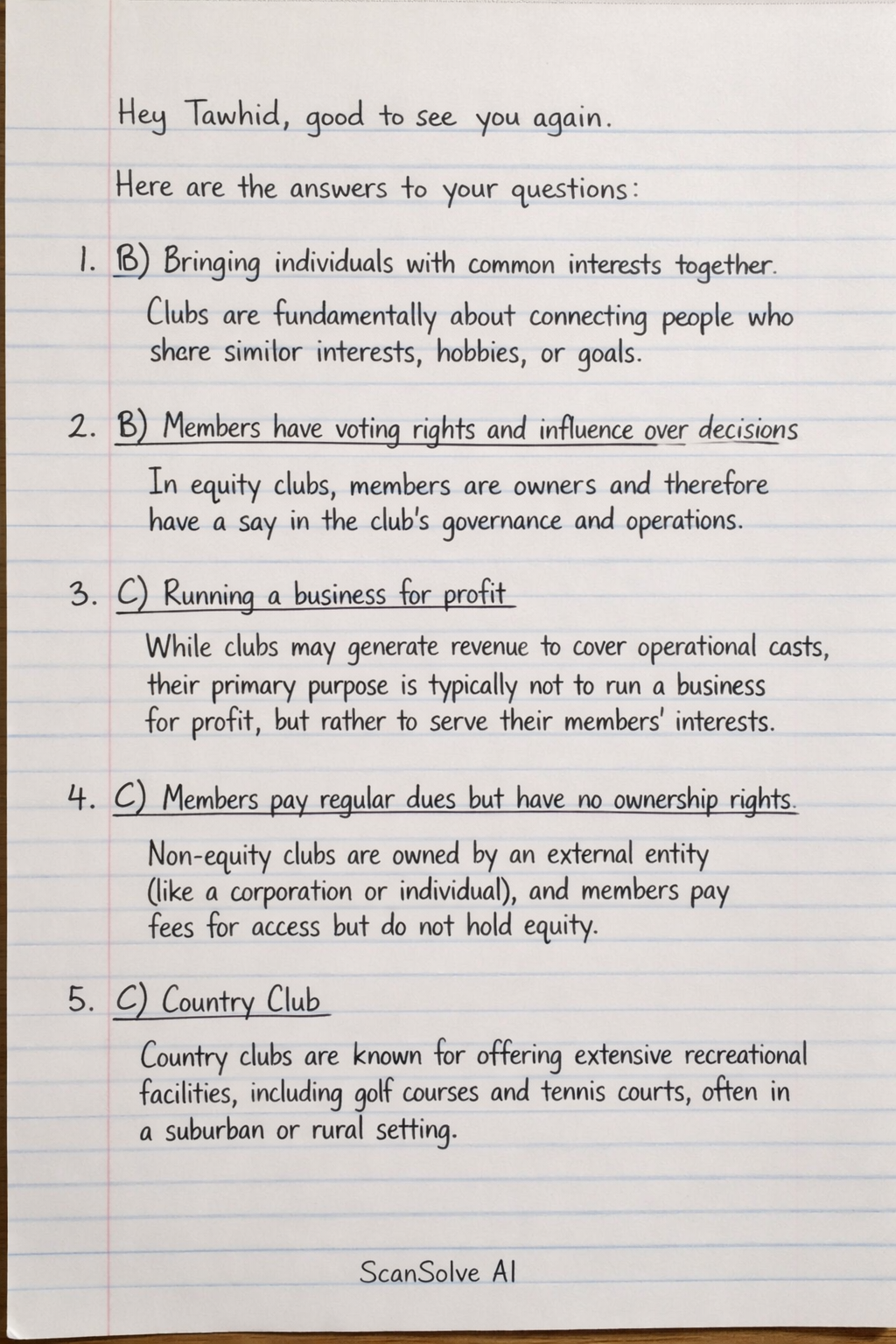
Handwritten Step-by-Step Solution
Get this as a handwritten image on WhatsApp — like a tutor wrote it for you.
Try on WhatsApp