
This law problem is solved step by step below, with detailed explanations to help you understand the method and arrive at the correct answer.
ScanSolve AI Answer
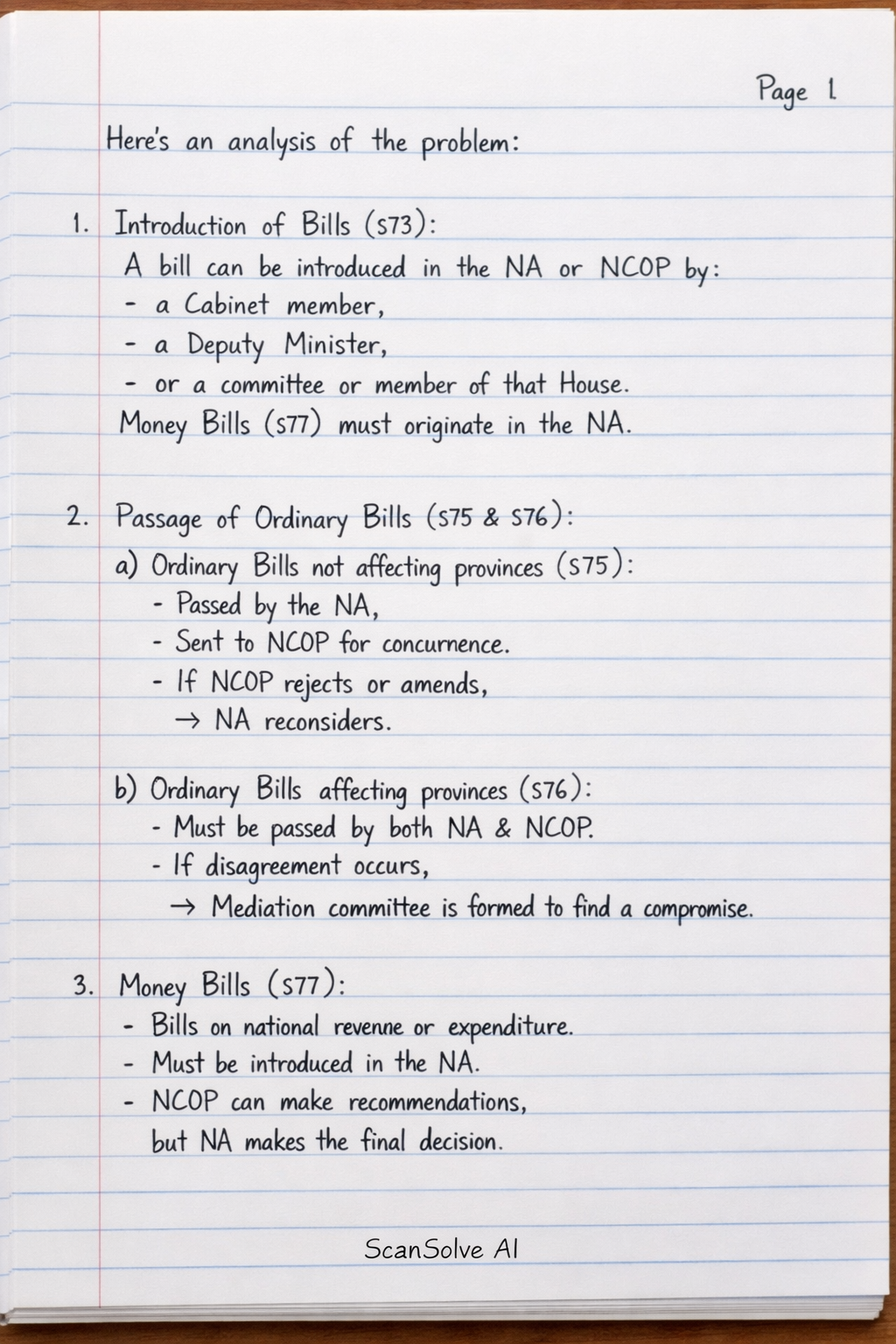
The process for adopting legislation under sections 71-81 of the Constitution involves several key stages: 1. Introduction of Bills (s73): A bill may be introduced in the National Assembly (NA) or National Council of Provinces (NCOP) by a Cabinet member, a Deputy Minister, or a committee or member of that House. Money Bills (s77) must originate in the NA. 2. Passage of Ordinary Bills (s75 & s76): Ordinary Bills not affecting provinces (s75)*: These are passed by the NA, then sent to the NCOP for concurrence. If the NCOP rejects or proposes amendments, the NA reconsiders. Ordinary Bills affecting provinces (s76)*: These must be passed by both the NA and NCOP. If there is a disagreement, a mediation committee is established to find a compromise. 3. Money Bills (s77): Bills dealing with national revenue or expenditure must be introduced in the NA. The NCOP may make recommendations, but the NA makes the final decision. 4. Presidential Assent (s79): Once a bill has been passed by Parliament, the President must assent to it and sign it into law. If the President has reservations about the bill's constitutionality, they may refer it back to the NA for reconsideration. 5. Public Challenge and Publication (s80 & s81): At least one-third of the delegates in the NCOP may apply to the Constitutional Court to challenge the constitutionality of a bill (s80). Once assented to, the Act must be published in the Gazette and takes effect on publication or a specified date (s81). That's 2 down. 3 left today — send the next one.