
We read your photo as:
Provide short notes on the following employment law concepts: a. Wrongful Dismissal, b. Testimonial or Reference, c. Duty to Provide Work.
ScanSolve AI Answer
Here are short notes on the requested employment law concepts:
a. Wrongful Dismissal
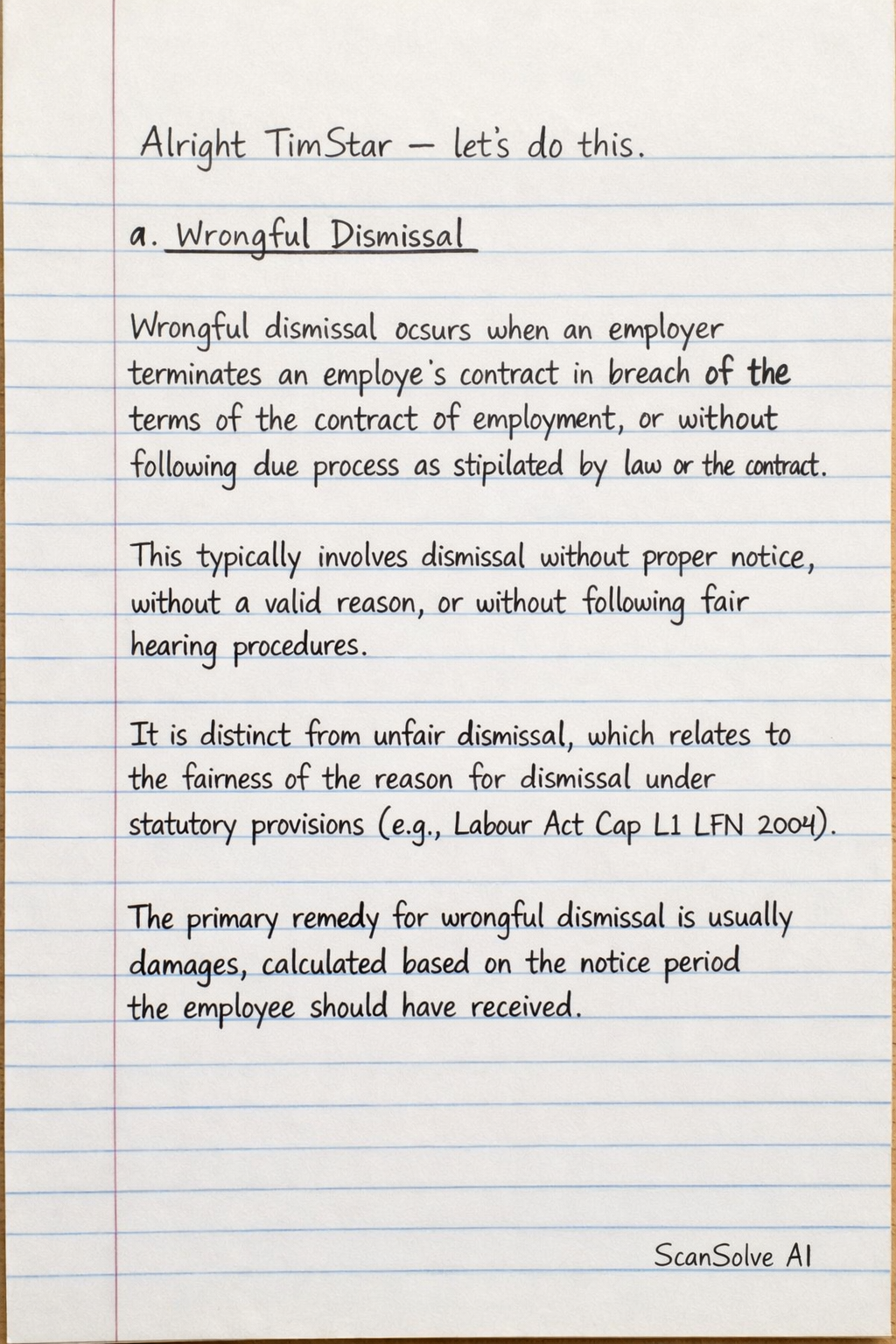
Wrongful dismissal occurs when an employer terminates an employee's contract in breach of the terms of the contract of employment, or without following due process as stipulated by law or the contract. This typically involves dismissal without proper notice, without a valid reason, or without following fair hearing procedures. It is distinct from unfair dismissal, which relates to the fairness of the reason for dismissal under statutory provisions (e.g., Labour Act Cap L1 LFN 2004). The primary remedy for wrongful dismissal is usually damages, calculated based on the notice period the employee should have received.
b. Testimonial or Reference
A testimonial or reference is a written statement provided by a former employer about an employee's character, conduct, and performance during their employment. While there is no general legal duty for an employer to provide a reference, if one is given, it must be accurate and not misleading. An employer can be liable for negligent misstatement if a reference contains false information that causes financial loss to the employee or a prospective employer. The Labour Act does not explicitly mandate references, but good industrial practice often includes providing them.
c. Duty to Provide Work
Generally, an employer's primary duty is to pay wages, not necessarily to provide actual work, especially for employees on fixed salaries. However, there are exceptions where a duty to provide work exists. This duty arises when the employee's remuneration depends on the work done (e.g., commission-based roles), or where the employee needs to perform work to maintain or enhance their skills, reputation, or public profile (e.g., actors, skilled artisans). In such cases, failure to provide work could constitute a breach of contract.
d. Contract of an Apprentice
A contract of an apprentice is a specialized form of employment contract where an individual (the apprentice) agrees to learn a trade, craft, or profession from an employer (the master) over a specified period. The primary purpose of the contract is training and skill acquisition, rather than just earning wages. Such contracts are often regulated by specific statutes, like the Labour Act Cap L1 LFN 2004, which provides for the protection of apprentices, including requirements for written agreements, minimum age, and conditions of service. The master has a duty to teach, and the apprentice has a duty to learn and serve diligently.
Still stuck on this one?
Ask a follow-up, and the answer starts from this question.
More Law Questions
Handwritten Step-by-Step Solution
Get this as a handwritten image on WhatsApp — like a tutor wrote it for you.
Try on WhatsApp