
We read your photo as:
Explain the role and functions of a constitution and the executive branch of government, including methods of executive control.
ScanSolve AI Answer
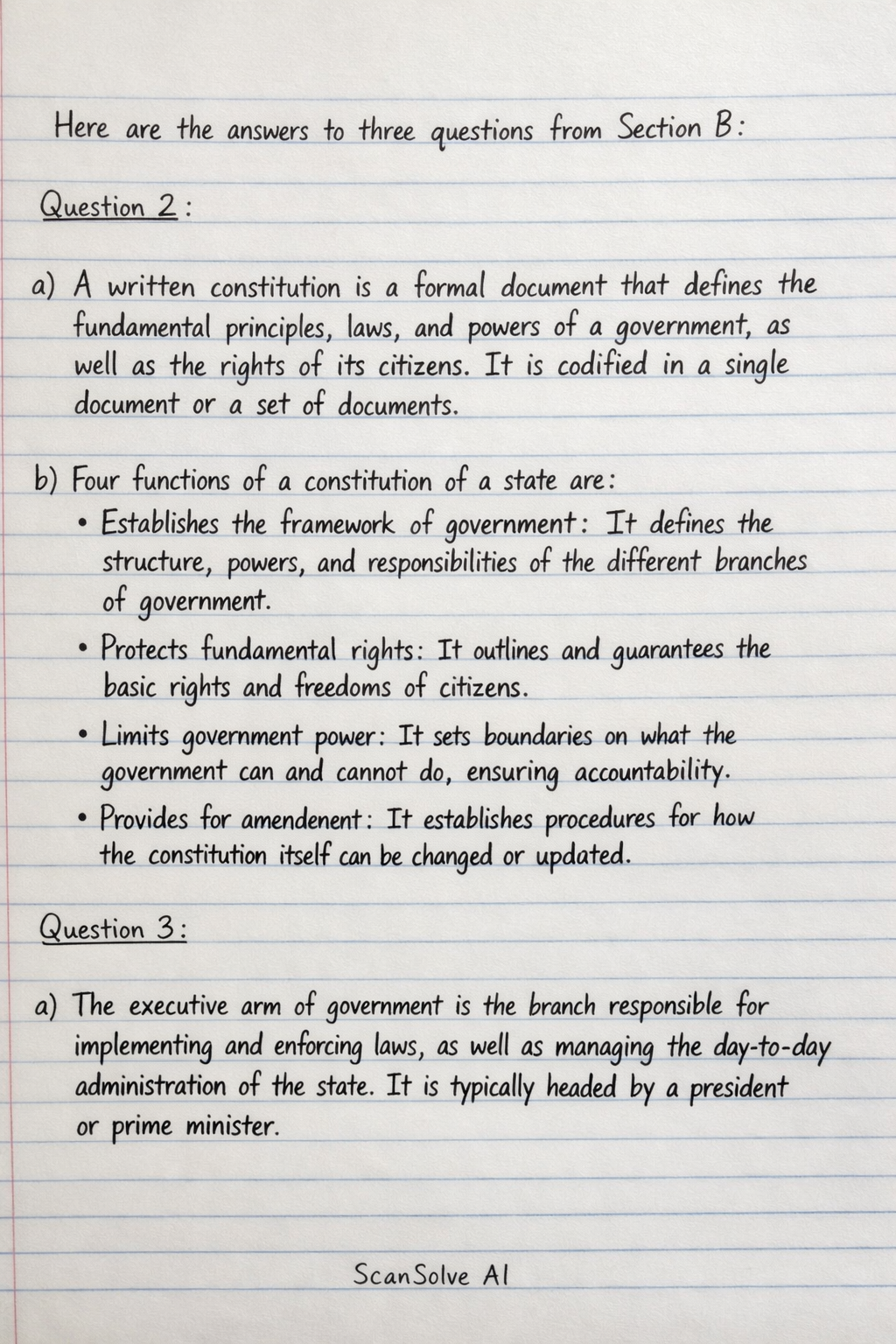
Here are the answers to three questions from Section B:
Question 2:
a) A written constitution is a formal document that defines the fundamental principles, laws, and powers of a government, as well as the rights of its citizens. It is codified in a single document or a set of documents.
b) Four functions of a constitution of a state are:
- Establishes the framework of government: It defines the structure, powers, and responsibilities of the different branches of government.
- Protects fundamental rights: It outlines and guarantees the basic rights and freedoms of citizens.
- Limits government power: It sets boundaries on what the government can and cannot do, ensuring accountability.
- Provides for amendment: It establishes procedures for how the constitution itself can be changed or updated.
Question 3:
a) The executive arm of government is the branch responsible for implementing and enforcing laws, as well as managing the day-to-day administration of the state. It is typically headed by a president or prime minister.
b) Four ways by which the executive is controlled in performing its functions are:
- Legislative oversight: The legislature (parliament/congress) can scrutinize executive actions, approve budgets, and impeach executive officials.
- Judicial review: Courts can declare executive actions or orders unconstitutional, ensuring the executive operates within the bounds of the law.
- Public opinion and media: Public pressure and media scrutiny can influence executive decisions and hold officials accountable.
- Elections: Citizens can vote out executive leaders who fail to perform their duties or act against the public interest.
Question 6:
a) A constitution is a body of fundamental principles or established precedents according to which a state or other organization is acknowledged to be governed. It serves as the supreme law of the land.
b) Five sources of a constitution are:
- Acts of Parliament/Legislature: Laws passed by the legislative body that establish or amend constitutional provisions.
- Judicial Precedents/Case Law: Decisions made by courts that interpret constitutional provisions and set legal precedents.
- Conventions: Unwritten rules and practices that are followed by political actors, often based on tradition and custom.
- Historical Documents/Charters: Significant historical documents or agreements that lay down foundational principles of governance.
- Customs and Traditions: Long-standing practices and beliefs within a society that become accepted as part of the constitutional framework.
Still stuck on this one?
Ask a follow-up, and the answer starts from this question.
More Law Questions
Handwritten Step-by-Step Solution
Get this as a handwritten image on WhatsApp — like a tutor wrote it for you.
Try on WhatsApp