
RSK4803-26-Y Welcome Message Assessment 2 Quiz Assessment 2 Question 11 Answer saved Marked out of 1.00 Flag question Question text Captive insurance … a. does not require a prefunding of the risk. b. does not insure its parent company. c. operates like a personal line insurer. d. enjoys a more flexible regulatory environment Question 12 Not yet answered Marked out of 6.00 Flag question Question text Ada Fleet Company is a transport SMME which has an insured fleet of four passenger buses. The insurance policy is due for renewal, the Managing Director of the company wants to determine the MPY in preparations for renewal negotiations. The company assumes that losses have an equal chance of occurring. Bus records are as follows: Buses Losses Liner 105 000 Biler 260 000 Zyder R170 000 Xyer R98 000 Question Calculate the MPYc using Chebyshev method and a factor of 1.05. a. R158 250,00 b. R128 340,43 c. R134 757,45 d. R293 007,45
ScanSolve AI Answer
Step-by-step solution
3 stepsQuestion 11
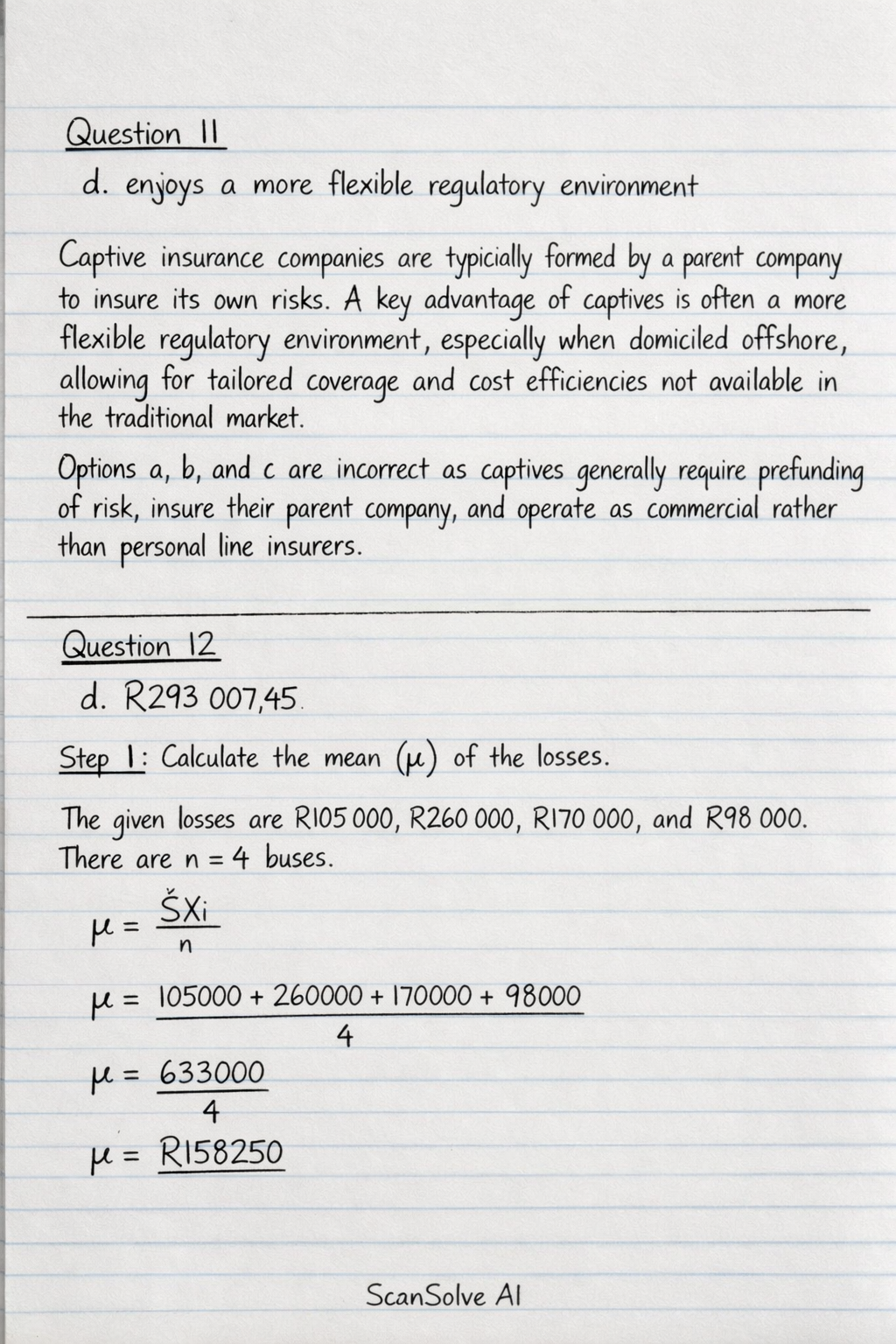
d. enjoys a more flexible regulatory environment
Captive insurance companies are typically formed by a parent company to insure its own risks. A key advantage of captives is often a more flexible regulatory environment, especially when domiciled offshore, allowing for tailored coverage and cost efficiencies not available in the traditional market. Options a, b, and c are incorrect as captives generally require prefunding of risk, insure their parent company, and operate as commercial rather than personal line insurers.
Question 12
d. R293 007,45
Calculate the mean () of the losses.
The given losses are R105 000, R260 000, R170 000, and R98 000. There are buses.
Identify the standard deviation () and the factor ().
The question asks for MPYc using the Chebyshev method and a factor of 1.05. The formula for MPYc using Chebyshev's method is typically .
By examining the given options, we can infer the intended standard deviation. We observe that option (c) R134 757,45 divided by the factor equals option (b) R128 340,43. This suggests that and .
Assumption: The standard deviation () to be used for this calculation is R128 340.43, as implied by the options, even though it cannot be directly derived from the provided loss data using standard statistical formulas. The given factor () is 1.05.Calculate the MPYc.
Using the mean from Step 1, the inferred standard deviation, and the given factor:
Rounding to two decimal places, the MPYc is R293 007.45.
The final answer is .
Still stuck on this one?
Ask a follow-up, and the answer starts from this question.
More Law Questions
Handwritten Step-by-Step Solution
Get this as a handwritten image on WhatsApp — like a tutor wrote it for you.
Try on WhatsApp