
We read your photo as:
SecureBank's culture emphasizes risk control and compliance. Managers use stories of past regulatory failures to remind staff about the importance of following procedures, shaping behavior, and focusi
ScanSolve AI Answer
SecureBank's culture emphasizes risk control and compliance. Managers use stories of past regulatory failures to remind staff about the importance of following procedures, shaping behavior, and focusing on standardized processes. Let's analyze which functions of organizational culture are in operation:
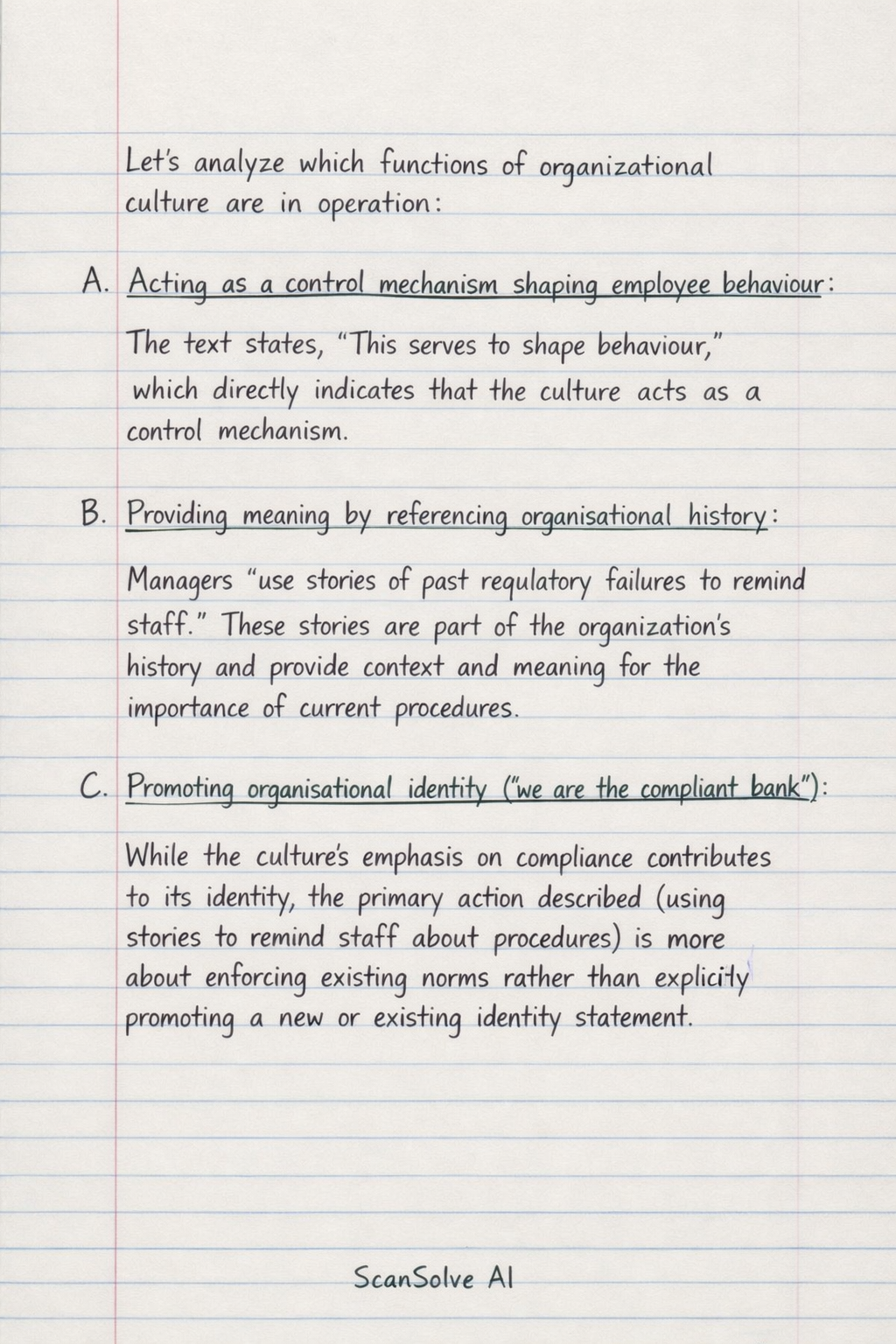
- A. Acting as a control mechanism shaping employee behaviour: The text states, "This serves to shape behaviour," which directly indicates that the culture acts as a control mechanism.
- B. Providing meaning by referencing organisational history: Managers "use stories of past regulatory failures to remind staff." These stories are part of the organization's history and provide context and meaning for the importance of current procedures.
- C. Promoting organisational identity ("we are the compliant bank"): While the culture's emphasis on compliance contributes to its identity, the primary action described (using stories to remind staff about procedures) is more about enforcing existing norms rather than explicitly promoting a new or existing identity statement.
- D. Facilitating commitment beyond individual self-interest: By highlighting "past regulatory failures" and the "importance of following procedure," the culture encourages adherence to collective organizational goals (compliance) over individual preferences. This implies fostering commitment.
- E. Reducing uncertainty by setting clear behavioural expectations: The focus on "standardised processes" and "following procedure" directly aims to clarify expected behaviors, thereby reducing ambiguity and uncertainty for employees.
Based on the direct evidence in the text:
- Statement A is strongly supported by "shape behaviour."
- Statement B is strongly supported by "stories of past regulatory failures to remind staff."
- Statement E is strongly supported by "focus attention on standardised processes" and "importance of following procedure."
Statements C and D are also plausible functions, but A, B, and E are the most direct and explicit functions described by the managers' actions in the scenario.
Let's evaluate the given options:
- A. Statements C, D, E: Misses A and B, which are strongly supported.
- B. Statements A, B, E: Includes three functions that are directly and strongly supported by the text.
- C. Statements A, C, D: Misses B and E, which are strongly supported.
- D. Statements B, C, D: Misses A and E, which are strongly supported.
Therefore, option B provides the best fit for the functions explicitly described in the scenario.
The final answer is
Still stuck on this one?
Ask a follow-up, and the answer starts from this question.
More Law Questions
Handwritten Step-by-Step Solution
Get this as a handwritten image on WhatsApp — like a tutor wrote it for you.
Try on WhatsApp