
We read your photo as:
How should different types of physical evidence, like blood and hair, be collected and packaged at a crime scene?
Law
ScanSolve AI Answer
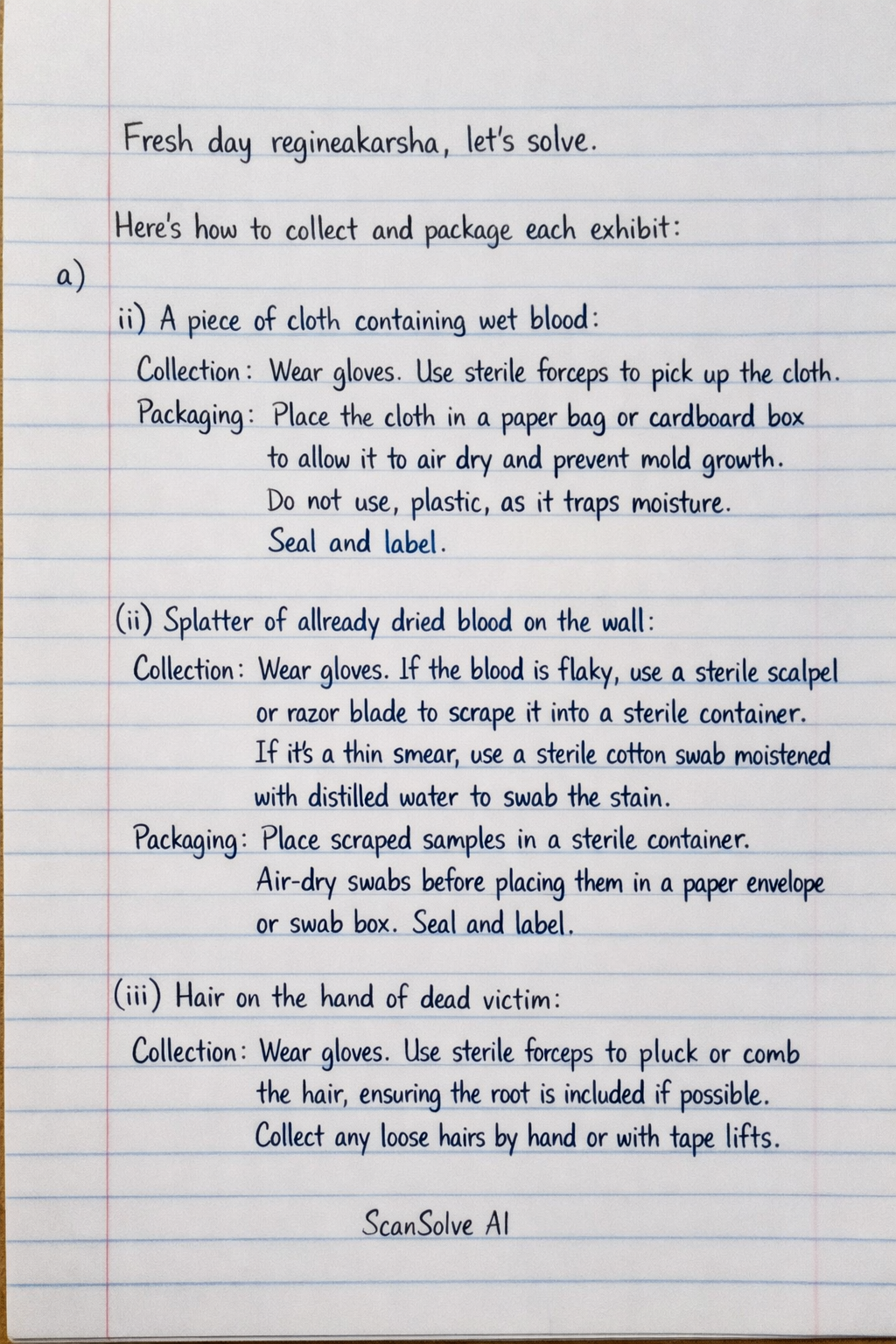
Here's how to collect and package each exhibit:
a)
- (i) A piece of cloth containing wet blood:
- Collection: Wear gloves. Use sterile forceps to pick up the cloth.
- Packaging: Place the cloth in a paper bag or cardboard box to allow it to air dry and prevent mold growth. Do not use plastic, as it traps moisture. Seal and label.
- (ii) Splatter of already dried blood on the wall:
- Collection: Wear gloves. If the blood is flaky, use a sterile scalpel or razor blade to scrape it into a sterile container. If it's a thin smear, use a sterile cotton swab moistened with distilled water to swab the stain.
- Packaging: Place scraped samples in a sterile container. Air-dry swabs before placing them in a paper envelope or swab box. Seal and label.
- (iii) Hair on the hand of dead victim:
- Collection: Wear gloves. Use sterile forceps to pluck or comb the hair, ensuring the root is included if possible. Collect any loose hairs by hand or with tape lifts.
- Packaging: Place hairs in a paper bindle or small envelope. Seal and label.
- (iv) A knife containing wet blood:
- Collection: Wear gloves. Handle the knife carefully by the non-bladed, non-bloody parts. Do not wipe or clean it.
- Packaging: Secure the knife in a sturdy cardboard box to prevent injury and contamination, ensuring the blade is protected. Allow blood to air dry if possible before sealing. Label the box clearly.
- (v) Torn pant and clothes with dried blood:
- Collection: Wear gloves. Carefully pick up the clothing, avoiding further damage.
- Packaging: Place each item of clothing separately in a large paper bag or cardboard box. Do not fold or crumple excessively. Seal and label.
b) Factors affecting the ability to obtain a DNA profile include:
- Quantity of DNA: Low amounts of DNA (e.g., from touch DNA, degraded samples) can make profiling difficult.
- Quality of DNA: Degradation due to environmental factors (heat, humidity, UV light, bacteria) can break down DNA, making it unsuitable for analysis.
- Contamination: The presence of DNA from other sources (e.g., investigators, victims, other suspects) can obscure the target DNA profile.
- Inhibitors: Substances like dyes, chemicals, or certain soil components can inhibit the PCR process, preventing DNA amplification.
- Sample type: Some sample types naturally contain less DNA or are more prone to degradation.
Was this helpful?
Still stuck on this one?
Ask a follow-up, and the answer starts from this question.
Got a different question?Ask your own question
More Law Questions
QWhat is the procedure for transporting and packaging cytological specimens?Q3.2.1 The technique used in this criminal investigation is DNA fingerprinting (or DNA profiling).QHow do you interview witness and.gather information during.an incident investigationQGroup presentation collection of blood samplesQCheck all that apply if blood exposure occurs immediately?
Browse by topic:Criminal Justice
Handwritten Step-by-Step Solution
Get this as a handwritten image on WhatsApp — like a tutor wrote it for you.
Try on WhatsApp