
We read your photo as:
Summarize the facts and legal question of the case Edward Nathan Sonnenbergs Inc v Judith Mary Hawarden, and explain the SCA's ratio decidendi regarding the proof of reasonable legal fees.
ScanSolve AI Answer
Here is a summary of the case Edward Nathan Sonnenbergs Inc v Judith Mary Hawarden (421/2023) [2024] ZASCA 90; 2024 (5) SA 9 (SCA) (10 June 2024):
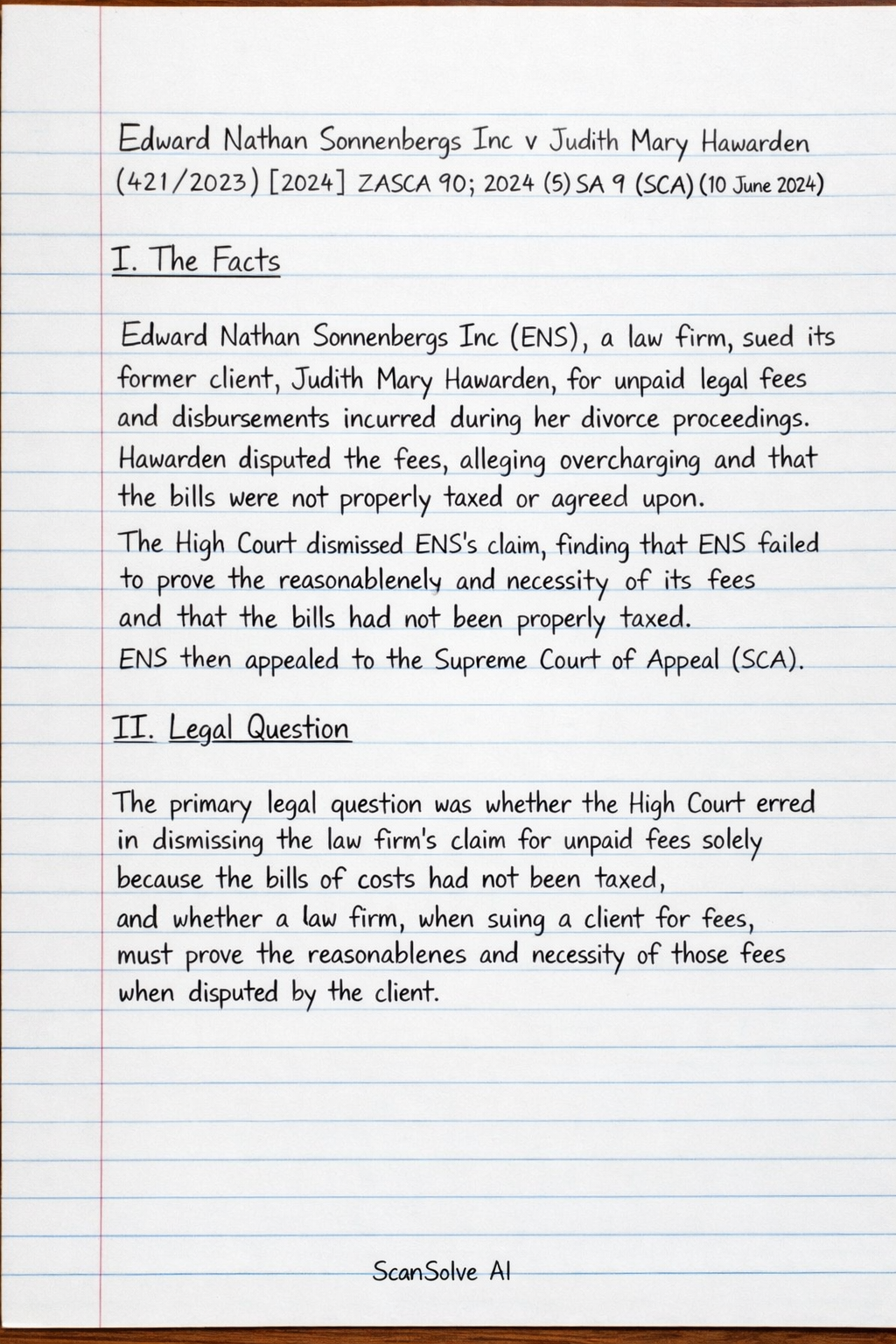
I. The Facts
Edward Nathan Sonnenbergs Inc (ENS), a law firm, sued its former client, Judith Mary Hawarden, for unpaid legal fees and disbursements incurred during her divorce proceedings. Hawarden disputed the fees, alleging overcharging and that the bills were not properly taxed or agreed upon. The High Court dismissed ENS's claim, finding that ENS failed to prove the reasonableness and necessity of its fees and that the bills had not been properly taxed. ENS then appealed to the Supreme Court of Appeal (SCA).
II. Legal Question
The primary legal question was whether the High Court erred in dismissing the law firm's claim for unpaid fees solely because the bills of costs had not been taxed, and whether a law firm, when suing a client for fees, must prove the reasonableness and necessity of those fees when disputed by the client.
III. Ratio Decidendi
The SCA clarified that while a client has a right to have a bill of costs taxed, this right does not automatically prevent a law firm from suing for its fees. When a client disputes the reasonableness of fees, the onus is on the law firm to prove that the fees charged were reasonable and necessary for the services rendered. However, the SCA held that the High Court erred by dismissing ENS's claim outright without allowing the firm to present evidence to prove the reasonableness of its fees. The court emphasized that a court can determine the reasonableness of fees based on evidence, even if the bill has not been formally taxed.
IV. Findings
The Supreme Court of Appeal upheld the appeal by Edward Nathan Sonnenbergs Inc. The order of the High Court dismissing ENS's claim was set aside. The matter was remitted to the High Court for further hearing, specifically to allow ENS to lead evidence to prove the reasonableness and necessity of its fees and for the High Court to properly adjudicate the dispute on its merits, including Hawarden's counterclaim.
Still stuck on this one?
Ask a follow-up, and the answer starts from this question.
More Law Questions
Handwritten Step-by-Step Solution
Get this as a handwritten image on WhatsApp — like a tutor wrote it for you.
Try on WhatsApp