
The earliest inhabitants of Cameroon were mainly the: A. Fulani B. Tikar C. Baka (Pygmies) D. Bamileke The Portuguese arrived in Cameroon in: A. 1415 B. 1472 C. 1884 D. 1916 The name “Cameroon” was derived from: A. Gold B. Palm oil C. Prawns D. Elephants The German annexation of Cameroon took place in: A. 1472 B. 1884 C. 1916 D. 1960 The treaty signed between the Douala chiefs and the Germans in 1884 was signed by: A. Rudolf Manga Bell B. King Akwa and King Bell C. Ahmadou Ahidjo D. Fon Gorgi Dinka The first German governor of Kamerun was: A. Jesko von Puttkamer B. Julius von Soden C. Gustav Nachtigal D. Otto von Bismarck The Duala resistance against German land expropriation was led by: A. Martin Paul Samba B. Rudolf Manga Bell C. Charles Atangana D. Kuva Likenye Martin Paul Samba was executed by the Germans in: A. 1884 B. 1905 C. 1914 D. 1918 Cameroon was divided between Britain and France after: A. World War I B. World War II C. The Berlin Conference D. Independence The League of Nations mandates were introduced after: A. The Berlin Conference B. World War I C. World War II D. The Cold War French Cameroon gained independence in: A. 1958 B. 1960 C. 1961 D. 1972 Southern Cameroons joined the Republic of Cameroon through: A. Referendum B. War C. Election D. Negotiation with France The reunification of Cameroon took place in: A. 1959 B. 1960 C. 1961 D. 1972 The federal constitution of Cameroon was abolished in: A. 1961 B. 1966 C. 1972 D. 1984 The first President of Cameroon was: A. Paul Biya B. John Ngu Foncha C. Ahmadou Ahidjo D. Charles Assale The capital of German Kamerun was: A. Douala B. Yaounde C. Buea D. Garoua The UPC was formed in: A. 1948 B. 1952 C. 1960 D. 1972 One major demand of the UPC was: A. Federalism only B. Immediate independence and reunification C. British rule D. Annexation to Nigeria The leader of the UPC assassinated in 1958 was: A. Felix Moumie B. Ruben Um Nyobe C. Ernest Ouandie D. Ndeh Ntumazah Ernest Ouandie was executed in: A. 1960 B. 1966 C. 1971 D. 1982 The Berlin Conference of 1884–1885 was convened by: A. Napoleon III B. Otto von Bismarck C. Cecil Rhodes D. Leopold II The main aim of the Berlin Conference was to: A. End slavery B. Promote African unity C. Partition Africa among European powers D. Spread Christianity only The policy of assimilation was practiced mainly by: A. Britain B. Germany C. France D. Portugal Indirect rule in Africa is closely associated with: A. Lord Lugard B. Cecil Rhodes C. Samori Toure D. Louis Faidherbe The Maji Maji rebellion occurred in: A. Kenya B. Sudan C. Tanganyika D. Ghana Samori Toure resisted French occupation in: A. Nigeria B. Guinea C. Congo D. Ethiopia The only African country that successfully resisted European colonization during the Scramble for Africa was: A. Liberia B. Egypt C. Ethiopia D. Morocco The Battle of Adowa took place in: A. 1884 B. 1896 C. 1900 D. 1914 Kwame Nkrumah became the first Prime Minister of: A. Nigeria B. Kenya C. Ghana D. Senegal Ghana gained independence in: A. 1956 B. 1957 C. 1960 D. 1963 Apartheid was officially practiced in: A. Zimbabwe B. Namibia C. South Africa D. Angola Nelson Mandela was released from prison in: A. 1980 B. 1985 C. 1990 D. 1994 The Mau Mau uprising occurred in: A. Uganda B. Kenya C. Tanzania D. Zambia The African National Congress (ANC) was formed in: A. South Africa B. Nigeria C. Egypt D. Algeria The Organization of African Unity (OAU) was formed in: A. 1957 B. 1960 C. 1963 D. 1975 The headquarters of the African Union is in: A. Cairo B. Nairobi C. Addis Ababa D. Lagos The first Secretary-General of the OAU was: A. Kwame Nkrumah B. Diallo Telli C. Julius Nyerere D. Haile Selassie Pan-Africanism aimed mainly at: A. Colonial expansion B. African unity and liberation C. Religious conversion D. Trade monopoly The leader associated with Ujamaa policy in Tanzania was: A. Jomo Kenyatta B. Julius Nyerere C. Kenneth Kaunda D. Patrice Lumumba Patrice Lumumba was the first Prime Minister of: A. Congo B. Gabon C. Chad D. Mali The Suez Canal was nationalized by: A. Anwar Sadat B. Gamal Abdel Nasser C. Muammar Gaddafi D. Haile Selassie The Boer War was fought in: A. Algeria B. Sudan C. South Africa D. Egypt Cecil Rhodes was associated with: A. French West Africa B. British expansion in Southern Africa C. Italian Somaliland D. Belgian Congo The system of government in pre-colonial Hausa states was mainly: A. Acephalous B. Emirate system C. Clan rule D. Age-grade system The trans-Atlantic slave trade mainly involved the exchange of: A. Gold and silver B. Slaves, guns and manufactured goods C. Salt and copper D. Cotton and tea The abolition of the slave trade by Britain occurred in: A. 1492 B. 1776 C. 1807 D. 1884 Which European power controlled the Congo Free State? A. France B. Britain C. Belgium D. Portugal The independence struggle in Algeria was against: A. Britain B. Spain C. France D. Portugal Jomo Kenyatta was a nationalist leader in: A. Uganda B. Kenya C. Ghana D. Tanzania Neo-colonialism refers to: A. Direct military occupation B. Economic and political control after independence C. Traditional African rule D. Religious expansion
Law
ScanSolve AI Answer
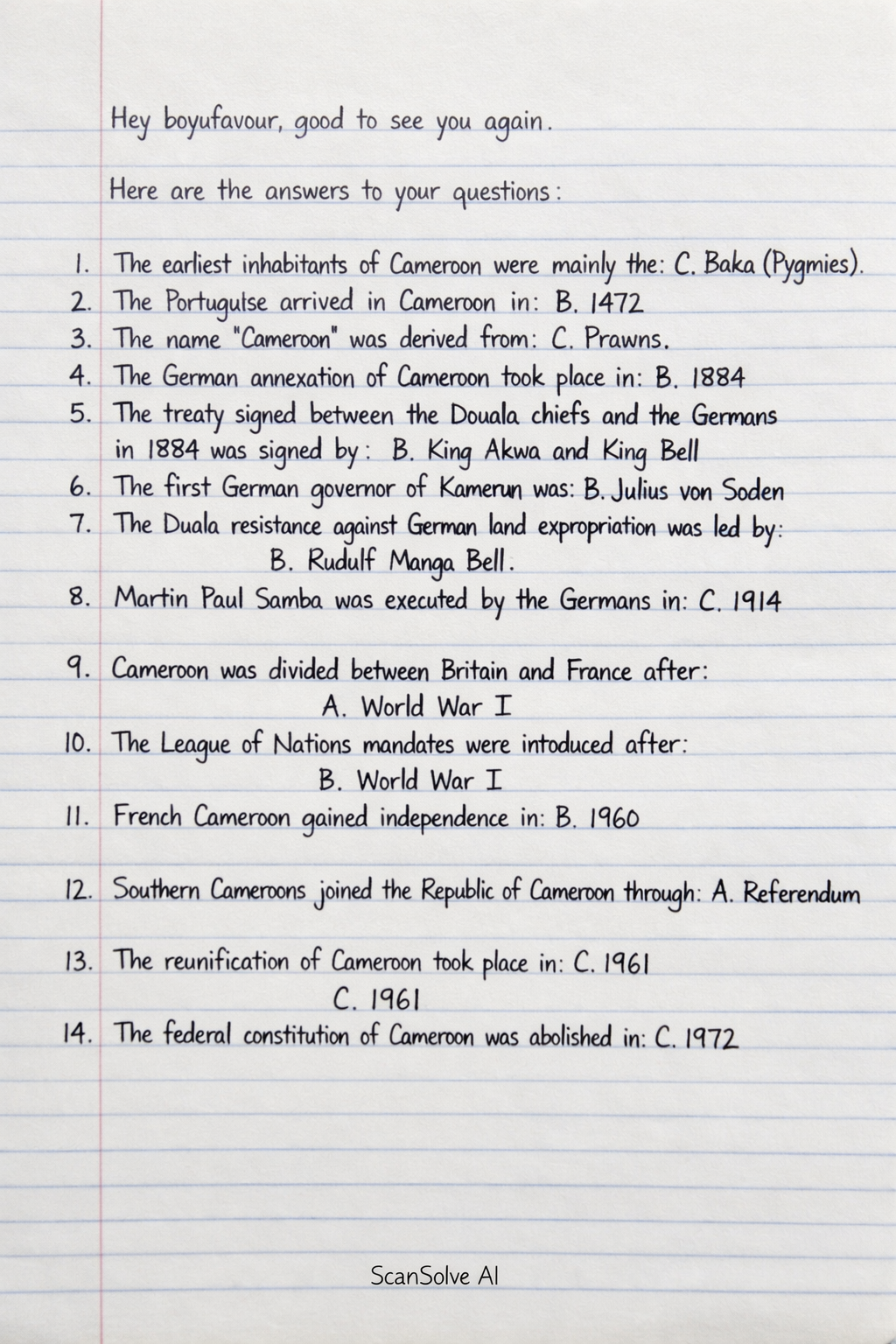
Here are the answers to your questions:
- The earliest inhabitants of Cameroon were mainly the: C. Baka (Pygmies)
- The Portuguese arrived in Cameroon in: B. 1472
- The name “Cameroon” was derived from: C. Prawns
- The German annexation of Cameroon took place in: B. 1884
- The treaty signed between the Douala chiefs and the Germans in 1884 was signed by: B. King Akwa and King Bell
- The first German governor of Kamerun was: B. Julius von Soden
- The Duala resistance against German land expropriation was led by: B. Rudolf Manga Bell
- Martin Paul Samba was executed by the Germans in: C. 1914
- Cameroon was divided between Britain and France after: A. World War I
- The League of Nations mandates were introduced after: B. World War I
- French Cameroon gained independence in: B. 1960
- Southern Cameroons joined the Republic of Cameroon through: A. Referendum
- The reunification of Cameroon took place in: C. 1961
- The federal constitution of Cameroon was abolished in: C. 1972
- The first President of Cameroon was: C. Ahmadou Ahidjo
- The capital of German Kamerun was: C. Buea
- The UPC was formed in: A. 1948
- One major demand of the UPC was: B. Immediate independence and reunification
- The leader of the UPC assassinated in 1958 was: B. Ruben Um Nyobe
- Ernest Ouandie was executed in: C. 1971
- The Berlin Conference of 1884–1885 was convened by: B. Otto von Bismarck
- The main aim of the Berlin Conference was to: C. Partition Africa among European powers
- The policy of assimilation was practiced mainly by: C. France
- Indirect rule in Africa is closely associated with: A. Lord Lugard
- The Maji Maji rebellion occurred in: C. Tanganyika
- Samori Toure resisted French occupation in: B. Guinea
- The only African country that successfully resisted European colonization during the Scramble for Africa was: C. Ethiopia
- The Battle of Adowa took place in: B. 1896
- Kwame Nkrumah became the first Prime Minister of: C. Ghana
- Ghana gained independence in: B. 1957
- Apartheid was officially practiced in: C. South Africa
- Nelson Mandela was released from prison in: C. 1990
- The Mau Mau uprising occurred in: B. Kenya
- The African National Congress (ANC) was formed in: A. South Africa
- The Organization of African Unity (OAU) was formed in: C. 1963
- The headquarters of the African Union is in: C. Addis Ababa
- The first Secretary-General of the OAU was: B. Diallo Telli
- Pan-Africanism aimed mainly at: B. African unity and liberation
- The leader associated with Ujamaa policy in Tanzania was: B. Julius Nyerere
- Patrice Lumumba was the first Prime Minister of: A. Congo
- The Suez Canal was nationalized by: B. Gamal Abdel Nasser
- The Boer War was fought in: C. South Africa
- Cecil Rhodes was associated with: B. British expansion in Southern Africa
- The system of government in pre-colonial Hausa states was mainly: B. Emirate system
- The trans-Atlantic slave trade mainly involved the exchange of: B. Slaves, guns and manufactured goods
- The abolition of the slave trade by Britain occurred in: C. 1807
- Which European power controlled the Congo Free State? C. Belgium
- The independence struggle in Algeria was against: C. France
- Jomo Kenyatta was a nationalist leader in: B. Kenya
- Neo-colonialism refers to: B. Economic and political control after independence
Was this helpful?
Still stuck on this one?
Ask a follow-up, and the answer starts from this question.
Got a different question?Ask your own question
More Law Questions
QCameroon History The earliest known inhabitants of Cameroon were the: A. Fulani B. Baka (Pygmies) C…QHistory ordinary level papers 1 SECTION A (Cameroon since 1800) Which was the most appropriate…QHistory students. ose the best answer from A–D. First World War (1914–1918) The immediate cause of…QBased on the images provided, here is the transcription of the history examination questions…QCameroon GCE O Level History MCQs Cameroon History — 50 Standard Questions The earliest inhabitants…
Handwritten Step-by-Step Solution
Get this as a handwritten image on WhatsApp — like a tutor wrote it for you.
Try on WhatsApp