
We read your photo as:
What are the exceptions to the general rule of relevance in Kenyan evidence law, as stipulated by the Evidence Act?
ScanSolve AI Answer
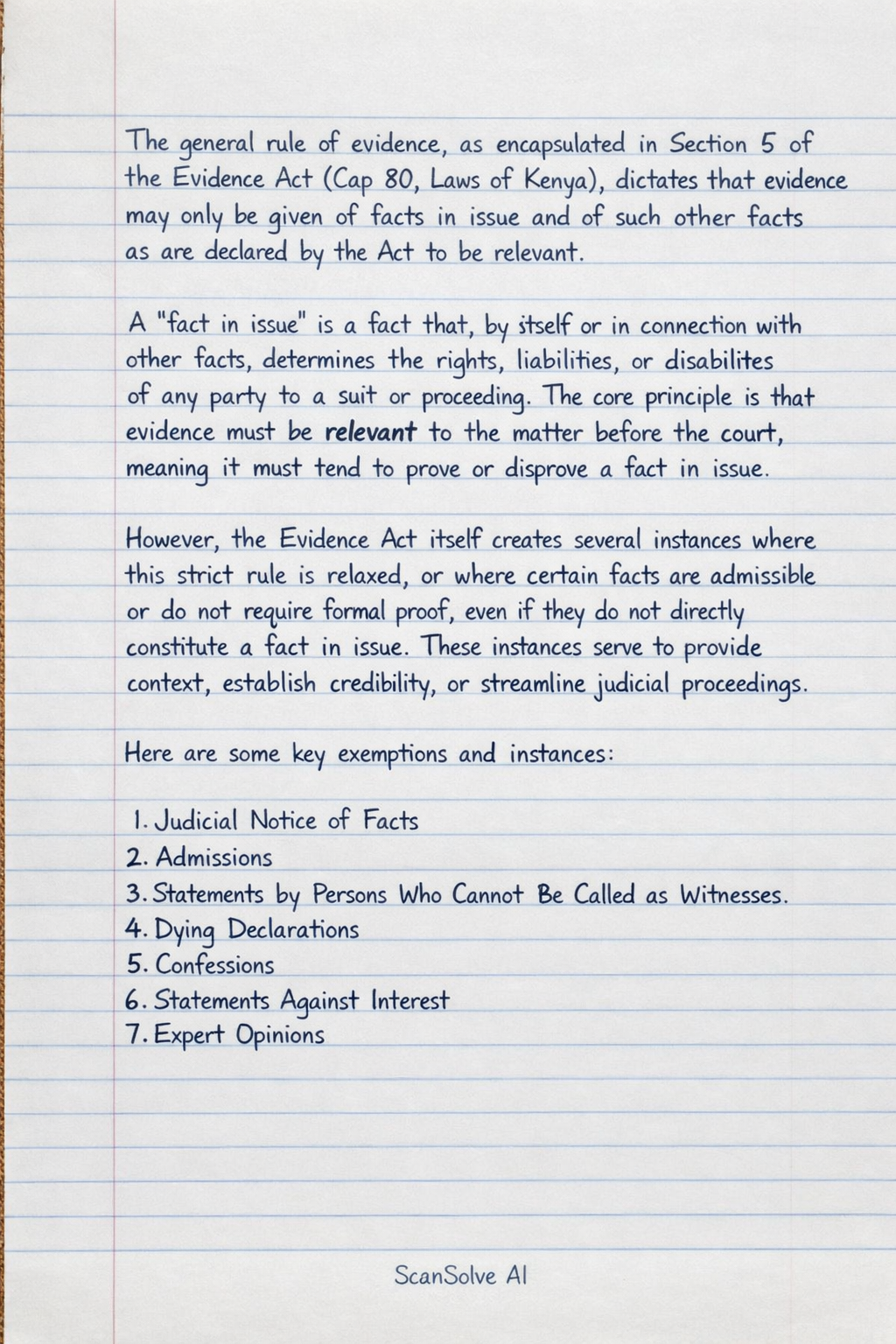
The general rule of evidence, as encapsulated in Section 5 of the Evidence Act (Cap 80, Laws of Kenya), dictates that evidence may only be given of facts in issue and of such other facts as are declared by the Act to be relevant. A "fact in issue" is a fact that, by itself or in connection with other facts, determines the rights, liabilities, or disabilities of any party to a suit or proceeding. The core principle is that evidence must be relevant to the matter before the court, meaning it must tend to prove or disprove a fact in issue.
However, the Evidence Act itself creates several instances where this strict rule is relaxed, or where certain facts are admissible or do not require formal proof, even if they do not directly constitute a fact in issue. These instances serve to provide context, establish credibility, or streamline judicial proceedings.
Here are some key exemptions and instances:
-
Facts Forming Part of the Same Transaction (Res Gestae - Section 6):
- Explanation: This section allows for the admission of facts that, though not in issue, are so connected with a fact in issue as to form part of the same transaction. These include facts that happen at the same time and place, or at different times and places, but are so linked as to form a continuous whole.
- Exemption: These facts are admitted not because they directly prove or disprove the main fact, but because they provide essential context and are inseparable from the event itself, making the fact in issue more intelligible. For example, cries of bystanders during an assault.
-
Facts Showing Motive, Preparation, or Previous/Subsequent Conduct (Section 8):
- Explanation: Evidence of any fact is relevant if it shows or constitutes a motive or preparation for any fact in issue or relevant fact. Similarly, the conduct of any party or agent, or of any person against whom an offence is committed, is relevant if such conduct influences or is influenced by any fact in issue or relevant fact.
- Exemption: These facts are not the central dispute but are crucial for understanding the actions and intentions of the parties involved, thereby making the existence or non-existence of a fact in issue highly probable.
-
Facts Necessary to Explain or Introduce Relevant Facts (Section 9):
- Explanation: Facts that are necessary to explain or introduce a fact in issue or a relevant fact, or which support or rebut an inference suggested by a fact in issue or relevant fact, or which establish the identity of anything or person, or fix the time or place at which any fact in issue or relevant fact happened, or which show the relation of parties by whom any such fact was transacted, are relevant.
- Exemption: These facts provide the necessary background and context, making the primary relevant facts understandable and preventing misinterpretation, even if they don't directly prove the ultimate fact in issue.
-
Admissions (Sections 17-23) and Confessions (Sections 25-32):
- Explanation: An admission is a statement, oral or documentary, which suggests any inference as to a fact in issue or relevant fact, and which is made by any of the persons and under the circumstances specified in the Act. A confession is a specific type of admission made by an accused person in a criminal case.
- Exemption: Admissions and confessions are exceptions to the general rule requiring direct proof of a fact. They are considered highly probative because they are statements made by a party against their own interest. They can be used as substantive evidence of the facts admitted, bypassing the need for independent proof of those facts.
-
Statements by Persons Who Cannot Be Called as Witnesses (Section 33):
- Explanation: This section provides several exceptions to the hearsay rule, allowing statements made by persons who are deceased, cannot be found, are incapable of giving evidence, or whose attendance cannot be procured without unreasonable delay or expense, to be admitted as evidence. Key examples include:
- Dying Declarations (Section 33(a)): Statements made by a person as to the cause of their death, or as to any of the circumstances of the transaction which resulted in their death, when the cause of that person's death comes into question.
- Statements Made in the Course of Business (Section 33(b)): Statements made by a person in the ordinary course of business, or in the discharge of professional duty.
- Statements Against Interest (Section 33(c)): Statements made by a person against their pecuniary or proprietary interest, or which would expose them to criminal prosecution or a suit for damages.
- Exemption: These are admitted due to necessity (the maker cannot testify) and a presumption of reliability (e.g., solemnity of impending death, routine nature of business records, unlikelihood of making false statements against one's own interest). They allow secondary evidence of a statement to prove the truth of its contents, despite the maker not being available for cross-examination.
- Explanation: This section provides several exceptions to the hearsay rule, allowing statements made by persons who are deceased, cannot be found, are incapable of giving evidence, or whose attendance cannot be procured without unreasonable delay or expense, to be admitted as evidence. Key examples include:
-
Judicial Notice (Sections 56-59):
- Explanation: Courts are mandated to take judicial notice of certain facts, meaning they accept these facts as true without requiring formal proof through evidence. These include laws, public acts, official gazettes, geographical divisions, and facts of common knowledge.
- Exemption: This is a direct exemption from the requirement of leading evidence to prove a fact. It streamlines proceedings by avoiding the need to prove facts that are universally known, easily verifiable, or officially recognized.
-
Estoppel (Sections 120-123):
- Explanation: Estoppel prevents a person from denying the truth of a fact that they have previously asserted or represented, either by words or conduct, and upon which another person has acted to their detriment.
- Exemption: This principle prevents a party from leading evidence to contradict a fact that they are legally barred from denying. It ensures consistency and prevents parties from taking contradictory positions in litigation, even if the fact might otherwise be open to dispute.
These instances demonstrate that while relevance to a fact in issue is paramount, the Evidence Act provides a nuanced framework that allows for the admission of other categories of facts or dispenses with the need for formal proof in specific circumstances, all aimed at achieving justice and efficiency in legal proceedings.
Still stuck on this one?
Ask a follow-up, and the answer starts from this question.
More Law Questions
Handwritten Step-by-Step Solution
Get this as a handwritten image on WhatsApp — like a tutor wrote it for you.
Try on WhatsApp