
We read your photo as:
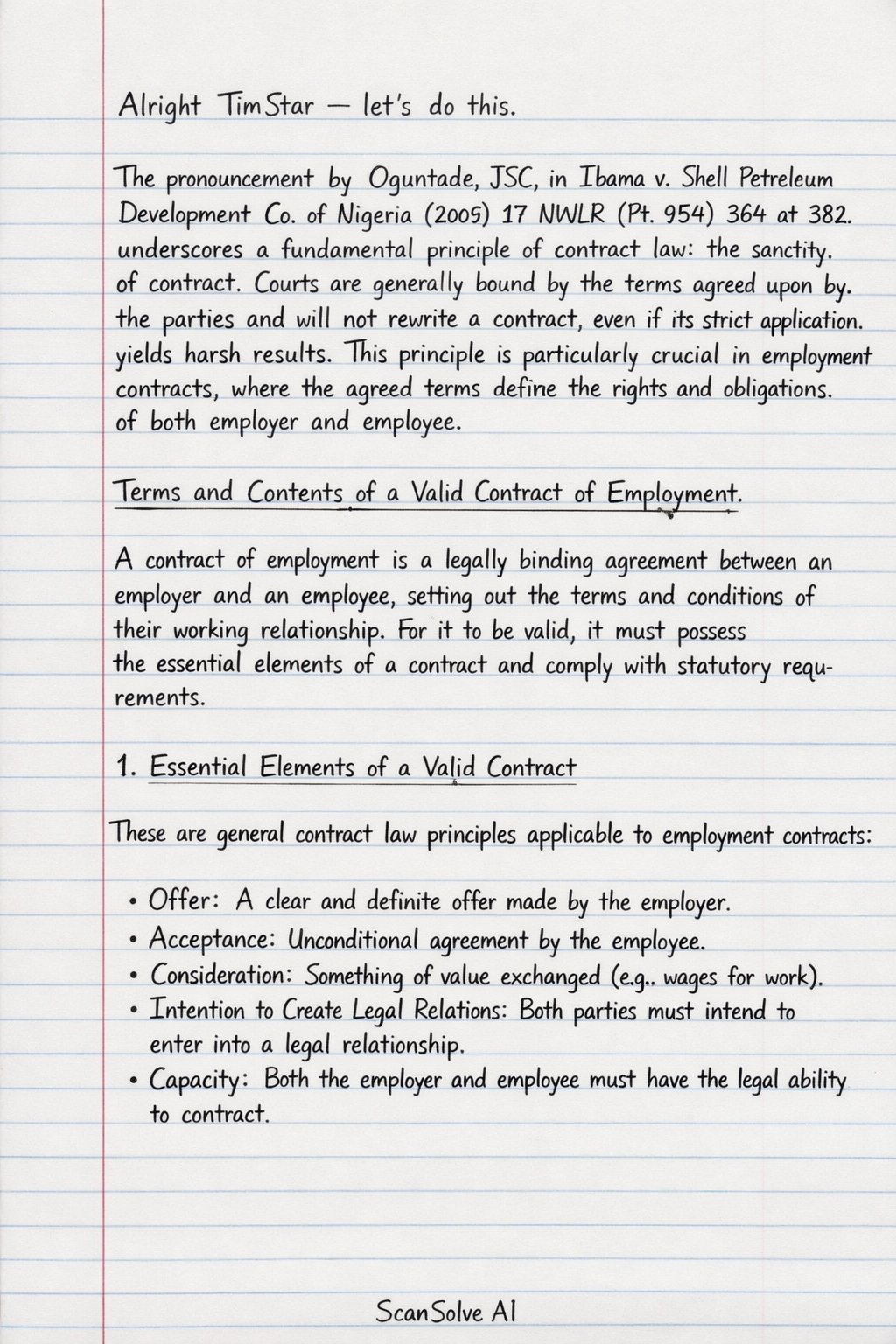
The pronouncement by Oguntade, JSC, in Ibama v. Shell Petroleum Development Co. of Nigeria (2005) 17 NWLR (Pt. 954) 364 at 382 underscores a fundamental principle of contract law: the sanctity of co
ScanSolve AI Answer
The pronouncement by Oguntade, JSC, in Ibama v. Shell Petroleum Development Co. of Nigeria (2005) 17 NWLR (Pt. 954) 364 at 382 underscores a fundamental principle of contract law: the sanctity of contract. Courts are generally bound by the terms agreed upon by the parties and will not rewrite a contract, even if its strict application yields harsh results. This principle is particularly crucial in employment contracts, where the agreed terms define the rights and obligations of both employer and employee.
Terms and Contents of a Valid Contract of Employment
A contract of employment is a legally binding agreement between an employer and an employee, setting out the terms and conditions of their working relationship. For it to be valid, it must possess the essential elements of a contract and comply with statutory requirements.
1. Essential Elements of a Valid Contract
These are general contract law principles applicable to employment contracts:
- Offer and Acceptance: There must be a clear offer of employment by the employer and an unequivocal acceptance by the prospective employee.
- Consideration: This refers to the exchange of value. The employee provides services (work), and the employer provides remuneration (wages, salary, benefits).
- Intention to Create Legal Relations: Both parties must intend for their agreement to be legally enforceable. This is usually presumed in commercial and employment contexts.
- Capacity to Contract: Both parties must have the legal capacity to enter into a contract (e.g., not minors, not of unsound mind).
- Legality of Object: The purpose of the contract must be legal and not against public policy.
2. Statutory Provisions Governing Contents
The Labour Act Cap L1 LFN 2004 is the primary statute regulating contracts of employment in Nigeria, particularly for "workers" (defined in Section 91 as persons engaged in manual labour or clerical work). It mandates certain minimum terms and conditions.
-
Section 7(1) of the Labour Act: This is a crucial provision. It mandates that not later than three months after the beginning of a worker's period of employment, the employer shall give the worker a written statement specifying:
- The name of the employer and the undertaking.
- The name and address of the worker and the place of engagement.
- The nature of the employment.
- The date of engagement.
- The duration of the contract (if for a fixed term).
- The appropriate period of notice to be given by the party wishing to terminate the contract.
- The rates of wages and the method of calculating them.
- The period of payment of wages (e.g., daily, weekly, monthly).
- Any terms and conditions relating to hours of work, holidays, holiday pay, incapacity for work (including sick pay), and pensions and pension schemes.
- Any special conditions of the contract.
-
Section 9 of the Labour Act: This section requires that contracts for a period of more than three months or for an unspecified period must be in writing.
3. Common Terms and Contents (Beyond Statutory Minimums)
While the Labour Act sets minimums, comprehensive employment contracts often include:
- Job Title and Description: Detailed outline of duties, responsibilities, and reporting lines.
- Commencement Date: The official start date of employment.
- Probationary Period: A specified period during which either party can terminate the contract with shorter notice, allowing assessment of suitability.
- Remuneration Package: Beyond basic wages, this includes allowances, bonuses, commission structures, and other benefits (e.g., health insurance, housing, transport).
- Working Hours: Standard daily/weekly hours, overtime policies, and break times.
- Leave Entitlements: Annual leave, sick leave, maternity/paternity leave, compassionate leave, and public holidays.
- Confidentiality Clauses: Obligations to protect the employer's proprietary information.
- Intellectual Property Clauses: Ownership of inventions or creative works developed during employment.
- Restrictive Covenants: Clauses preventing an employee from working for competitors or soliciting clients/employees after leaving, subject to reasonableness.
- Disciplinary and Grievance Procedures: Outlines the process for addressing misconduct or employee complaints.
- Termination Clauses: Detailed conditions for termination, including notice periods, grounds for summary dismissal, and severance pay.
- Governing Law: Specifies the jurisdiction whose laws will govern the contract.
4. Judicial Authorities
Nigerian courts consistently uphold the principle that parties are bound by the terms of their contract.
- Olatunji v. University of Ilorin Teaching Hospital Management Board (2005) 10 NWLR (Pt. 933) 468: This case reiterates that where a contract of employment contains specific provisions for its termination, those provisions must be strictly complied with. Any deviation renders the termination wrongful.
- Chukwumah v. Shell Petroleum Development Co. of Nigeria Ltd (1993) 4 NWLR (Pt. 289) 512: The Supreme Court emphasized that an employer can only terminate an employee's contract in the manner provided by the contract itself or by statute.
- A.C.B. Plc v. Nwaigwe (1997) 1 NWLR (Pt. 482) 440: The court held that the terms and conditions of service regulate the relationship between employer and employee.
In conclusion, a valid contract of employment must satisfy general contract law requirements and, for "workers," adhere to the mandatory provisions of the Labour Act. The Ibama case serves as a powerful reminder that the courts will enforce the agreed terms, highlighting the critical importance of clearly defining all aspects of the employment relationship in the contract itself.
Still stuck on this one?
Ask a follow-up, and the answer starts from this question.
More Law Questions
Handwritten Step-by-Step Solution
Get this as a handwritten image on WhatsApp — like a tutor wrote it for you.
Try on WhatsApp