
This is for my arts students. I'll be pointing out areas several questions I came across in the mock exams tdai came out from. For USE OF ENGLISH The Comprehension, although I don't remember the exact title, was on Mental health and emotional attachment. On stress patterns, these words i.) Complicate ii.) Examine III.) Analysis iv.) Conclusion From the recommended text, Lekki headmaster One question asked if Bibi's experience was: (a) Nightmare (b.) Terrors (c.) Hallucinations (d.) Phobia Another one asked why boarding fees was decreased in stardom schools And another on the annual excursions for JSS1 students As expected, emphatic stress and identification of sounds came out too. _____________________ From here, I'll be writing general points the questions came form cuz I can't recall them individually. LITERATURE IN ENGLISH Here, I'd say my questions were mostly on poetry. Please y'all should study ALL the poems. 😭 •Few others from Inspector calls, Marriage of Anansewa and others •Identification of literary devices •There was a question on identifying the difference between figures of expression like Alliteration and assonance. GOVERNMENT •I came across several questions on International organisations, their headquarters and date of endorsement. Please take note of this! •I also saw basic attributes of the state, i.e Sovereignty, Legitimacy and all worth not. •Then, weaknesses of Lytletton constitution •Ummmm, Origin of federalism as well C.R.S •Elijah's conquest on Mount Carmel •Attributes of an effective prayer •How the early Christians lived •Paul's letter concerning marriages I'm glad to share this little info with y'all. I hope you make good use of it. Success to all of us! 🥰🤞 > Excellence Academy ⚜️⚜️
Law
ScanSolve AI Answer
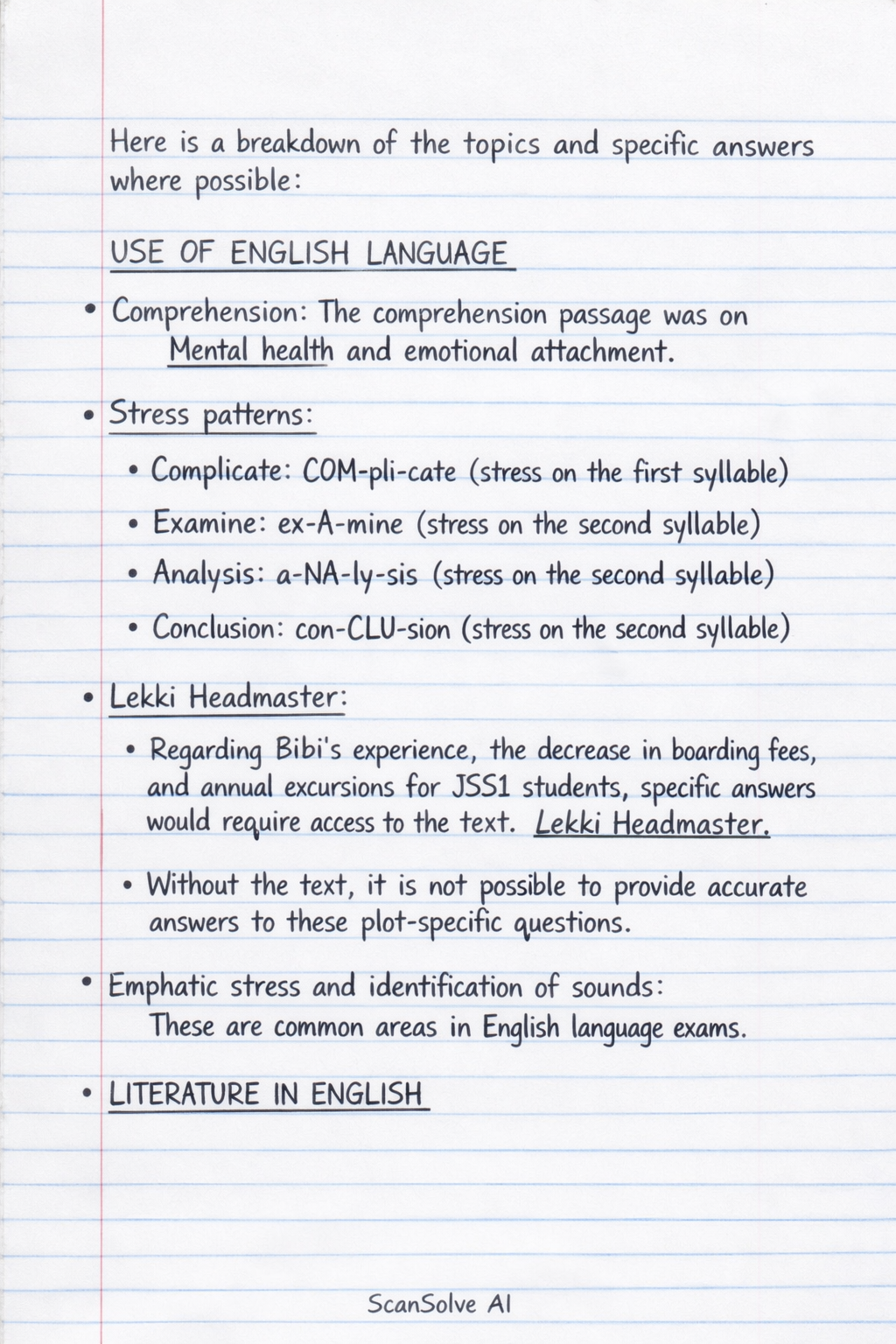
Here is a breakdown of the topics and specific answers where possible:
USE OF ENGLISH LANGUAGE
- Comprehension: The comprehension passage was on Mental health and emotional attachment.
- Stress patterns:
- Complicate: COM-pli-cate (stress on the first syllable)
- Examine: ex-A-mine (stress on the second syllable)
- Analysis: a-NA-ly-sis (stress on the second syllable)
- Conclusion: con-CLU-sion (stress on the second syllable)
- Lekki Headmaster:
- Regarding Bibi's experience, the decrease in boarding fees, and annual excursions for JSS1 students, specific answers would require access to the text Lekki Headmaster. Without the text, it is not possible to provide accurate answers to these plot-specific questions.
- Emphatic stress and identification of sounds: These are common areas in English language exams.
LITERATURE IN ENGLISH
- Poetry: It is important to study all prescribed poems thoroughly.
- Other texts: Questions also came from Inspector Calls, Marriage of Anansewa, and other texts.
- Identification of literary devices: This is a key area to focus on.
- Difference between Alliteration and Assonance:
- Alliteration is the repetition of initial consonant sounds in words that are close together (e.g., "Peter Piper picked a peck of pickled peppers").
- Assonance is the repetition of vowel sounds within words that are close together (e.g., "The rain in Spain falls mainly on the plain").
GOVERNMENT
- International organisations: Focus on their headquarters and dates of endorsement.
- Basic attributes of the state:
- Sovereignty: The supreme and independent authority of a state over its territory and people, free from external control.
- Legitimacy: The popular acceptance of a government's authority to rule.
- Other attributes include territory, population, and government.
- Weaknesses of Lyttelton Constitution (1954):
- It retained the unitary structure of the police and judiciary, which was a source of contention.
- It created a weak central government with limited powers, making it difficult to govern effectively.
- It introduced regionalism, which intensified ethnic and regional rivalries.
- The office of the Prime Minister was not created, leading to a lack of clear national leadership.
- Origin of federalism: Federalism originated as a system of government where power is divided between a central authority and constituent political units (like states or regions). Its origins can be traced to the desire to unite diverse regions or states while allowing them to retain some autonomy, often seen in historical examples like the formation of the United States.
C.R.S
- Elijah's conquest on Mount Carmel: This event (1 Kings 18) describes the prophet Elijah challenging the prophets of Baal to a contest to determine the true God. Both sides built altars, but only Elijah's sacrifice was consumed by fire from heaven, demonstrating the power of God and leading the people to turn back to Him.
- Attributes of an effective prayer: An effective prayer is often characterized by faith, sincerity, humility, persistence, and alignment with God's will.
- How the early Christians lived: The early Christians (Acts 2:42-47, Acts 4:32-35) lived in community, sharing their possessions, devoting themselves to the apostles' teaching, fellowship, breaking of bread, and prayer. They showed love for one another and experienced growth in numbers.
- Paul's letter concerning marriages: In his letters (e.g., 1 Corinthians 7), Paul addresses various aspects of marriage, emphasizing mutual respect, fidelity, the sanctity of marriage, and the importance of celibacy for those who can manage it, especially for dedicated service to God. He also provides guidance on marriage between believers and non-believers.
Was this helpful?
Still stuck on this one?
Ask a follow-up, and the answer starts from this question.
Got a different question?Ask your own question
More Law Questions
QCOMPILATION OF 2026 JAMB MOCK EXAM QUESTIONS 🔥📍 Please note that the exact questions may not be…QWassce 2026 literature likely questionsQPHYSICS 1. when an airplane passes overhead at high altitude little sound is heard because. 2…QPRIMARY SCHOOL EXAMINATIONS MID TERM II EXAMINATIONS 2026 P.5 ENGLISH LANGUAGEQExamination questions on oral literature,grade 10..structured with questions
Handwritten Step-by-Step Solution
Get this as a handwritten image on WhatsApp — like a tutor wrote it for you.
Try on WhatsApp