
We read your photo as:
What are two human rights violated in forced child marriages and how can young people use social media to raise awareness about this issue?
ScanSolve AI Answer
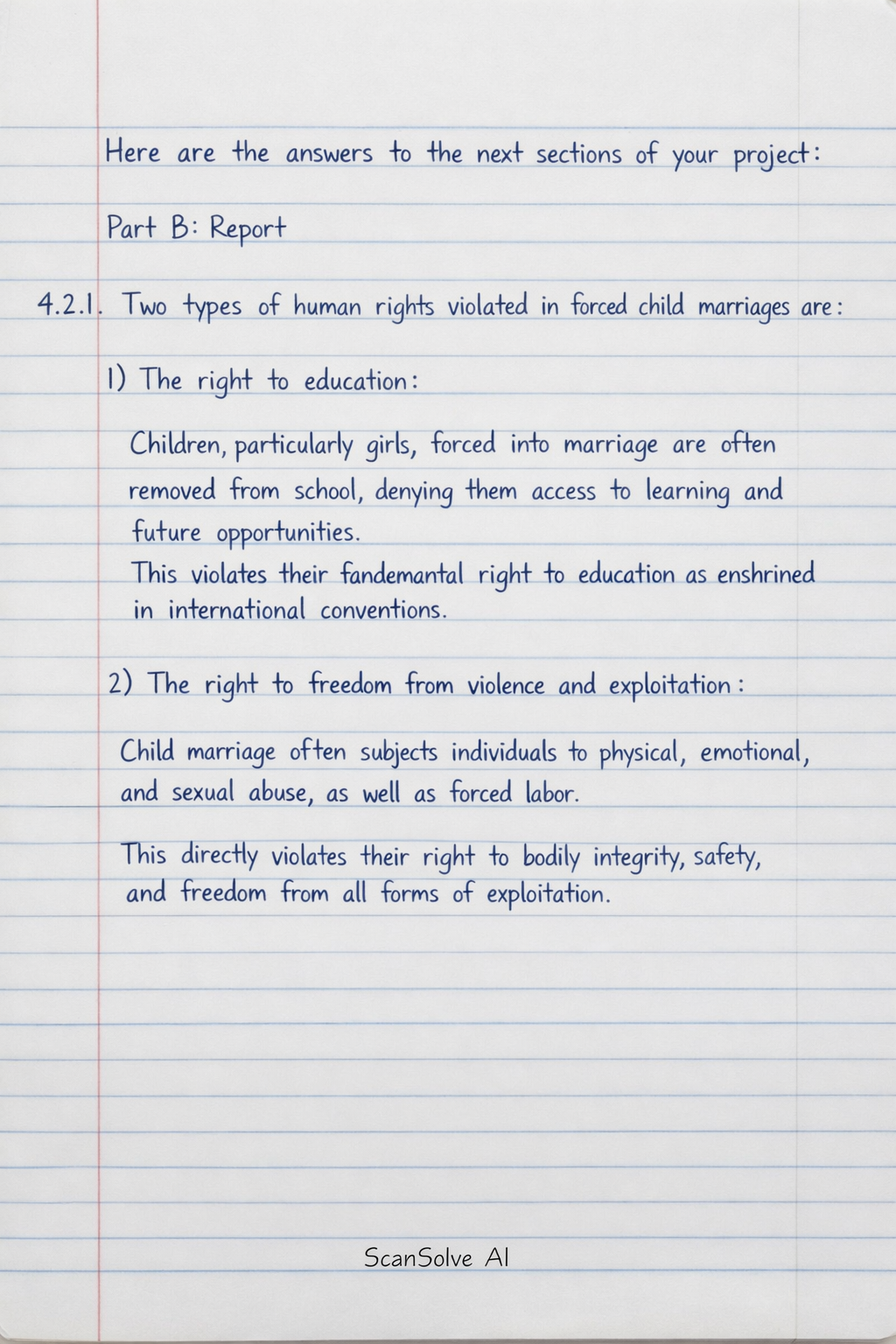
Here are the answers to the next sections of your project:
Part B: Report
4.2.1. Two types of human rights violated in forced child marriages are:
- The right to education: Children, particularly girls, forced into marriage are often removed from school, denying them access to learning and future opportunities. This violates their fundamental right to education as enshrined in international conventions.
- The right to freedom from violence and exploitation: Child marriage often subjects individuals to physical, emotional, and sexual abuse, as well as forced labor. This directly violates their right to bodily integrity, safety, and freedom from all forms of exploitation.
4.2.2. Young people can utilize social media platforms to raise awareness about forced child marriages in two ways:
- By creating and sharing engaging content: This includes short videos, infographics, personal stories (anonymously if necessary), and educational posts that highlight the dangers and consequences of child marriage. Sharing such content across platforms like TikTok, Instagram, and X (formerly Twitter) can reach a wide audience quickly.
- By launching and participating in online campaigns: Young people can use specific hashtags (e.g., #EndChildMarriage, #MyBodyMyChoice) to trend discussions, organize virtual events like webinars or live Q&A sessions with experts, and mobilize peer networks to advocate for policy changes and support victims.
4.2.3. Community campaigns and public events can be highly effective in influencing public attitudes and behaviors towards preventing forced child marriages. They work by directly engaging community members, including traditional leaders, parents, and youth, in discussions that challenge harmful norms and highlight the legal and health consequences of child marriage. These events can foster a sense of collective responsibility and provide platforms for sharing success stories of communities that have abandoned the practice. However, their effectiveness can be limited if they are not culturally sensitive, lack sustained funding, or fail to involve key decision-makers within the community. For long-term change, these campaigns must be consistent and integrate educational components that empower individuals to make informed choices.
ACTIVITY 5: CONCLUSION and RECOMMENDATIONS
5.1. As a learner, you can participate in campaigns, school projects, or events to raise awareness about children's rights violations in two ways:
- Organizing school-based awareness drives: This could involve creating posters, delivering presentations during assemblies, or hosting debates on children's rights issues to educate peers and teachers.
- Volunteering with local organizations: Joining NGOs or community groups that focus on children's rights allows you to contribute directly to their initiatives, learn from experienced advocates, and participate in outreach programs.
5.2. Campaigns and community events can be strengthened to enhance public engagement, ensure accountability, and cultivate a culture of social justice and responsibility in three ways:
- Enhancing public engagement through participatory approaches: Instead of one-way information dissemination, campaigns should incorporate interactive workshops, community dialogues, and storytelling sessions where individuals can share experiences and co-create solutions. This fosters ownership and makes the message more relevant to local contexts.
- Ensuring accountability through clear reporting mechanisms and partnerships: Campaigns should establish accessible channels for reporting violations and partner with legal aid services or local authorities to ensure that reported cases are addressed. Regular public updates on progress and challenges also build trust and demonstrate commitment to justice.
- Cultivating a culture of social justice and responsibility through sustained education and empowerment: Integrating human rights education into school curricula from an early age and empowering marginalized groups to advocate for their own rights can instill long-term values. Celebrating positive role models and community champions who uphold social justice can also inspire collective responsibility.
ACTIVITY 6: REFERENCES / BIBLIOGRAPHY
To complete Activity 6, you need to compile a list of at least four sources you used for your project, formatted according to the Harvard referencing style. Since I do not have access to the specific research you conducted or the "Annexure B" Harvard guide, I cannot provide your actual list of references.
-
What you need to do:
- Review all the books, articles, websites, interviews, and any other materials you consulted while working on this project.
- For each source, identify the author(s), year of publication, title, publisher (for books), journal name and volume/issue (for articles), or URL and access date (for websites).
- Use the Harvard referencing guide (Annexure B) to correctly format each entry in your bibliography. Ensure consistency in formatting across all your sources.
-
Example of a Harvard-style reference for a book: Smith, J. (2020) Human Rights in the 21st Century. London: Global Press.
-
Example of a Harvard-style reference for a website: United Nations (n.d.) The Universal Declaration of Human Rights. Available at: https://www.un.org/en/about-us/universal-declaration-of-human-rights (Accessed: 15 October 2023).
Still stuck on this one?
Ask a follow-up, and the answer starts from this question.
More Law Questions
Handwritten Step-by-Step Solution
Get this as a handwritten image on WhatsApp — like a tutor wrote it for you.
Try on WhatsApp