
We read your photo as:
Explain the Zambian Bill of Rights, including its purpose, entrenchment, key provisions, and enforcement mechanisms. (Questions 1 & 2)
ScanSolve AI Answer
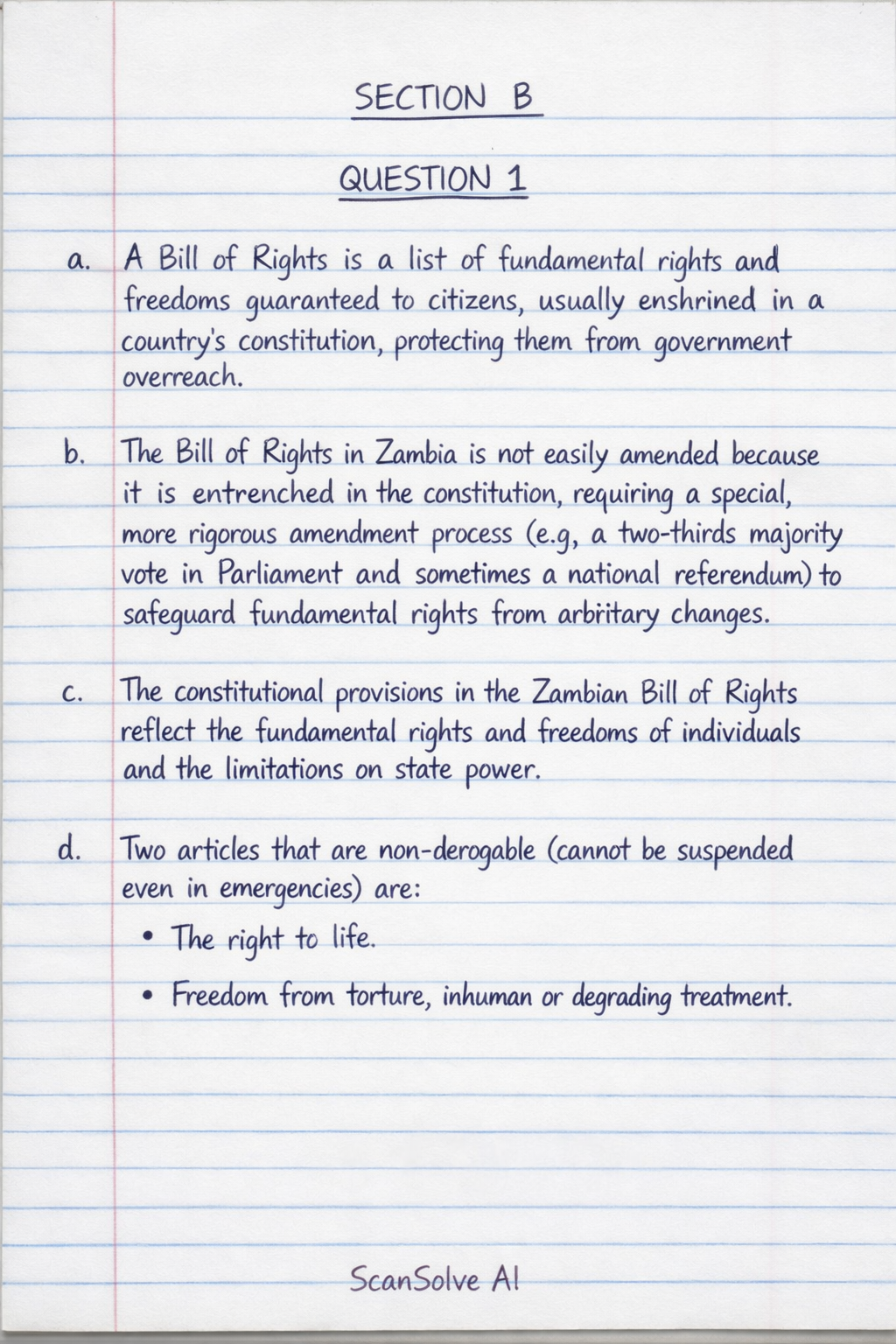
SECTION B
QUESTION 1
a. A Bill of Rights is a list of fundamental rights and freedoms guaranteed to citizens, usually enshrined in a country's constitution, protecting them from government overreach.
b. The Bill of Rights in Zambia is not easily amended because it is entrenched in the constitution, requiring a special, more rigorous amendment process (e.g., a two-thirds majority vote in Parliament and sometimes a national referendum) to safeguard fundamental rights from arbitrary changes.
c. The constitutional provisions in the Zambian Bill of Rights reflect the fundamental rights and freedoms of individuals and the limitations on state power.
d. Two articles that are non-derogable (cannot be suspended even in emergencies) are:
- The right to life.
- Freedom from torture, inhuman or degrading treatment.
e. Two ways of enforcing the Bill of Rights are:
- Through judicial review, where courts can declare laws or actions unconstitutional if they violate the Bill of Rights.
- Through public awareness campaigns and human rights institutions that educate citizens about their rights and provide avenues for redress.
QUESTION 2
The Zambian Bill of Rights is primarily found in Part III of the Constitution. Its origins are rooted in the pre-independence era, influenced by international human rights instruments like the Universal Declaration of Human Rights. Upon gaining independence in 1964, Zambia adopted a constitution that included a Bill of Rights, largely based on the Westminster model, focusing mainly on civil and political rights. Over the years, various constitutional review commissions (such as the Mvunga and Mwanakatwe Commissions) have sought to strengthen and expand the Bill of Rights, particularly to include economic, social, and cultural rights. These efforts aimed to make the Bill of Rights more comprehensive and reflective of the aspirations of the Zambian people, ensuring broader protection of fundamental freedoms and democratic governance.
QUESTION 3
a. Public media are media outlets owned and funded by the state or public, intended to serve the public interest rather than commercial interests.
Example: Zambia National Broadcasting Corporation (ZNBC).
b. Private media are media outlets owned and operated by individuals or private companies, typically funded through advertising, subscriptions, or private investment.
Example: Diamond TV.
c. Electronic media refers to media that uses electronic technology to access content, including broadcast media like radio and television, and digital media like the internet.
Example: Radio Phoenix.
d. Print media refers to media disseminated through physical printed materials.
Example: Daily Mail.
QUESTION 4
Four components of culture are:
- Values and Beliefs: These are the shared ideas about what is good, right, and desirable within a society, and the convictions held to be true. They guide behavior and shape worldview.
- Norms: These are the unwritten rules and expectations for behavior within a society. They can be formal (laws) or informal (customs, etiquette).
- Symbols: These are objects, gestures, sounds, or images that represent something else and carry shared meaning within a culture. Examples include flags, language, and religious icons.
- Language: A system of communication using sounds, gestures, or written symbols that allows people to express thoughts, feelings, and ideas, and is crucial for transmitting culture across generations.
QUESTION 5
Four government institutions that promote human rights and their functions are:
- Human Rights Commission (HRC): Investigates human rights abuses, educates the public on human rights, and recommends remedial action to the government.
- Judiciary (Courts): Interprets and applies laws, including the Bill of Rights, to protect individual freedoms and ensure justice.
- Police Service: Responsible for maintaining law and order, and has a duty to protect citizens' rights during arrests, detentions, and investigations.
- National Assembly (Parliament): Enacts laws that uphold human rights, scrutinizes government actions, and ratifies international human rights treaties.
QUESTION 6
a. Cultural diversity refers to the variety of human societies or cultures in a specific region, or in the world as a whole. It encompasses the different ways people live, think, and express themselves.
b. Four challenges to cultural diversity are:
- Assimilation: Pressure on minority cultures to adopt the dominant culture, leading to loss of unique traditions.
- Discrimination and Prejudice: Negative attitudes and unfair treatment based on cultural differences.
- Globalization: The spread of dominant cultural forms, potentially eroding local traditions and languages.
- Conflict and Misunderstanding: Differences in cultural values and practices can
Still stuck on this one?
Ask a follow-up, and the answer starts from this question.
More Law Questions
Handwritten Step-by-Step Solution
Get this as a handwritten image on WhatsApp — like a tutor wrote it for you.
Try on WhatsApp