

This English question involves literary analysis, grammar, or writing skills. The detailed response below provides a well-structured answer with supporting evidence and clear explanations.
ScanSolve AI Answer
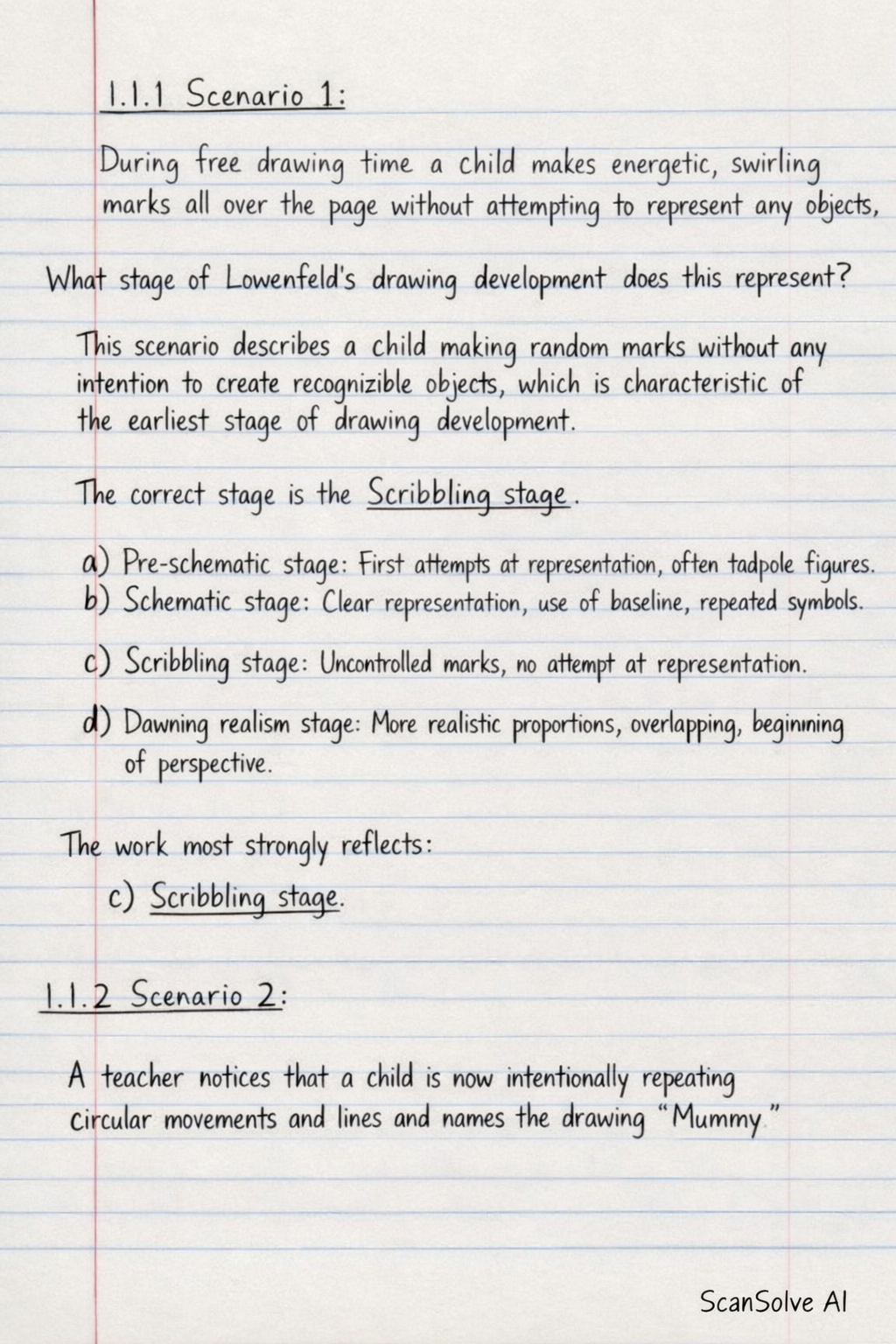
1.1.1 Scenario 1: During free drawing time in a child makes energetic, swirling marks all over the page without attempting to represent any objects. What stage of Lowenfeld's drawing development does this represent? This scenario describes a child making random marks without any intention to create recognizable objects, which is characteristic of the earliest stage of drawing development. The correct stage is the Scribbling stage. a) Pre-schematic stage: First attempts at representation, often tadpole figures. b) Schematic stage: Clear representation, use of baseline, repeated symbols. c) Scribbling stage: Uncontrolled marks, no attempt at representation. d) Dawning realism stage: More realistic proportions, overlapping, beginning of perspective. The work most strongly reflects: c) Scribbling stage 1.1.2 Scenario 2: A teacher notices that a child is now intentionally repeating circular movements and lines and names the drawing "Mummy". Which sub-stage is most evident? The child is intentionally making marks and assigning meaning (naming the drawing), which indicates a cognitive leap from purely motor activity to symbolic representation within the scribbling phase. The correct sub-stage is Named scribbling. a) Uncontrolled scribbling: Random marks without control or meaning. b) Named scribbling: Marks are given names, showing intent and imagination. c) Controlled scribbling: Repetitive marks with more motor control, but not necessarily named. d) Realistic drawing: Not a scribbling sub-stage. The work most strongly reflects: b) Named scribbling 1.1.3 Scenario 3: A learner draws a person with a circle for a head and straight lines for arms and legs. The drawing now occupies the full page and is anchored to a baseline. Which stage is the learner most likely in? This description indicates the first attempts at drawing recognizable human forms, often simplified "tadpole" figures, and the introduction of a baseline to organize the drawing. This is characteristic of the pre-schematic stage. The correct stage is the Pre-schematic stage. a) Scribbling stage: No recognizable forms. b) Pre-schematic stage: First representational attempts (tadpole figures), often with a baseline. c) Dawning realism stage: More detail, better proportions, some depth. d) Pseudo-naturalistic stage: Focus on realism, shading, perspective. The work most strongly reflects: b) Pre-schematic stage 1.1.4 Scenario 4: A teacher encourages learners to include hands, fingers and facial features in their drawings by asking guiding questions. This strategy supports the development of: Encouraging specific details like hands, fingers, and facial features directly helps learners observe and represent these elements more accurately, thus improving their ability to perceive and depict fine details. The correct development is Visual perception and detail awareness. a) Visual perception and detail awareness: Focuses on observing and representing specific details. b) Colour-mixing skills: Not related to drawing specific features. c) Perceptive drawing skills: While related, "visual perception and detail awareness" is more specific to the described action. d) Group identity development: Not related to drawing specific features. The strategy supports the development of: a) Visual perception and detail awareness 1.1.5 Scenario 5: A Grade 2 learner draws birds as "m" shapes and trees as lollipop shapes. The drawing tells a story and uses a baseline. Which statement best describes the drawing? The use of repeated, simplified symbols ("m" for birds, "lollipop" for trees) is known as applying a schema. This, along with a narrative and a baseline, is characteristic of the Schematic stage. The correct statement is The child is applying a personal schema for objects. a) The child is producing realistic proportions: "m" shapes and "lollipop" trees are not realistic. b) The child is applying a personal schema for objects: Using repeated, simplified symbols for objects. c) The child lacks fine motor control: The description focuses on representation, not motor skill issues. d) The drawing indicates dawning realism: Dawning realism involves more detail and less reliance on simple schemata. The work most strongly reflects: b) The child is applying a personal schema for objects 1.1.6 Scenario 6: A group of 8-year-olds draw pictures showing houses, animals and people placed in a structured composition with clear relationships and repeated symbolic patterns. The work most strongly reflects the: This description highlights the use of repeated symbolic patterns (schemata), a structured composition, and clear relationships between objects, which are defining characteristics of the Schematic stage. The correct stage is the Schematic stage. a) Pre-schematic stage: Simpler forms, less structured. b) Scribbling stage: No recognizable objects. c) Schematic stage: Characterized by repeated symbols, structured composition, and a baseline. d) Pseudo-naturalistic stage: More focus on realism, perspective, and less on symbolic patterns. The work most strongly reflects: c) Schematic stage 1.1.7 Scenario 7: A 10-year-old learner begins shading surfaces, adding folds to clothing, and shrinking background objects to show distance, but becomes frustrated when the drawing does not look "real". Which stage is the learner entering? The learner is attempting advanced techniques like shading, folds, and perspective (shrinking background objects) to achieve realism. The frustration when the drawing doesn't look "real" is a key indicator of the Pseudo-naturalistic stage, where children become highly critical of their work in comparison to reality. This stage often overlaps with Dawning Realism. The correct stage is Dawning realism/Pseudo-naturalistic stage. a) Scribbling stage: Too early. b) Pre-schematic stage: Too early. c) Dawning realism/Pseudo-naturalistic stage: Characterized by attempts at realism, shading, perspective, and often frustration with lack of realism. d) Schematic stage: Relies on symbols, not realism. The learner is entering: c) Dawning realism/Pseudo-naturalistic stage