

This English question involves literary analysis, grammar, or writing skills. The detailed response below provides a well-structured answer with supporting evidence and clear explanations.
ScanSolve AI Answer
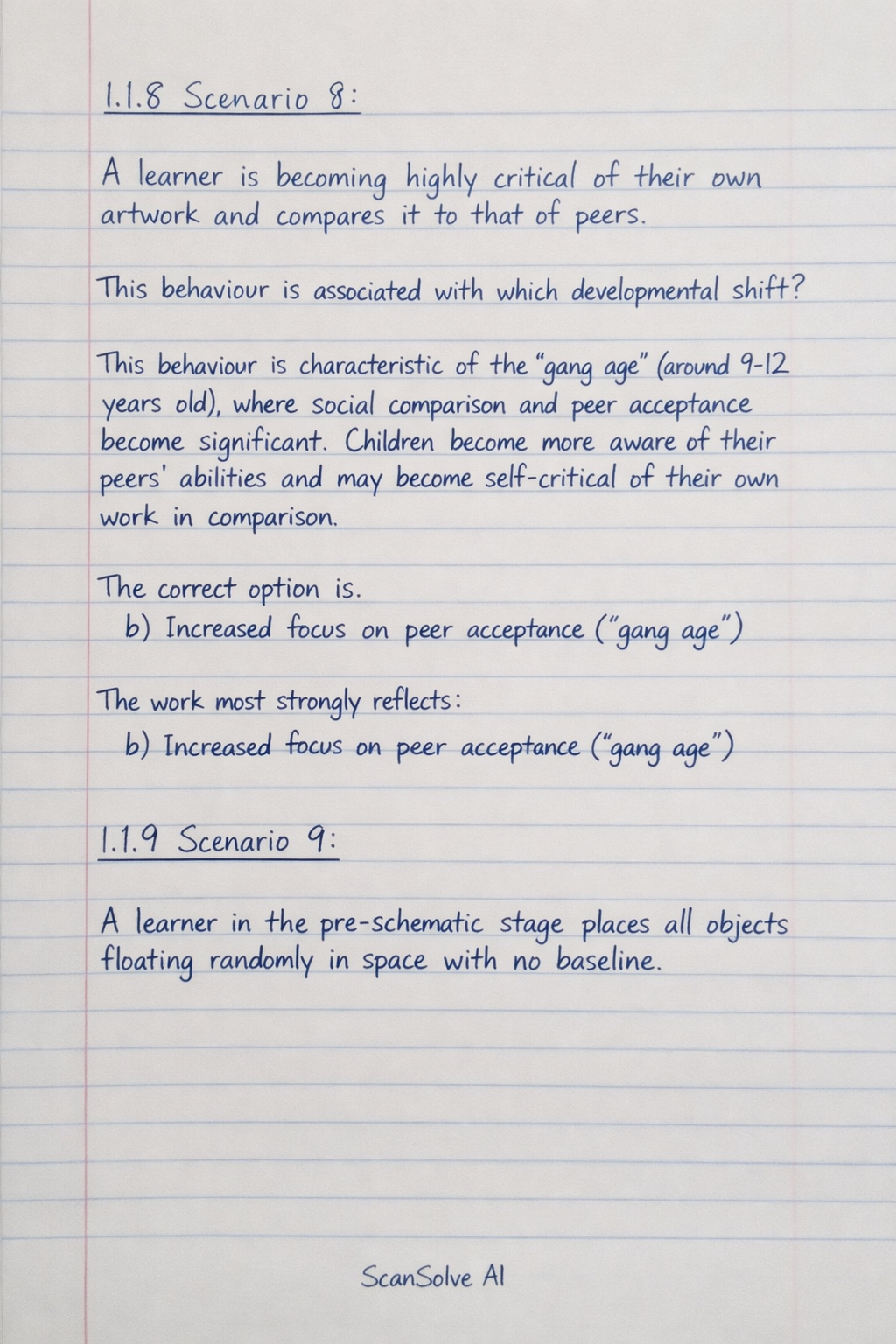
1.1.8 Scenario 8: A learner is becoming highly critical of their own artwork and compares it to that of peers. This behaviour is associated with which developmental shift? This behavior is characteristic of the "gang age" (around 9-12 years old), where social comparison and peer acceptance become significant. Children become more aware of their peers' abilities and may become self-critical of their own work in comparison. The correct option is b) Increased focus on peer acceptance ("gang age"). The work most strongly reflects: b) Increased focus on peer acceptance ("gang age") 1.1.9 Scenario 9: A learner in the pre-schematic stage places all objects floating randomly in space with no baseline. Which teacher action is MOST supportive? In the pre-schematic stage, children are beginning to represent objects but often lack spatial organization. Encouraging observation and asking questions about how objects relate in space helps them develop spatial awareness and understand concepts like a baseline. The correct option is b) Encourage observation and ask questions that prompt spatial awareness. The work most strongly reflects: b) Encourage observation and ask questions that prompt spatial awareness 1.1.10 Scenario 10: An 11-year-old becomes discouraged and avoids drawing because they feel their artwork "doesn't look right". Which teacher response is MOST developmentally appropriate? At this age (often the Dawning Realism or Pseudo-naturalistic stage), learners become highly critical of their work. The most supportive approach is to reassure them, validate their effort, and emphasize that art is a process of exploration and expression, not just about achieving perfect realism. The correct option is b) Reassure and emphasise drawing as a process rather than perfection. The work most strongly reflects: b) Reassure and emphasise drawing as a process rather than perfection 1.2. READ the paragraph below and TYPE OUT the answer in the space provided. The elements of art are the visual tools artists use to communicate. They are similar to the parts of language. The key elements are line, tone, colour, texture, shape and form. A line is a mark that has width, direction and length. Lines can be curved and natural, which are known as organic lines, or straight and structured, which are known as geometric lines. [1]: form* [2]: length* [3]: organic* [4]: geometric*