

This history question requires analysis of historical events, causes, and consequences. The detailed answer below provides context, evidence, and a well-structured explanation.
ScanSolve AI Answer
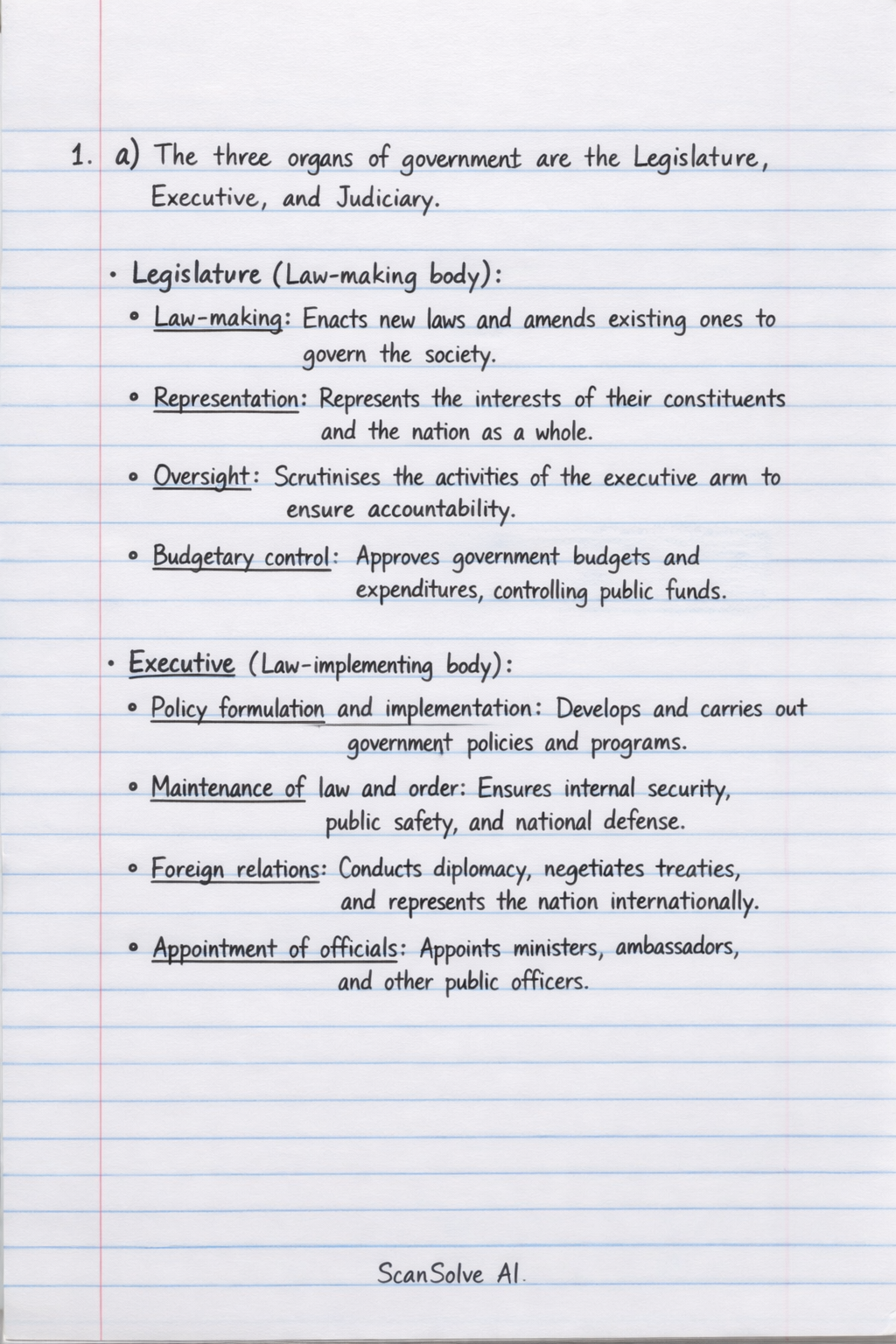
1. a) The three organs of government are the Legislature, Executive, and Judiciary. Legislature (Law-making body): Law-making*: Enacts new laws and amends existing ones to govern the society. Representation*: Represents the interests of their constituents and the nation as a whole. Oversight*: Scrutinizes the activities of the executive arm to ensure accountability. Budgetary control*: Approves government budgets and expenditures, controlling public funds. Executive (Law-implementing body): Policy formulation and implementation*: Develops and carries out government policies and programs. Maintenance of law and order*: Ensures internal security, public safety, and national defense. Foreign relations*: Conducts diplomacy, negotiates treaties, and represents the nation internationally. Appointment of officials*: Appoints ministers, ambassadors, and other public officers. Judiciary (Law-interpreting body): Interpretation of laws*: Explains the meaning and application of laws. Administration of justice*: Settles disputes between individuals or between individuals and the state, and punishes offenders. Protection of fundamental human rights*: Safeguards the rights and freedoms of citizens as enshrined in the constitution. Judicial review*: Can declare laws or executive actions unconstitutional if they violate the supreme law of the land. b) Factors that cause political apathy in Nigeria include: Corruption*: Widespread corruption in government and electoral processes discourages citizens. Lack of trust in government*: Citizens often feel that their leaders are not accountable or that their votes do not matter. Poor governance and unfulfilled promises*: Government failure to deliver on promises or improve living conditions leads to disillusionment. Poverty and economic hardship*: People prioritize survival over political engagement when facing severe economic challenges. Electoral malpractice*: Experiences of rigged elections, violence, or intimidation during elections deter participation. 2. a) Merits and demerits of Bicameral and Unicameral legislature: Bicameral Legislature (Two chambers, e.g., Senate and House of Representatives): Merits*: Checks and balances*: Provides a second review of legislation, preventing hasty or ill-considered laws. Better representation*: Allows for representation of diverse interests, such as states in one chamber and population in another. Reduces tyranny*: Makes it harder for a single party or group to dominate the legislative process. Demerits*: Slow legislative process*: Bills take longer to pass due to review by two chambers. Increased cost*: More expensive to maintain and operate two legislative bodies. Deadlocks*: Disagreements between chambers can lead to legislative stalemates. Unicameral Legislature (One chamber): Merits*: Faster legislative process*: Bills can be passed more quickly without a second review. Reduced cost*: Less expensive to maintain a single legislative body. Clear accountability*: Easier to identify responsibility for legislative outcomes. Demerits*: Hasty decisions*: Lack of a second chamber for review can lead to poorly considered laws. Less representation*: May not adequately represent diverse interests within the nation. Potential for tyranny*: Easier for a dominant party to push through its agenda without significant checks. b) Three sources, features, and importance of a constitution: Sources of Constitution: Acts of Parliament/Legislature*: Laws passed by the legislative body that form part of the constitutional framework. Judicial precedents/Case law*: Decisions of higher courts that interpret the constitution and establish legal principles. Customs and conventions*: Long-standing practices and traditions that are accepted as binding rules of government. Features of Constitution: Supremacy*: It is the supreme law of the land, and all other laws must conform to it. Separation of powers*: Divides governmental powers among the legislative, executive, and judicial organs. Fundamental human rights*: Guarantees and protects the basic rights and freedoms of citizens. Importance of Constitution: Establishes government structure*: Defines the organs of government, their powers, and their relationships. Protects rights*: Safeguards the fundamental human rights and liberties of citizens. Limits government power*: Prevents arbitrary rule and abuse of power by setting boundaries for government actions. 3. a) Arguments for and against the institution of delegated legislation: Arguments For (Merits): Saves parliamentary time*: Parliament can focus on broad policy issues, leaving details to experts. Flexibility*: Allows for quick adaptation to changing circumstances, emergencies, or new technologies. Expertise*: Technical and complex details can be handled by specialists in relevant fields. Local needs*: Enables laws to be tailored to specific local conditions or particular groups. Speed*: Facilitates rapid implementation of policies without lengthy parliamentary procedures. Arguments Against (Demerits): Lack of parliamentary scrutiny*: Delegated legislation often receives less debate and oversight compared to primary legislation. Potential for abuse of power*: Executive bodies might exceed their delegated authority, leading to arbitrary rule. Complexity and volume*: Can lead to a large volume of complex laws, making it difficult for citizens to understand and follow. Undemocratic*: Laws are made by unelected officials rather than directly by elected representatives. Difficulty in challenging*: Challenging delegated legislation in courts can be complex and costly for individuals. b) Five reasons why people demand for federalism: To accommodate diversity*: Allows different ethnic, linguistic, or religious groups to maintain their distinct identities and cultures within a larger nation. To prevent concentration of power*: Divides governmental power between central and regional authorities, acting as a check against potential tyranny. To bring government closer to the people*: Local issues can be addressed more effectively by regional governments that are more responsive to local needs. To promote unity in diversity*: Enables a strong central government to manage national affairs while respecting regional autonomy and self-governance. To manage large geographical areas*: Provides a more efficient system of governance for large countries with diverse populations and vast territories. 4. a) Four duties and obligations of citizens: Obey laws*: Adhere to the laws of the land and respect the legal system. Pay taxes*: Contribute to government revenue through taxes to fund public services and infrastructure. Vote*: Participate in elections to choose leaders and influence government policies. Defend the nation*: Be ready to serve in the military or civil defense if required, and protect national interests. b) The major differences between a citizen and a subject are: A citizen is typically a member of a republic or state* who possesses full political rights, such as the right to vote and hold public office, and has a direct relationship with the state. A subject is an individual who owes allegiance to a monarch or sovereign* in a monarchy. Historically, subjects had fewer political rights and more obligations to the ruler, with their status often defined by birth within the monarch's realm.