
We read your photo as:
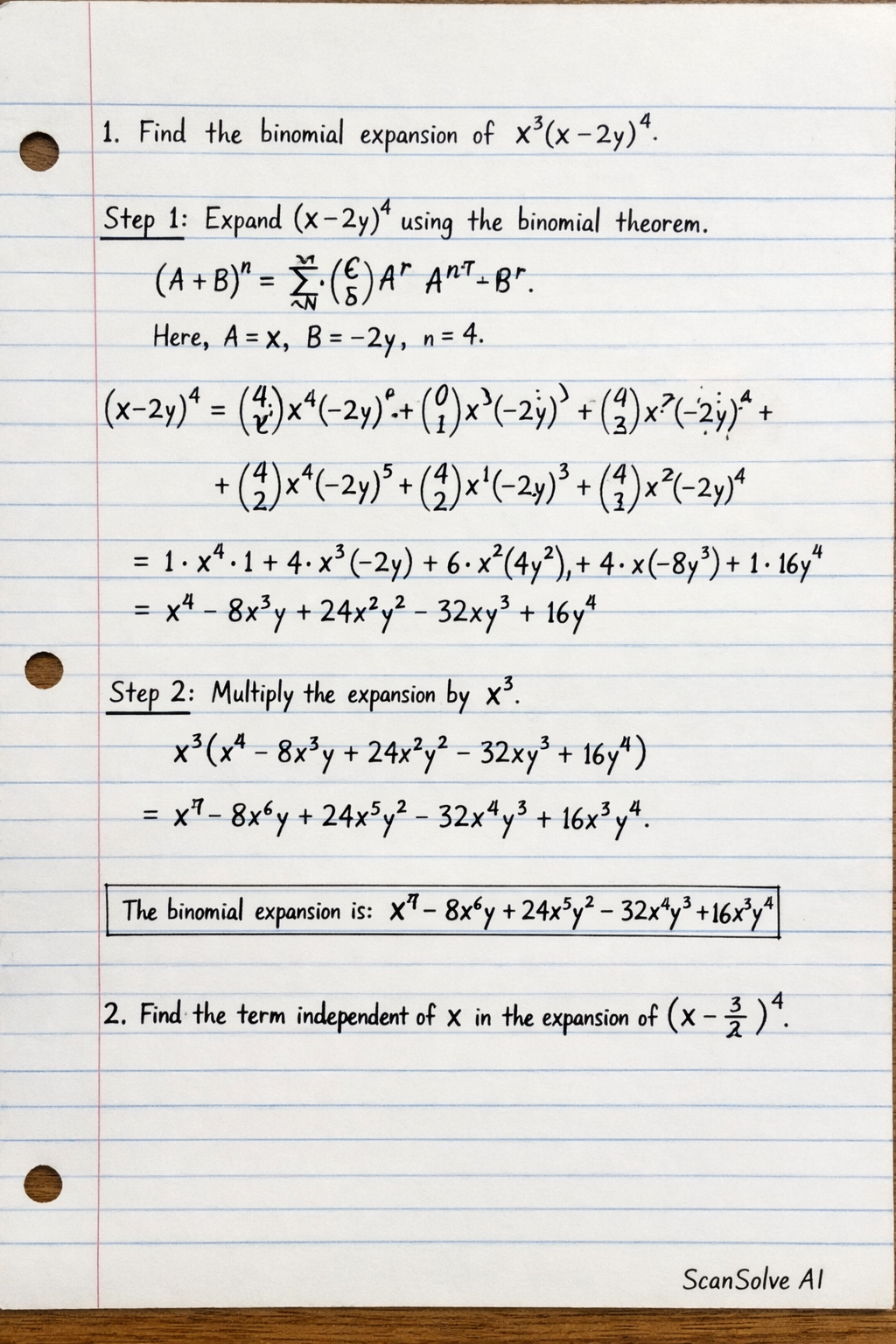
Find the binomial expansion of x³(x-2y)⁴.
ScanSolve AI Answer
This answer stops before the end.
It was cut off when it was first written. Ask ScanSolve this question again for the full working.
1. Find the binomial expansion of .
-
Step 1: Expand using the binomial theorem. The binomial theorem states that . Here, , , and .
-
Step 2: Multiply the expansion by .
The binomial expansion is .
2. Find the term independent of in the expansion of .
-
Step 1: Write the general term of the expansion. The general term in the expansion of is given by . Here, , , and .
-
Step 2: Find the value of for the term independent of . For the term to be independent of , the power of must be 0.
-
Step 3: Substitute into the general term to find the term.
The term independent of is .
3. Find the first three terms in ascending powers of in the expansion of .
-
Step 1: Use the generalized binomial theorem. The generalized binomial theorem for is . Here, and .
-
Step 2: Calculate the first term. The first term is 1.
-
Step 3: Calculate the second term.
-
Step 4: Calculate the third term.
-
Step 5: Combine the first three terms. The first three terms in ascending powers of are .
4. Find the coefficient of in the expansion of .
- Step 1: Expand . Let and . Using :
Still stuck on this one?
Ask a follow-up, and the answer starts from this question.
More Mathematics Questions
Handwritten Step-by-Step Solution
Get this as a handwritten image on WhatsApp — like a tutor wrote it for you.
Try on WhatsApp