
We read your photo as:
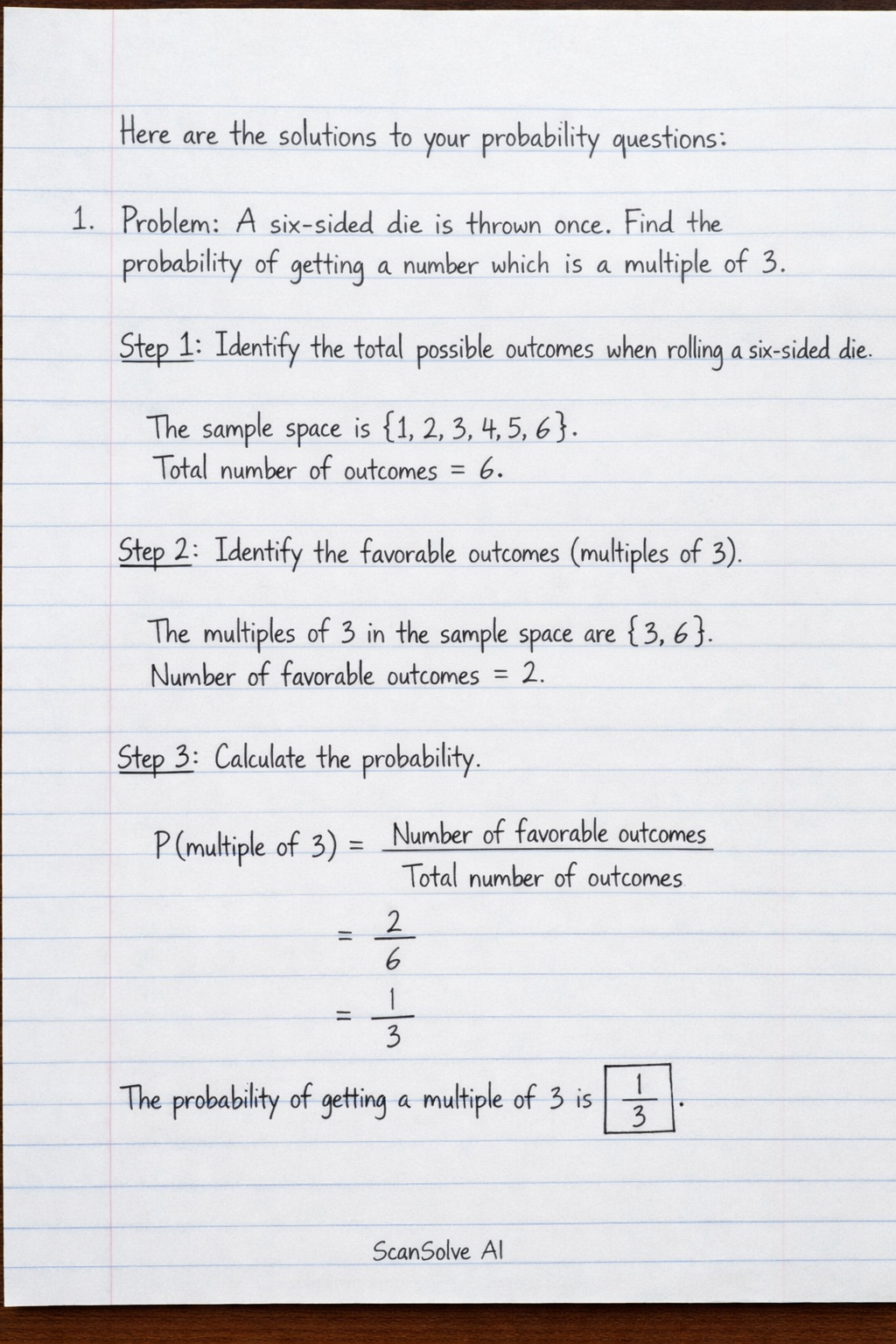
Problem: A six-sided die is thrown once. Find the probability of getting a number which is a multiple of 3.
ScanSolve AI Answer
Step-by-step solution
6 stepsHere are the solutions to your probability questions:
Problem
A six-sided die is thrown once. Find the probability of getting a number which is a multiple of 3.
- Step 1: Identify the total possible outcomes when rolling a six-sided die. The sample space is . Total number of outcomes = 6.
- Step 2: Identify the favorable outcomes (multiples of 3). The multiples of 3 in the sample space are . Number of favorable outcomes = 2.
- Step 3: Calculate the probability. The probability of getting a multiple of 3 is .
Problem
A fair die is rolled once. Find the probability of a 4 showing up.
- Step 1: Identify the total possible outcomes when rolling a fair die. The sample space is . Total number of outcomes = 6.
- Step 2: Identify the favorable outcome (a 4 showing up). The favorable outcome is . Number of favorable outcomes = 1.
- Step 3: Calculate the probability. The probability of a 4 showing up is .
Problem
A letter is chosen at random from the letters of the word "EXCELLENT". What is the probability that the letter "E" is chosen?
- Step 1: Count the total number of letters in the word "EXCELLENT". The letters are E, X, C, E, L, L, E, N, T. Total number of letters = 9.
- Step 2: Count the number of times the letter "E" appears. The letter "E" appears 3 times. Number of favorable outcomes = 3.
- Step 3: Calculate the probability. The probability that the letter "E" is chosen is .
Problem
In a bag there are 4 blue marbles, 3 red marbles and 2 white marbles. What is the probability of picking at random a red marble?
- Step 1: Calculate the total number of marbles in the bag. Total marbles = marbles.
- Step 2: Identify the number of red marbles. Number of red marbles = 3.
- Step 3: Calculate the probability of picking a red marble. The probability of picking a red marble is .
Problem
The probability that a boy will be late for school on any particular day is . Find, in terms of , the probability that he will not be late for school.
- Step 1: Understand the relationship between an event and its complement. The probability of an event happening plus the probability of it not happening is equal to 1. .
- Step 2: Apply this to the given problem. Let be the probability that the boy is late, which is given as . Let be the probability that the boy is not late. The probability that he will not be late for school is .
Problem
The probability of Kasukulu waking up late is 0.3. What is the probability that she will wake up early?
- Step 1: Assume that "waking up early" is the complement of "waking up late". The sum of the probabilities of these two events must be 1. .
- Step 2: Use the given probability to find the unknown probability. Given . The probability that she will wake up early is .
Still stuck on this one?
Ask a follow-up, and the answer starts from this question.
More Mathematics Questions
Handwritten Step-by-Step Solution
Get this as a handwritten image on WhatsApp — like a tutor wrote it for you.
Try on WhatsApp