
We read your photo as:
Prove that 1+2+3++n = sum_k=1ⁿ k = (n(n+1))/(2), n 1.
Mathematics
ScanSolve AI Answer
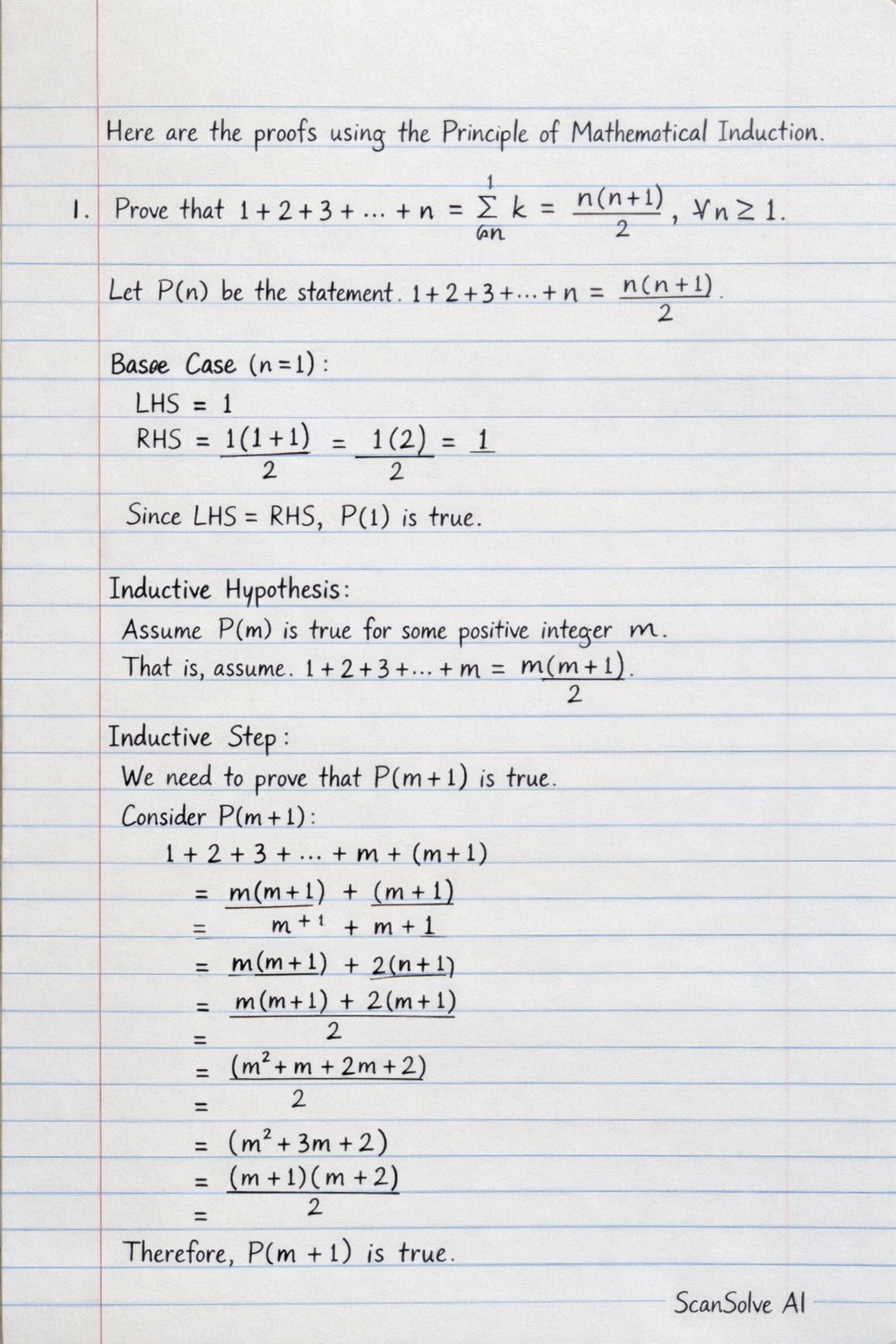
Here are the proofs using the Principle of Mathematical Induction.
1. Prove that , .
Let be the statement .
-
Base Case (n=1): LHS RHS Since LHS = RHS, is true.
-
Inductive Hypothesis: Assume is true for some positive integer . That is, assume .
-
Inductive Step: We need to prove that is true.
Was this helpful?
Still stuck on this one?
Ask a follow-up, and the answer starts from this question.
Got a different question?Ask your own question
More Mathematics Questions
QProve the following formulas: sumk=1ⁿ k2 = (n(n+1)(2n+1))/(6) and sumk=1ⁿ (2k−1)2 = (1)/(3)n(4n2-1)QProve the identity sum_k=1ⁿ k4 = (n(n+1)(2n+1)(3n2+3n−1))/(30) using mathematical induction.QEvaluate sum_k=1ⁿ (k2 + k).QProve the statement 1 imes 2 + 2 imes 3 + ext... + n(n+1) = racn(n+1)(n+2)3 using mathematical…
Handwritten Step-by-Step Solution
Get this as a handwritten image on WhatsApp — like a tutor wrote it for you.
Try on WhatsApp